Keep up-to-date with all the latest news, articles, event and product updates posted on Developing Telecoms.
Subscribe to our FREE weekly email newsletters for the latest telecom info in developing and emerging markets globally.

Keep up-to-date with all the latest news, articles, event and product updates posted on Developing Telecoms.
Subscribe to our FREE weekly email newsletters for the latest telecom info in developing and emerging markets globally.
Belgian cable operator Telenet, which is wholly owned by Liberty Global, has announced that it will enter into the energy market in April as it launches its new service “Blossom”, which will be used for the installation and running of at home charging stations for electric cars.
Blossom will be spun out as separate company under the Telenet group, which will initially focus on focus on installing and activating smart charging stations for the employees of companies, with private customers coming later.
According to Telenet, there will be 1.7 million electric vehicles on the road in Belgium by 2030 with 65% of vehicle charging done at home. The estimate that 800,000 home charging stations will be installed by the end of the decade, but currently, say Telenet, the user experience is not adequate.
The ambition behind the project is clear. According to a press release, Telenet aims for Blossom to “to become an ally to customers in the energy transition by providing innovative and simple home solutions. Specifically, Blossom will start offering a service to smartly charge electric vehicles at home. Initially, the focus will lie on the corporate market. In a later phase, Blossom will also offer charging services directly to self-employed workers and private customers.”
Blossom will partner with Scoptvision, Optimile, and Unit-T, amongst others, to launch the company.
“By placing renewed emphasis on the ongoing digitization of our society, as well as the rapid electrification of our mobility, we can optimize both the installation and management of home charging stations through a unique digital platform,” said Telenet CEO John Porter. “This way, we can simplify the lives of both employees and employers and create a win-win for both parties,” he continued.
Parent company Liberty Global launched a similar service in the UK in 2022 with a venture called “Egg”. The service will, amongst other things, provide subscription-based electric vehicle charging. The subscription model had not been available in the UK before, and Liberty Global say “customers benefit from ongoing maintenance and technical support, all included in a monthly £30 fee and without any up-front fees”.
This is a great example of a company in the broadband and telco industry going beyond their usual connectivity realm – and is the type of thing we’re looking for to win “The Beyond Connectivity” award at this year’s World Communication Awards – held in London this December.
The winner of this award will have developed a product or service that moves beyond the traditional connectivity-based offerings, into new business areas or new market segments – enter now!
Also in the news:
BT wins £26m contract to connect UK schools
Apple fined €1.8bn by European Commission over Spotify row
Japan to reduce regulatory pressure on incumbent NTT

Three bits of network news from Europe and a colo upgrade project rather further away: … [visit site to read more]

Keep up-to-date with all the latest news, articles, event and product updates posted on Developing Telecoms.
Subscribe to our FREE weekly email newsletters for the latest telecom info in developing and emerging markets globally.
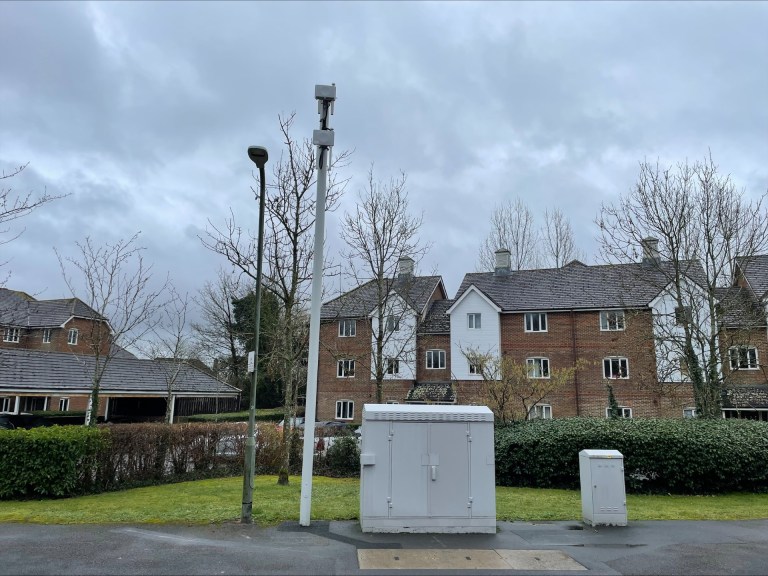
British broadband and mobile operator Virgin Media O2 (VMO2) has announced its latest initiative – the Smart Pole Trial, in collaboration with shareholder Liberty Global.
As part of the trial, VMO2 has erected 4G and 5G smart poles on their existing fibre network to help boost mobile network coverage and capacity.
The poles are smaller than normal mobile masts and can be set up quickly and without regulatory hurdles such as planning permission. As VMO2 have approximately 25,000 street cabinet dotted across the UK, the trial allows for a wide scale rollout that would speed up network build, reduce costs and de-risk upgrade programmes.
The company also claim that in a UK first, the electricity “is supplied by Virgin Media’s fibre network rather than a traditional power supply through innovative ‘digital electricity’ technology, which transmits power from on-street cabinets in the local area along fibre optic cables”.
There is also the possibility that in the future, the smart poles could power smart city solutions and electric vehicle chargers using the company’s existing network.
“As we continue investing to upgrade and expand our network, we’re always looking for new ways to work smarter and deliver more for our customers,” said Chief Technology Officer Jeanie York in a press release.
“The ability to use our existing national fixed network to backhaul and power small cells could be transformational – helping us save time and money, open up new revenue streams, support smart city technology and fully leverage the benefits of our scaled converged network,” she continued.
Keep up to date with the latest telecoms news by subscribing to the Total Telecom daily newsletter
Also in the news:
BT wins £26m contract to connect UK schools
Apple fined €1.8bn by European Commission over Spotify row
Japan to reduce regulatory pressure on incumbent NTT


Michael Flannery is President of the Enterprise business unit at Windstream. A seasoned business leader with more than 24 years of industry experience, he oversees all components of Windstream Enterprise and transformative initiatives within the enterprise world. We spoke with Michael to get his perspectives on trends he believes will shape business strategies in the telecommunications sector this year. He shares … [visit site to read more]

The Cellular Operators Association of India (COAI) has reportedly urged the Department of Telecommunications (DoT) to do more to stop the theft of telecoms gear from cell towers, which has escalated in the last few months amid aggressive 5G rollouts.
According to ETTelecom, the COAI – which represents Reliance Jio, Bharti Airtel, and Vodafone Idea – sent a letter to DoT secretary Neeraj Mittal last Thursday saying that incidents of theft have increased “multi-fold” since October 2023.
COAI Director General SP Kochhar said in the letter that thieves are mainly making off with remote radio units (RRUs) and baseband units (BBUs). He also said that theft is particularly rampant in Delhi NCR, Rajasthan, Assam, Andhra Pradesh & Telangana, Tamil Nadu, Karnataka and Punjab & Haryana, “with just 31 districts contributing to as much as 50% of the theft incidents reported pan India”, the report said.
The letter also said that a “huge number of sites” have been robbed multiple times and claims that the stolen gear is being openly sold on e-commerce sites such as Ebay, Telefly, Seeker816, Dorfatrade, and Alibaba, according to the report.
Kochhar added that in most cases, telcos are unable to recover both the stolen equipment and the subsequent losses in replacing them.
The increase in theft cases comes as Jio and Airtel complete their rollouts of 5G technologies across the country, while Vodafone Idea has started its rollout and is planning to launch 5G in the second half of this year,
The COAI letter asked the DoT to contact all state chief secretaries to prioritise telecoms theft cases, arrange police protection for telecoms infrastructure and block websites selling the equipment, the report said.

Operators have reported connectivity disruption across Africa after multiple subsea cables had been reported to be damaged off the coast in West Africa.
Subsea cables carry the bulk of connectivity traffic with a small part carried by satellites. Reports of internet connectivity being disrupted came in yesterday (March 14). Internet security company Cloudflare reported Liberia saw disruptions lasting more than 12 hours, while in Gambia and Guinea outages only lasted 30 minutes.
In a statement to Developing Telecoms, Orange said the ACE, MainOne Sat 3, and WACS cables had been damaged along the West Coast of Africa.
“Major impacts on international connectivity (voice and data) have been observed in several countries, particularly for Orange subsidiaries in the Ivory Coast, Liberia, Burkina Mali and Guinea,” said an Orange spokesperson.
The operator said the cause of the outages is unknown at this time, and it is looking to reroute traffic and connect isolated countries through alternative routes. “Several terrestrial links have already been reinforced to improve the situation,” said Orange.
Vodacom posted on X (formerly Twitter) that there had been “undersea cable failures between South Africa and Europe” which had affected South African MNOs”. The operator implemented alternative solutions and “normal service has been restored to customers”.
Angola Cables detailed in a statement there had indeed been “cable breaks” off the coast of West Africa, specifically in the Ivory Coast. Traffic has been redirected to the SACS cable which connects Angola directly to Brazil, the US and Europe.
“Angola Cables has network backup and restoration solutions available through cables that have not been affected by the faults off the Ivory Coast,” the cable company said.
A couple of financial moves, some new optical gear, and a mobile launch in the MSO world: … [visit site to read more]
This week, Julia Lopez MP, Minister for Data and Digital Infrastructure, penned an recent open letter directed to all fixed-line operators, cracking down on the installation of new telegraph poles in the UK, suggesting that the infrastructure should be shared.
According to the letter, many MPs have highlighted the issue, as constituents have grown frustrated the duplication of overhead fibre networks. They have advised that their constituents feel they have no control over how infrastructure is deployed in their local area, and this can negatively affect the overall perception of full fibre deployment.
While these concerns are more pronounced in specific regions (especially rural areas), she emphasized their resonance across the nation, urging fixed-line operators to heed and address these issues promptly.
Therefore, the government wants to implement a refreshed set of guidelines that makes sure that “communities feel engaged in the deployment of new broadband infrastructure, whilst still allowing operators to continue deploying their networks.”
“Telegraph poles are a key piece of infrastructure bringing faster connectivity to communities and businesses across the country,” said Lopez.
“Most telecoms companies are doing a fantastic job in delivering that connectivity with the support of those communities, by sharing existing infrastructure and taking into account surroundings when putting up new poles. But we know that there are some firms that are losing that vital community support by inappropriately or unnecessarily throwing up new infrastructure.”
Lopez confirmed that she had written to operators asking them to share existing infrastructure. Of particular note was Lopez’s announcement of forthcoming revisions to the Cabinet Siting and Pole Siting Code of Practice. This which provides guidance on ways operators can ensure that telegraph pole and cabinet installations are placed appropriately, and that local authorities and communities are engaged with regarding proposed installations.
The new changes will make sure that communities feel engaged in the deployment of new broadband infrastructure, whilst still allowing operators to continue deploying their networks, bringing faster connectivity and greater choice to consumers.
The epistle culminated with expressions of gratitude for operators’ tireless efforts in advancing the country’s connectivity goals, underscoring the pivotal role of infrastructure sharing in rallying public support and expediting broadband deployment.
In response to Lopez’s the letter, telecom operators are set to reassess their deployment strategies, placing heightened emphasis on infrastructure sharing and community engagement.
Keep up to date with the latest international telecoms news by subscribing to the Total Telecom newsletter
Also in the news:
BT wins £26m contract to connect UK schools
Apple fined €1.8bn by European Commission over Spotify row
Japan to reduce regulatory pressure on incumbent NTT