

Here’s a quick look at some international items from the last day or three: … [visit site to read more]
18
Sep, 2023

Connected Britain 2023: Which tracks are right for me?
Connected Britain 2023 is set to be our biggest event to date, featuring over 5,000 attendees, 350 speakers, and 1,500 organisations from every aspect of the UK telecoms sector and beyond.
Connected Britain is the UK’s leading digital economy event, featuring 12 tracks full of specialised sessions spanning everything from fixed line and mobile broadband to local connectivity initiatives and regulatory discussions.
Let’s take a closer look at some at what the tracks below. Don’t forget, last minute tickets are still available – register here today!
Connected Keynotes:
The Connected Britain keynotes will address key questions such as: What does the future of the UK’s connectivity landscape look like? Where do the commercial opportunities of enhanced and ubiquitous connectivity lie? What is the industry doing to ensure that inclusive and meaningful growth is delivered in every corner of the UK? Explore the Keynote panel speakers here.
Digital Britain:
Here we explore how the future of work is changing in an increasingly digital world. New skills are needed, new mindsets, and new partnerships. What is being done in the UK to fill the ‘skills gap’? What is needed both from government and the private sector to ensure that the UK remains a technology and business leader on the international stage?
Connected Communities:
A truly ‘Connected Britain’ is one where every individual and every business has access to the best connectivity. Connected Communities will explore strategies for connecting rural and hard-to-reach communities while also focussing on connectivity for social housing, care homes, schools, and other critical services.
Connected Infrastructure:
Digital connectivity is the cornerstone of the UK’s ambitions when it comes to intelligent transport systems, smart utility networks, EV charging, and more. The potential is huge, so how can the UK capitalise on these exciting opportunities?
Gigabit Britain:
Here we will take a strategic look at the investment and regulatory context for the deployment of next-generation communications infrastructure in the UK. Gigabit Britain will also explore the commercial strategy and business models for the rollout of both fibre and 5G networks.
Project Rollout:
This track will focus on the realities of building fibre and 5G networks. Key themes will include the technologies enabling network rollout, engineering strategies, supply chain issues, and the role of public–private partnerships.
Connected Society:
Keeping people connected has never been more important. Tackling the digital divide, promoting digital inclusion, developing the provision of digital public services, and providing support for those who need it most is crucial to delivering a more connected and inclusive Britain.
Smart Britain:
Smart Britain will focus on the delivery of smart places and how this will impact the regeneration and economic development of the UK’s cities, towns, and rural communities. It will also explore how digital infrastructure is driving a greener, more sustainable future.
Connected Industries:
From manufacturing to logistics, from healthcare to the creative industries, next-generation communications infrastructure is creating new opportunities and enabling exciting new use cases. Connected Industries will bring together CSPs, technology providers, enterprises, and the public sector to explore how cross-sector partnerships and connectivity are driving innovation.
Connected Enterprise:
From SMEs through to large-scale enterprises, the demands of private and public sector enterprise customers are constantly evolving. Connected Enterprise will explore the evolution of the UK’s enterprise communications market, the technologies that are re-shaping B2B communications as well new products and services.
Local Authority Showcase:
Local authorities are the driving force behind the innovative technology projects and trials which are underway across the UK to solve key challenges, covering everything from mobility to housing, from healthcare to town planning. The Showcase Stage is a platform for digital champions from across the UK’s public sector to share their successes as well as their challenges and to learn from their peers.
Startup Britain:
The Startup Britain stage will offer a celebration of innovation. Startups will have the chance to pitch their idea to potential investors, partners, and customers. Investors, accelerators, scale-ups and SMEs will share their insights into the keys for business growth and success.
Connected Britain 2023 promises to be bigger and better than ever before.
Taking place on the 20–21 of September, it’s not too late to grab your tickets.
Visit the Connected Britain website to reserve your place now
Also in the news:
UK government announces £88 million investment in connectivity R&D
Connected Britain 2023: the keynote panel agenda
Intelsat reaches teleport network deal with Italy’s Telespazio
18
Sep, 2023

Hungarian government confirms telecom tax reforms in MoU with Magyar Telekom
An otherwise uncontroversial recent MoU from Hungary on government and private sector telecoms cooperation nevertheless contained some significant points about taxation policy.
Late last week came the announcement that the government of Hungary and leading operator Magyar Telekom had signed a memorandum of understanding confirming their long-term cooperation « for the digital transformation of Hungary ».
In the memorandum Magyar Telekom said it confirmed its intention to promote the development of long-term sustainable fixed and mobile infrastructure as well as the rollout of services, contributing to the EU’s Digital Decade programme and the achievement of the 2030 objectives, in line with the country’s National Digitalisation Strategy.
Magyar Telekom says it now offers gigabit speed to more than 3.5 million homes and businesses and increased its outdoor population-based 5G coverage to 60% as part of its mobile network modernisation programme. Continuing these developments, Magyar Telekom is committed to build a gigabit-capable fixed network covering an additional one million households in four years, making a fixed gigabit-capable network infrastructure available to 4.5 million Hungarian homes and businesses by the end of 2027.
The company says it will also accelerate the rollout of 5G coverage, resulting in an increase to close to 99% population-based outdoor 5G coverage by 2026.
However, importantly, the government of Hungary confirmed in the MoU its intention to abolish the utility tax payment obligation of electronic telecommunication providers from January 2024, and the supplementary telecommunication tax from January 2025.
This joint statement underlines the point made in our April feature that the Hungarian government is “increasingly displaying its determination to boost the state’s role in the telecoms sector”.
However, it is interesting that, for now at least, the government seems to be avoiding the route popular with many governments of taxing a sector perceived as highly profitable. And it’s not alone. Back in July President Bola Ahmed Tinubu of Nigeria ordered the suspension of the 5% excise tax on telecommunications services in the country.
It’s unlikely that this is a trend; spectrum pricing and telecoms taxation are often seen as easy revenue wins by governments. However, the policy directions of Hungary and Nigeria hint at an acknowledgment from some quarters that the imposition of too many telecoms taxes can penalise end users and businesses as well as boosting the exchequer.
MORE ARTICLES YOU MAY BE INTERESTED IN…
18
Sep, 2023

Industry Spotlight: Metro Edge’s Craig Huffman on Chicago’s IMD1 Project
Undertaking a large development in any major city is daunting, especially when the development is as complex as a data center. However, complicated doesn’t mean impossible, and a new entrant with local real estate expertise thinks they have found a unique way to crack it. Metro Edge Development Partners (Metro Edge) is preparing to kick off the buildout of IMD1, an exclusive five-story data center to be located within the Illinois Medical District, just two miles west of the central business district of Chicago. With us today to talk about the project’s past, present and future is Metro Edge Co-Founder and CEO Craig Huffman. … [visit site to read more]
16
Sep, 2023

Startup Stories: Jetty
Insight
Tell us about your start up. Who do you sell to? What do you offer?
Completely unique to the UK, Jetty is a white-label customer management platform built specifically for fibre retailers. It uses the latest technologies to manage the full journey of a residential fibre customer efficiently, compliantly and at scale.
Jetty provides all this functionality out-of-the-box to Altnets and Communication Service Providers, enabling a rapid route to market and the reassurance that their customers will be managed efficiently and compliantly.
The Jetty platform is totally end-to-end, bringing together a number of products to support the customer experience, including Sales / Order / Provisioning, Customer Service, Customer Communications, Billing & Payments, Contact Centre Technology, Hardware Logistics and Digital Applications.
This full service offering allows our clients to focus on scaling their business either organically, or through acquisition by leaning on Jetty’s expertise of consolidating customer bases.
What is your USP?
Jetty is the only white-label SaaS platform in the UK that automates the full journey of a residential fibre customer – efficiently, compliantly and at scale.
Jetty is run by a team who, individually, have all previously worked in customer telcos. As a result, the client and its customers are put at the heart of every single decision. Being built around the principles of case management, Jetty automates the customer journey and creates frictionless digital experiences for customers. Consequently, customer service agents only handle the most complex cases.
What is your relationship with the telecom sector?
Jetty has worked hand-in-glove with its clients to enhance the experience of its customers and customer service agents, as well as delivering a transformation programme to unlock millions of pounds of value to the group.
We are now offering this platform to other fibre retailers to transform the experiences of their customers too.
How have you got to your current stage of development? (role of accelerators, partners etc)
Jetty launched in 2022 following a management buy-out led by OVO’s previous Director of Telecoms, Alex Hollingdale.
As well as Alex, the Jetty board includes Vinny Casey (CFO at OVO) and Steven Ackroyd (VP at OVO & Vertical Aeropace).
Why did you establish the business?
For the last few years we have seen over 100 UK Altnets secure funding to build a fibre network and start acquiring customers. We knew that once they started reaching some degree of scale, the manual processes and systems that had got them to launch, would not be fit for purpose. We know how hard and expensive it is to build an efficient and compliant BSS. We believe a more efficient model is for Jetty to license our platform to them as part of a managed service. This would in turn mean the Altnets could focus on the things that add the most value to them; a) building fibre networks and b) putting customers on those networks
Who inspired you? Do you have a mentor?
I have been fortunate to work for 2 incredible entrepreneurs in my career, both of whom have founded not just one, but two £1bn+ unicorns.
Firstly Sir Charles Dunstone (Carphone Warehouse, TalkTalk), who taught me the importance of putting the customer and those that speak with customers at the heart of every decision you make.
Secondly, Stephen Fitzpartick (OVO, Vertical Aerospace), who continually challenges the status quo and is driven to help solve our greatest global challenge of achieving net zero.
What does the future hold for your business?
Since Jetty is a cloud-based application and multi-tenant by design, technologically its scalability is limitless. Over time we anticipate Jetty expanding to offer its clients a multi-product offering (Fibre, Mobile, TV, Energy) completely on their brand. In addition we are already seeing opportunities to expand into Europe, Africa, Australia and North America.
Fundamentally we will be successful only if our clients are successful. Our belief is that by enabling them to grow by using our technology and our deep industry knowledge, Jetty will be the platform of choice for retailers globally.
Make sure to catch Jetty exhibiting at this year’s Connected Britain on stand S5
Also in the news:
Connected Britain 2023: the keynote panel agenda
Intelsat reaches teleport network deal with Italy’s Telespazio
T-Mobile signs spectrum deal with Comcast worth up to $3.3 billion
15
Sep, 2023

UK government announces £88 million investment in connectivity R&D
News
The investment will aid the UK’s aim to be a global leader in telecoms research and development
The UK government has announced an £88 million investment in open 5G open network solutions across the country.
The funding has been awarded to 19 successful projects through the Open Networks Ecosystem competition, which aims to find new solutions for the delivery of mobile phone data in densely populated places, such as tourist hotspots or sports stadiums. In areas such as these, the simultaneous use of many devices can create issues for mobile operators, as they are handling high levels of traffic.
The 19 successful projects will demonstrate the reliability and usability of Open RAN technologies, highlighting how they can bring resilient connectivity to UK citizens and businesses.
Instead of using only one company’s equipment, Open Radio Access Networks (Open RAN) allows different companies’ technology to work together, allowing for a better and more flexible network.
“Whether you’re in a busy city centre or a rural village, a fast and reliable mobile connection is vital to staying in touch, accessing services and doing business,” said Sir John Whittingdale, Minister for Data and Digital Infrastructure.
“In order to secure that, we need to embrace a diverse and secure range of technology that will underpin the network”
“The projects we’re backing today with £88 million in government research and development investment will use innovative Open RAN solutions to make our mobile networks more adaptable and resilient, with future-proofed technology to support bringing lightning-fast connections across the country for many years to come”.
The successful projects will run until March 2025 in major urban areas such as London, Glasgow and Liverpool, large events venues such as Cardiff’s Principality Stadium, Sunderland’s Stadium of Light, and seaside resorts of Blackpool and Worthing.
The four major mobile network operators in the UK: EE, Three, Virgin Media O2 and Vodafone, have all endorsed the UK’s Open RAN principles, which aims for 35% of the UK’s network traffic to pass through open and interoperable Radio Access Network (RAN) technologies by 2030, which has been affirmed by a Memorandum of Understanding.
“The Government’s funding to tackle adoption barriers of open mobile networks is another significant contribution to the telecoms industry, and once again highlights the important role the sector plays in driving connectivity and economic growth in the UK,” said Nick Johnson, Head of UKTIN.
“Building a diversified telecoms infrastructure in the UK is crucial to unlocking opportunities for growth and creating a prosperous future. The projects announced today, in support of that mission, will both deliver exciting innovations and consider how to overcome some of the tricky but important challenges to wide-scale deployments.”
The full list of successful projects can be found here.
Hear from Sir John Whittingdale, Minister for Data and Digital Infrastructure, at this year’s Connected Britain in his day one ministerial address. It’s not too late to get tickets – grab yours now!
Also in the news:
Connected Britain 2023: the keynote panel agenda
Intelsat reaches teleport network deal with Italy’s Telespazio
T-Mobile signs spectrum deal with Comcast worth up to $3.3 billion
15
Sep, 2023
Ensuring RFT field Operations Through Computer Vision: Opportunities for UK Full Fibre Network Providers
Insight
Summary:
• RFT operations are fundamental for all operators building and running FTTP networks
• Computer vision is a game changing technology that can help operators enhance RFT operations
• Learn which are the immediate use cases that can benefit from computer vision
Market landscape
The race is on for UK FTTP operators to complete their network deployments, whilst juggling the challenges of build contractor shortages, network overbuild, rising cost bases and most recently consolidation, as market dynamics and insufficient scale proves unsustainable for some players.
Network deployments are often plagued with quality issues, leading to roll-out delays, additional costs and disruption for residents. In overbuild areas, delays lead to a detrimental impact on ROI when customers make the switch to full fibre using a competitor.
Once the network is ready for service (RFS), there is also an ever-increasing focus on delivering the best possible installation journey, not just to differentiate, but to better manage the cost base, accelerate time to revenue and ensure great Net Promoter Score (NPS) feedback when engaging with customers.
Enhancing RFT through computer vision
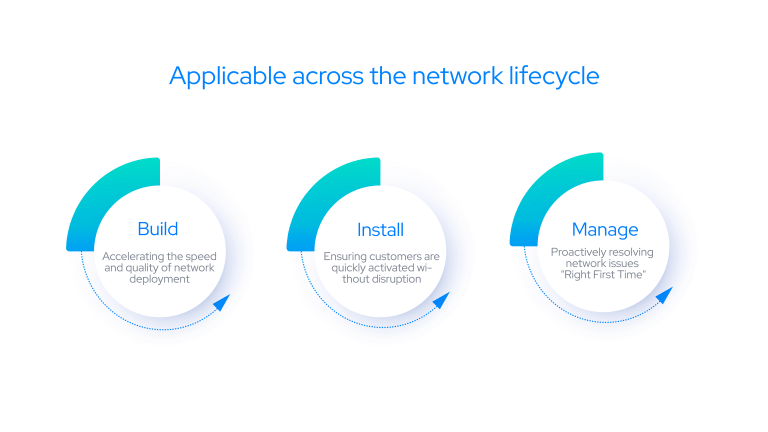
Right First Time (RFT) operations have become the key metric of choice in helping operators address these challenges. It measures whether tasks are correctly completed to the required standard in the initial attempt, without the need for rework. Whether applied to network build, customer install or resolving network faults, RFT reduces revisits, operational costs and time spent on each task.
Computer vision solutions are being deployed to help operators significantly increase RFT rates through the detection of anomalies and poor-quality operations, enabled by the automated analysis of visual data, captured and uploaded by engineers or auditors in the field. Having successfully deployed with FTTP providers in Europe, we see immediate benefits for UK alt-nets.
Openreach PIA: Managing Openreach’s PIA compliance process is a pain-point for many FTTP providers reliant on access to Openreach’s ducts, poles, and chambers to deliver and build out their own networks. Similar to other markets, adherence to strict quality standards and compliance with photographic evidence is mandatory. Using computer vision, operators are able to capture noncompliant photos or sub-standard work prior to sending to Openreach, avoiding delays and unnecessary costs that come with resubmissions or additional site visits.
Network Build Audits: As-built network auditing and documentation is often incomplete, with many operators seeking to improve their quality control processes. Computer vision can be used to ensure build standards are met, avoiding delays in handover and accelerating RFS network availability. Relevant for equipment across end-to-end fibre network, automating real time quality checks via AI, significantly reduces rework, as well as the time, effort and costs needed to complete desktop and site surveys.
Customer Installs: Issues with network availability, splicing, broadband speeds, reinstatement or even poorly mounted ONTs can result in service delays, issues or unhappy customers, where an additional site visit maybe required. Using computer vision to automate install health checks, operators can detect any corrective rework needed on the day of install, as well as guarantee the best possible install experience for their customers.
Inveniam AI – a better way to benefit from computer vision. Inveniam AI is a fully managed solution that integrates computer vision and machine learning capabilities to enhance field service operations, transforming raw data into real time actionable insights when engineers are in the field. With every stage of the computer vision life cycle covered, we build, deploy, and manage transformative computer vision solutions without our customers having to invest in their dedicated AI resources.
Get in touch or meet us at Connected Britain to explore how Inveniam can support you to enhance RFT operations.
Also in the news:
Connected Britain 2023: the keynote panel agenda
T-Mobile signs spectrum deal with Comcast worth up to $3.3 billion
Intel to sell minority stake in IMS Nanofabrication to TSMC
15
Sep, 2023

Batelco taps Oracle for upgrades
Keep up-to-date with all the latest news, articles, event and product updates posted on Developing Telecoms.
Subscribe to our FREE weekly email newsletters for the latest telecom info in developing and emerging markets globally.
Sending occasional e-mail from 3rd parties about industry white papers, online and live events relevant to subscribers helps us fund this website and free weekly newsletter. We never sell your personal data. Click here to view our privacy policy.
15
Sep, 2023

National Telecom, AIS strike roaming deal
Keep up-to-date with all the latest news, articles, event and product updates posted on Developing Telecoms.
Subscribe to our FREE weekly email newsletters for the latest telecom info in developing and emerging markets globally.
Sending occasional e-mail from 3rd parties about industry white papers, online and live events relevant to subscribers helps us fund this website and free weekly newsletter. We never sell your personal data. Click here to view our privacy policy.
15
Sep, 2023

Harnessing AI’s Potential to Detect Visual Bugs Faster
This Industry Viewpoint was authored by Prashant Maloo, Senior Director at Prodapt
Service providers in the Connectedness industry focus on gaining a competitive edge over the competition by maintaining a premium quality of service. However, quality assurance has been a tough challenge, given the need to master the various stages of the product life cycle, such as requirements gathering, product development, product testing, support & maintenance, etc. … [visit site to read more]