

Construction begins on Medusa submarine cable system


Press Release

Alcatel Submarine Networks (ASN), Elettra Tlc, Medusa and Orange are pleased to announce the coming into force of the construction contract for the Medusa Submarine Cable System. This milestone marks the start of an ambitious project that will boost connectivity across the Mediterranean.

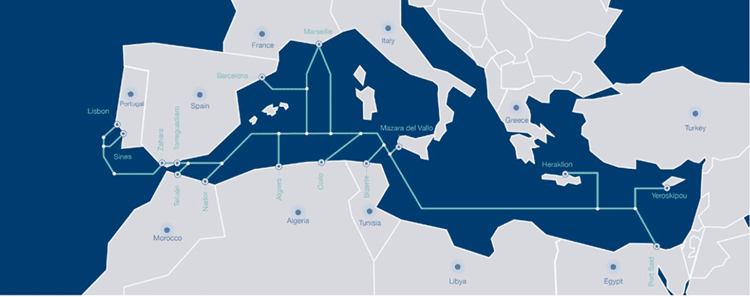
Medusa will establish crucial connections between Morocco, Portugal, Spain, France, Algeria, Tunisia, Italy, Greece, Cyprus and Egypt. The subsystem named Via Tunisia, part of the Medusa Cable, linking France and Tunisia, is cofunded by the European Union under the Connecting Europe Facility (CEF) program, as already announced by Orange.When complete, Medusa will span an impressive distance of over 8,700 kilometers, making it the longest cable in the Mediterranean Sea and providing enhanced North-South and East-West connectivity.

The construction has been awarded to industry leaders ASN and Elettra Tlc. The Medusa system is built on stateof-the-art 24-pair fiber optic Open Cable technology to meet increasing broadband requirements in the region, with 20Tb/s minimum capacity per fiber pair.

Elettra Tlc will promptly engage survey operations, while equipment manufacturing and installation are planned to span over 2024 and 2025. Orange will provide landing infrastructures in France, Tunisia and Morocco.

By connecting North Africa and Southern Europe, as well as several of the Mediterranean islands to the mainland, including Sicily, Crete and Cyprus, the Medusa submarine cable system will create unprecedented opportunities for collaboration, innovation and economic development. It will also provide an effective bridge between the Mediterranean and Atlantic regions, facilitating increased communication and cooperation across all these areas.
Medusa is committed to reducing the digital divide and this construction is an important step towards achieving this goal.

The construction of Medusa is funded by AFR-IX Telecom, Orange and the European Union though CEF (Connecting Europe Facilities) grants.

This collaboration highlights the commitment of industry leaders and governmental organizations to contribute to a more connected and prosperous future for the Mediterranean region.

Norman Albi, CEO of Medusa, highlights the strategic value of Medusa to improve connectivity in the Mediterranean: “We have been working for more than 3 years to reach this point and we are tremendously grateful to all those who, from early stages, supported Medusa: collaborating companies and European institutions. Thanks to the support of North African Operators, financial institutions and leading companies such as ASN, Elettra Tlc, Orange and AFR-IX Telecom, Medusa will be in service the 4th quarter of 2025”

Paul Gabla, Chief Sales and Marketing Officer of ASN said “The Medusa submarine cable system marks a major step forward in telecommunications infrastructure. ASN is honored to be at the forefront of this ambitious project, which will bring high-speed Internet connectivity and seamless communication to the region, unlocking a world of opportunities for businesses, communities and individuals throughout the Mediterranean region.”

Didier Dillard, President and CEO of Elettra Tlc said “We are very happy to be in charge of the marine works for the first phase of the MEDUSA project, the marine survey and the installation. Elettra Tlc is a true Mediterranean company that has installed and repaired a very large number of cables in this area, and we are excited to contribute to the construction of this future telecommunications backbone of the Mediterranean Sea.”

“Orange is delighted to put its leadership and industry expertise in the construction of this new system that will foster digital exchanges between Europe and North Africa and to welcome Medusa into its carrier neutral infrastructures in Marseille” said Aurélien Vigano, Vice President International Transmission Networks at Orange.

The submarine cable ecosystem is evolving. Join the cable operators and the wider connectivity industry in discussion at Submarine Networks EMEA 2024

Also in the news:
SK Telecom overhauls AI service ‘A.’ using ChatGPT
Leveraging 5G to develop new value and unlock digital dividends
SKT invests $100m in flying taxi company Joby Aviation

ZTE aids in bagging GSMA AMO award

Keep up-to-date with all the latest news, articles, event and product updates posted on Developing Telecoms.
Subscribe to our FREE weekly email newsletters for the latest telecom info in developing and emerging markets globally.

Sending occasional e-mail from 3rd parties about industry white papers, online and live events relevant to subscribers helps us fund this website and free weekly newsletter. We never sell your personal data. Click here to view our privacy policy.

Foxconn to inject $246m into Vietnam

Keep up-to-date with all the latest news, articles, event and product updates posted on Developing Telecoms.
Subscribe to our FREE weekly email newsletters for the latest telecom info in developing and emerging markets globally.

Sending occasional e-mail from 3rd parties about industry white papers, online and live events relevant to subscribers helps us fund this website and free weekly newsletter. We never sell your personal data. Click here to view our privacy policy.

SK Telecom overhauls AI service ‘A.’ using ChatGPT


Press Release

SK Telecom today announced that it has released a major UX overhaul of its AI service ‘A.’ (pronounced A dot) to enhance customers to enjoy various content based on personal tastes and preferences. The reorganisation includes enhancements to several features such as the addition of new AI agents that are capable of taking on diverse personas.

SKT has improved the UX of the main screen of ‘A.’ so that various content can be viewed on one screen at once according to the user’s unique preferences.

The company has also added a chatroom in ‘A.’ where users can have conversations with an AI character. Through these conversations, users can share information about their daily life like they are talking to a close friend.

In addition, SKT has added ‘Chat T’ to ‘A.’, using the ChatGPT model of Microsoft’s Azure OpenAI service. By asking ‘Chat T’ questions, users can receive rich and informative responses beyond simple answers.

SKT also upgraded its own Large Language Model (LLM) to enable users to engage in a multi-turn dialogue. The model can understand the context of a conversation and grasp complex intentions, thereby creating a more logical and useful conversation.

Furthermore, through a joint development project with Scatter Lab, an AI startup known for the Lee Lu-da chatbot, SKT has introduced its new AI agents named ‘A. friends’ to bring colourful personas to its improved ‘A.’

‘A. friends’ are applied with conversational AI technology that enables emotional and human-like conversations. By engaging in conversations with ‘A. friends’, users can receive counselling and advice on a wide variety of topics. The feature is available on Android with the iOS version coming at the end of July.

In addition, to enable more customers to experience generative AI, SKT eased the age limit for signing up for ‘A.’ so that those under 14 years of age can join the service.

“With the massive overhaul of ‘A.’, we expect more customers to feel comfortable and enjoy using our conversational AI,” said Kim Yong-hun, Vice President and Head of AI Service Business Office. “We will continue to evolve ‘A.’ into a service that can help customers in their daily lives in all kinds of ways.”

How is the AI changing the telecoms world? Join the operators in discussion at this year’s Total Telecom Congress live in Amsterdam

Also in the news:
What’s in a name? Trials and tribulations of being an altnet
Orange-MásMóvil merger may reduce competition in Spain, says European Commission
White House announces state BEAD allocations

AIS trials mmWave SA 5G with Qualcomm, ZTE

Keep up-to-date with all the latest news, articles, event and product updates posted on Developing Telecoms.
Subscribe to our FREE weekly email newsletters for the latest telecom info in developing and emerging markets globally.

Sending occasional e-mail from 3rd parties about industry white papers, online and live events relevant to subscribers helps us fund this website and free weekly newsletter. We never sell your personal data. Click here to view our privacy policy.

Leveraging 5G to Develop New Value and Unlock Digital Dividends


VIEWPOINT

The global digital industry, enabled by 5G, continues to move from strength to strength. In the last four years, 5G has not only gained one billion users across the world but is also playing a crucial role in the digitalization of all industries.

“All stakeholders from across the industry will need to work together, exploring innovative ways to connect people, homes, industries, machines, and vehicles. We will have to create new value with 5G to unleash digital dividends as it delivers higher traffic, more extensive connectivity, more reliable latency, and ubiquitous cloud services and intelligent applications,” says Li Peng, Corporate Senior Vice President, President of the Carrier BG at Huawei. He was delivering address, Creating New Value with 5G to unleash Digital Dividends at Mobile World Congress Shanghai 2023.

Modernizing networks to meet evolving consumer demands

A key reason for the growing 5G adoption is the ever-growing demand for new experiences in the consumer market. This is fostering innovation in this segment leading to the development of new forms of content and application, which are expected to drive future growth.

“To meet these high demands, the Chinese carriers have been promoting new applications like New Calling, cloud phones, and naked-eye 3D. New Calling helps carriers better connect consumers using video-based calls. The application facilitates communication in both personal and professional settings, making remote work easier. A single New Calling user can generate over 1 GB of data per week,” explains Li Peng.

On the other hand, cloud phones are being used in China to support cloud gaming, mobile office and more. Naked-eye 3D helps users enjoy higher-definition content from more perspectives. This application’s value chain is rapidly maturing, and the traffic generated by naked-eye 3D content will see a three-to-ten-fold increase compared with 2D videos.

However, for service providers to deliver these innovative applications requires them to upgrade their networks to deliver 10Gbps connectivity.

“Spectrum resources will have a big role to play in this network upgrade. The industry needs access to new frequency bands, including the 6 GHz and mmWave bands, as well as sub-100 GHz spectrum for 5G New Radio,” says Li Peng. Huawei has conducted field tests to demonstrate that a 10Gbps downlink speed can be achieved on the 6GHz band with the help of Extremely Large Aperture Arrays (ELAA). Even so, the growing digital ecosystem means that the demand for new 5G frequency bands will continue to grow as new applications emerge.

“There needs to be more 5G chips, IoT modules, and devices that support new spectrum bands. More efforts will be needed to pilot new applications around the world,” he adds.

This ever-increasing demand for improved experiences in the home segment means that the telcos would need to improve user experience.

“We believe the smart home market will develop rapidly in the next decade. To help carriers maximize the potential of this market, we launched 5G FWA Square solutions. We have FWA Pro for ultrafast connectivity, FWA Lite for cost-effective connectivity, and FWA Biz for the highly reliable connectivity required in industrial scenarios,” elaborated Li Peng.

Huawei is also working with carriers to explore FTTR [Fiber-to-the-Room] innovation and drive technology and business upgrade. This enables carriers to provide gigabit Wi-Fi connections to all parts of the premises without impacting the quality, paving the way for the telcos to adopt an innovative business model. “Early adopters of FTTR have already seen more than 30% increase in the ARPU of their home broadband services as well as a huge drop in their churn rate,” explains Li Peng.

Accelerating digital transformation of the enterprises with 5G

Unlike the previous technologies, 5G is helping enterprises accelerate digitalization and use it to grow production and efficiency. Huawei has helped conduct a trial of the industry’s first 5.5 G-enabled production line. The trial demonstrated that the 5.5G deterministic network guaranteed ultra-high reliability and reduced latency to 4 milliseconds in a high-concurrency environment.

Growing importance of 5.5G

“Customers will require new services and experiences in new scenarios, so carriers will need to upgrade their networks to 5.5G, in order to support 10 Gbps downlink, 1 Gbps uplink, and 100 billion IoT connections. 5.5G will open up unlimited opportunities for carriers,” says Li Peng. The industry is moving towards this with the 3GPP’s Release 18, the first standard for 5.5G to be released in the first half of 2024.

All the industry stakeholders will need to work together to drive the adoption of 5.5G to spur innovation in this segment and to be able to maximize the revenue potential of this technology.

Solving the workforce crisis for successful fiber deployment

This Industry Viewpoint was authored by Todd Kuty, Director Customer Service Telecoms, IQGeo

The telecom industry has embraced ground-breaking solutions to meet the growing demand for internet connectivity. In a world where people work remotely, communicate digitally and increasingly consume online, fiber broadband and 5G technology have become a critical role in bridging the digital divide and ensuring equitable high-speed internet access. … [visit site to read more]

Huawei to support private 5G plans of Costa Rica’s ICE

Keep up-to-date with all the latest news, articles, event and product updates posted on Developing Telecoms.
Subscribe to our FREE weekly email newsletters for the latest telecom info in developing and emerging markets globally.

Sending occasional e-mail from 3rd parties about industry white papers, online and live events relevant to subscribers helps us fund this website and free weekly newsletter. We never sell your personal data. Click here to view our privacy policy.

SKT invests $100m in flying taxi company Joby Aviation


News

The South Korean operator is deepening its existing partnership with the air mobility specialist, aim to become a key player in country’s emerging Urban Air Mobility (UAM) market

Today, South Korea’s largest mobile operator, SK Telekom (SKT), has announced it will take a roughly 2% stake in UAM specialist Joby Aviation for $100 million.

Joby is currently developing an electric vertical take-off and landing (eVTOL) aircraft, with which it aims to ultimately provide commercial urban air travel. The aircraft will reportedly have a range of 241km and will be able to reach speeds of up 322km/h.

Joby is aiming to launch the vehicle in the US – the company’s home market – in 2024.

SKT first partnered with Joby in February last year, with the operator pledging to provide the prospective aerial taxis with connectivity and its nationwide ride-sharing app TMAP. By September, the SKT had announced a pilot programme on Jeju Island with the K-UAM Dream Team Consortium, which also included defence and IT specialist Hanwha Systems, the Korea Meteorological Institute, and Korea Airports Corporation (KAC), the national airport authority.

This consortium aims to participate in the South Korean government’s K-UAM Grand Challenge, a competition created to demonstrate the safety of UAM flight and find the country’s first official UAM operator.

With this direct investment in Joby, SKT is demonstrating its further commitment to this goal, hoping to leverage its national network and ridesharing experience.

“We will do our utmost to promote the demonstration and commercialization of urban air mobility in Korea, based on our partnership with Joby Aviation,” said Ryu Young-sang, CEO of SKT. “This technology promises to greatly reduce customers’ travel time and we look forward to turning Korea into a mobility powerhouse.”

“Our partnership with SKT places Joby in the best possible position to capitalize on the opportunity presented by the Korean market, where we continue to see a strong drive from the government to realize aerial ridesharing,” added JoeBen Bevirt, founder and CEO of Joby Aviation. “We’re grateful for SKT’s commitment to Joby and look forward to working with them as we develop a transformational air taxi service for Korea.”

SKT is targeting the launch of commercial flying taxis by 2025.

From autonomous driving to flying taxis, what role will mobile connectivity play in the transport infrastructure of the future? Join the operators in discussion at this year’s Total Telecom Congress live in Amsterdam

Also in the news:
What’s in a name? Trials and tribulations of being an altnet
Orange-MásMóvil merger may reduce competition in Spain, says European Commission
White House announces state BEAD allocations