Nokia, Telia and Nscale to lead AI Gigafactory Northern consortium

News

The project will see AI infrastructure deployed across Northern Europe

Nokia, Nscale, Skeleton Technologies, Telia and Verda have announced a new partnership to jointly develop federated AI infrastructure cross the Baltic and Nordic states.

The AI Gigafactory (AIGF) Northern consortium aims to deploy large-scale AI computing capacity with sovereign cloud services across multiple sites in multiple countries.

Initial sites include Oulu (Finland), Iru (Estonia,) and Valmiera (Latvia), with a Swedish location still to be confirmed.

These locations have been selected due to the reliable, decarbonised energy supply, availability advanced digital networks, and a cool climate that reduces cooling demand.

Nokia will provide connectivity infrastructure to link the sites and Nscale will provide its cloud platform and AI infrastructure knowledge. Telia, with its subsidiary Telia Cygate, will provide connectivity, data transmission, infrastructure operations and cloud solutions. Verda will provide AI-native expertise, particularly around training, and Skeleton will supply high-power systems to enhance data centre efficiency.

“Europe’s AI ambitions depend on infrastructure it can trust, control and scale. AIGF Northern brings together the connectivity, computing, cloud and energy capabilities needed to turn that ambition into reality,” said Mikko Hautala, Chief Geopolitical & Government Relations Officer, and Chairman at Nokia Defense. “By linking strengths across borders, we can build a more resilient foundation for European innovation, competitiveness and technological sovereignty.”

The project will also be supported by VTT Technical Research Centre of Finland, one of Europe’s leading research organisations, and KTH Royal Institute of Technology, Sweden’s largest technical university. Combined, these institutions will work alongside AIGF Northern members to align research, innovation, and talent networks.

Europe has been under pressure in recent years to rapidly scale its AI infrastructure capacity and reduce reliance on US technology. The EU’s InvestAI initiative aims to mobile €30 billion in investment to this end, combining €20 billion in private-sector funding with €10 billion from EU and national public sources.

AIGF Northern creates a partnership positioned to benefit from this funding, pledging to become a key player in Europe’s sovereign AI ecosystem.

“Our customers – and our continent – have a rapidly increasing need for scalable and trusted AI services. To meet this need, Europe’s best must step up,” said Anders Olsson, Executive Vice President, Head of Telia Sweden.

How is the UK’s AI infrastructure rollout progressing? Join the experts in discussion at Intelligent Britain 2027

Also in the news
Shared Rural Network rollout extends to UK national parks with over 150 4G masts live
Vodafone touts latest attempt to bridge the UK’s digital divide
Virgin Media O2 cuts 5,200 tonnes of carbon dioxide emissions

South Africa’s MTN and Telkom mull tie-up once again

News

Two of South Africa’s largest telcos are back the negotiating table after previous talks collapsed in 2022

MTN Group is in early talks to acquire rival Telkom SA, a move that would create the largest mobile network operator in South Africa.

The deal would see MTN’s mobile business combined with that of Telkom, reducing the number of mobile players in the market from five to four and creating a new market leader.

The move would also see MTN take control of Telkom-owned Openserve, South Africa’s second largest fibre broadband network operator.

The proposed deal would see Telkom shareholder receive cash for their holdings or accept MTN shares.

Discussions are reportedly at an early stage with nothing yet formally agreed.

MTN has been seeking to acquire Telkom for over a decade, viewing the tie-up as the primary route to challenging the dominance of mobile market leader Vodacom.

In 2015, MTN negotiated and then abandoned plans to purchase RAN assets from Telkom, following intervention from the Competition Commission. Seven years later, in 2022, the company went further, beginning formal discussions to buy Telkom outright, but these too quickly faltered.

Since then, a return to the negotiating table has never been far away, including rumours of resumption last year, but no formal discussions were initiated.

The combination of MTN and Telkom would create a mobile operator in control of roughly 50% of the nation’s subscribers, hence would likely trigger significant regulatory scrutiny.

Also in the news
Shared Rural Network rollout extends to UK national parks with over 150 4G masts live
Vodafone touts latest attempt to bridge the UK’s digital divide
Virgin Media O2 cuts 5,200 tonnes of carbon dioxide emissions

Millicom eyeing Entel’s operations in Peru

Entel has reportedly received a non-binding offer from Millicom to acquire all shares in its Peruvian operations, Entel Peru and Americatel Peru.

Chilean newspaper Diario Financiero reported that the offer was disclosed via a material event notice to the Chilean Financial Market Commission (CMF) on Thursday 12th November 2026. In a statement, Entel’s general manager Antonio Büchi confirmed that the proposal was originally submitted on 29th June this year.

Büchi noted that discussions between the firms had reached an advanced stage, although he underlined that any deal would be subject to “necessary corporate authorisations from the parties” and agreed final terms and conditions.

Millicom has been expanding aggressively in Latin America in recent years – frequently by acquiring many of the assets sold off by Telefonica, amidst the Spanish group’s broader exit from the region.

While Millicom does not currently have any presence in Peru, in a results call earlier this year CFO Bart Vanhaeren identified the country as a potential market for expansion, along with Venezuela – although he acknowledged that the latter market presented significant challenges.

Vodacom rolls out 5G carrier aggregation across South Africa

Vodacom South Africa has commercially deployed 5G NR Carrier Aggregation across its network, saying it is the first operator in the market to introduce the technology at scale.

Carrier Aggregation combines multiple 5G spectrum bands to increase network capacity and deliver faster, more consistent connections, particularly in busy areas. Vodacom said the capability is part of its live network and is not a limited trial.

The company said customers with compatible devices should see improved performance for activities such as streaming, gaming, video calls and large downloads, including during periods of high network demand.

“NR Carrier Aggregation is not just about faster peak speeds but about creating a network that performs consistently when it matters the most,” said Beverly Ngwenya, Vodacom South Africa’s technology director.

Vodacom said the technology also helps it use spectrum more efficiently as data demand grows. For businesses, the added capacity could support cloud applications, real-time data access and other digital operations, Ngwenya said.

The company did not provide specific speed gains or say which devices are compatible. It said the network will continue to be optimised following the commercial rollout.

China Mobile’s model for experience-oriented operations

Telecoms operators have spent years expanding network capacity. Yet a stronger network does not always feel like a better one to the person using it. A fan at a sold-out concert may still struggle to upload a video; a commuter can see latency spike during a video call as a train moves between cells. For customers, the quality of a connection is measured in moments like these – not in network metrics alone.

China Mobile’s experience-oriented operations initiative takes aim at that gap. Using the UE Logo 2.0 interactive terminal portal alongside the core-network analytics capability NWDAF and Huawei’s XSpeed Intelligent Golden Pipe, the operator is bringing network optimisation closer to the user and the moment when it is needed. Commercial deployments across multiple provinces in China offer a practical example of how operators can make premium network capabilities easier to discover, activate and experience.

Putting the service where the need arises

The model is designed for scenarios where network demand and user expectations meet: crowded stadiums and tourist attractions, and high-speed rail journeys and metro commutes. At a concert, people may be filming and sharing high-definition video while thousands of others are doing the same. On a train, a business traveller might be on a video call while a gamer streams or downloads content.

In both settings, a user’s experience can deteriorate even when conventional network indicators appear acceptable. Congestion can slow uploads or cause them to fail; fast handovers between cells can introduce jitter and sudden latency spikes. And if an operator’s premium optimisation service is difficult to find, customers may not know it is available until after the disruption.

UE Logo 2.0 is intended to close that last-mile gap. Building on the earlier version’s ability to display network identity and entitlements, the upgraded portal adds two-way interaction. A pull-down notification bar gives users a place to check network status and available services, including free trials and one-tap activation. A dynamic “Live Window” can surface a tailored optimisation option when conditions degrade.

The shift is from asking customers to search for a service to presenting a relevant option when they are likely to need it. In a stadium or on a journey, that can mean activating an optimisation without leaving the app or activity already in progress.

A closed loop from perception to delivery

Behind the portal, NWDAF helps connect network conditions with user and service experience. It brings together data on factors such as service performance, location and network load to identify changing demands in specific scenarios. Those insights can inform policy decisions and coordinate core and radio network resources for differentiated service delivery.

The aim is a continuous loop: detect a change in experience, decide on an appropriate response, coordinate resources, deliver the service and assess the outcome. That gives the operator a way to match network treatment more closely to the user, application and setting.

China Mobile Screenshot.001

XSpeed provides the deterministic rate assurance element. Using 5G-Advanced multi-carrier coordination and joint control of time and frequency resources, it is designed to improve rate stability for users who opt into the service. The brief reports up to a twofold relative deterministic rate gain for subscribed users under the solution, while preserving baseline internet access for other customers and managing overall network capacity.

That balance matters. The proposition is not to give a small number of users a premium experience at the expense of everyone else. It is to use network resources more deliberately, with differentiated guarantees that can be activated when they add value.

From trials to commercial deployment

China Mobile’s provincial work illustrates how the approach is being tested and extended. Henan began joint innovation on UE Logo 2.0 and multi-speed optimisation in 2025. On 28 April 2026, it launched the combination commercially, with a scenario-led service model that includes trial before adoption. By October 2026, the initiative had reached 10,000 commercial users, according to the brief.

The solution has been validated at sports stadiums, cultural tourism sites and on high-speed rail routes. Henan has prepared capacity for a user base of 100,000 to support further rollout. Separately, NWDAF-based exclusive guarantee entitlements have surpassed 10 million users, extending experience improvements to a broader consumer base.

Shandong has focused on turning the approach into a repeatable operating model. It has integrated multi-speed optimisation with the UE Logo 2.0 portal, including a speed dial and an entitlement panel, and tested portal stability across geographies and device models. The province’s roadmap includes commercial trials and measurement through an online operations platform, supporting evaluation as deployments grow.

For users, the intended difference is straightforward: when a network slows, the option to improve the connection is visible and easy to activate. One stadium-goer quoted in the brief described being able to accept an acceleration prompt and share footage without leaving the current app. A commuter cited clearer status information and a prompt when network fluctuations affected video calls and gaming.

The commercial model also offers operators ways to package the capability. High-end plans can include multi-speed optimisation entitlements, while separate 1.5-times and two-times acceleration packages can be paired with monthly free trial allowances. Huawei’s brief says commercial trials have seen a 20–35% increase in conversion to premium services. The “try before buy” approach is designed to let customers experience the benefit before committing.

A broader operating model for operators

The significance extends beyond a single product or network feature. Experience-oriented operations point to a change in how operators organise consumer services: from selling connectivity primarily as a volume of data to making network quality more perceptible, interactive and relevant to the situation.

That differs from traditional network slicing and quality-of-service approaches, which have largely focused on enterprise requirements. This model targets consumer scenarios at scale, with reusable resources and controlled costs. It also translates specialist network capabilities into indicators and actions that customers can understand.

The approach is attracting interest across the industry. The brief cites initiatives by e&, Globe, KT and Turkcell, and comparable priority services from Telkomsel in Indonesia, AIS in Thailand and Zain in Saudi Arabia. China Mobile has also worked with provincial subsidiaries and partners including China Mobile Device Company, OPPO, HiSilicon and Huawei on UE Logo 2.0 and related technologies, with contributions to GSMA and 3GPP work.

Huawei China Mobile 2

Wider adoption will depend on more than network equipment. Interactive portal features require support from device makers, and compatibility remains uneven. Operators will also need to explain scenario-based services to customers used to straightforward data plans. Since spectrum allocations and carrier deployments vary, performance and rollout timelines will differ by market; each operator will need to adapt the model to local conditions.

There may also be an efficiency benefit. By dynamically reusing available spectrum, operators can seek experience gains without relying solely on new site builds, potentially reducing the energy demands associated with capacity expansion. At major public events, more targeted resource coordination can help maintain important services within finite network resources.

Making experience a network capability

As user expectations diversify, capacity growth alone cannot guarantee a better experience. China Mobile’s deployments show how an interactive service portal, network analytics and coordinated resource scheduling can work together to make optimisation visible and usable in everyday scenarios.

For Huawei’s Cloud Core Network business, the initiative demonstrates the role of the core network in linking insight to action: understanding experience in context, informing differentiated policies and helping deliver services through a convenient user touchpoint. The broader lesson for operators is that the value of network capabilities depends partly on whether customers can perceive and access them.

As networks evolve toward 6G, real-time perception, scenario awareness and on-demand optimisation are likely to become increasingly central to experience-led design. The path begins with a practical loop: network capability, clear user perception and convenient activation. China Mobile’s experience-oriented operations offer one model for building that loop at consumer scale.

Signal on the Roof, WiFi on the Wall: How Outdoor CPE Is Quietly Cutting 5G Build-Out Costs in Southeast Asia and Africa

Signal on the Roof, WiFi on the Wall: How Outdoor CPE Is Quietly Cutting 5G Build-Out Costs in Southeast Asia and Africa

This Industry Viewpoint was authored by Gerard Zhong

5G has a geography problem that most coverage maps don’t show. The sub-6 GHz mid-band spectrum carrying the bulk of today’s fixed wireless traffic — the n77/n78 bands — is significantly worse at penetrating walls than the low-band LTE it is replacing. In Southeast Asia and Africa, where dense concrete, metal roofing, and high ambient temperatures are … [visit site to read more]

Poste Italiane launches €600m co-investment fund for digital infrastructure

News

The fund will finance new data centre projects, with an initial 20MW development already in the pipeline.

In its quarterly result today, Poste Italiane revealed that it has set up a €600 million co-investment fund aimed at jointly deploying new data centres in Italy.

The fund, approved by the Bank of Italy in September, is already involved in an initial project to deploy facilities with a combined total capacity of 20MW.

The fund will use a co-investment model, with Poste seeking to attract institutional and third-party investors to help finance new facilities. According to CEO Matteo Del Fante, the structure will allow data centre projects to be developed through dedicated special-purpose vehicles outside the group’s consolidated balance sheet, reducing the amount of capital Poste itself needs to commit.

Poste is controlled by the Italian state and operates ​mail, financial, energy, and mobile services throughout the country. It recently acquired a controlling stake in the nation’s largest telco, Telecom Italia (TIM), raising its equity from 18.3% to 87% in a deal worth an estimated €13 billion and expected to deliver €700 million in annual synergies.

The company had been seeking control of TIM for years, buying a 9.8% stake in 2025 that was subsequently increased to roughly 20% thanks to the acquisition of shares from Vivendi.

Part of takeover’s attractiveness lay in TIM’s existing digital infrastructure footprint, with Poste aiming to accelerate the company’s shift into digital, telecom, and cloud services.

TIM already owns and operates 18 data centres with a combined capacity of 120–125MW.

The fund is part of a broader push by Poste to expand its position in Italy’s digital infrastructure market, which includes the separate development of 70MW data centre in Lombardy.

How is the UK’s satellite landscape evolving? Join the discussion at Satellite Live 2027, co-located with Connected Britain 2027

Also in the news
Shared Rural Network rollout extends to UK national parks with over 150 4G masts live
Vodafone touts latest attempt to bridge the UK’s digital divide
Virgin Media O2 cuts 5,200 tonnes of carbon dioxide emissions

ITU re-elects Doreen Bogdan-Martin for second term as secretary-general

The International Telecommunication Union (ITU) has re-elected Doreen Bogdan-Martin (pictured) as secretary-general for a second four-year term, giving her 164 of the 173 votes cast by member states at its Plenipotentiary Conference in Doha, Qatar.

Bogdan-Martin, who became the first woman to hold the post when she took office in 2023, will continue to lead the UN agency as it focuses on expanding global connectivity, strengthening digital resilience and ensuring emerging technologies such as AI create wider opportunities.

Her priorities for the new term include connecting the estimated 2 billion people who remain offline, expanding digital skills and strengthening cybersecurity. She also pledged to make the ITU more agile, transparent and responsive to its members.

During her first term, the ITU’s Partner2Connect Digital Coalition secured more than US$120 billion in connectivity commitments. The organisation also expanded its engagement with industry, academia and civil society, bringing its total number of non-governmental participants to more than 1,000 alongside its 194 member states.

Bogdan-Martin previously served as director of the ITU’s Telecommunication Development Bureau from 2018 to 2022 and has more than 30 years of experience in international telecoms policy.

The Plenipotentiary Conference, the ITU’s highest decision-making body, will also elect its deputy secretary-general and the directors of its radiocommunication, standardisation and development bureaux. Member states will additionally vote for the Radio Regulations Board and the ITU Council, which oversees the organisation between conferences.

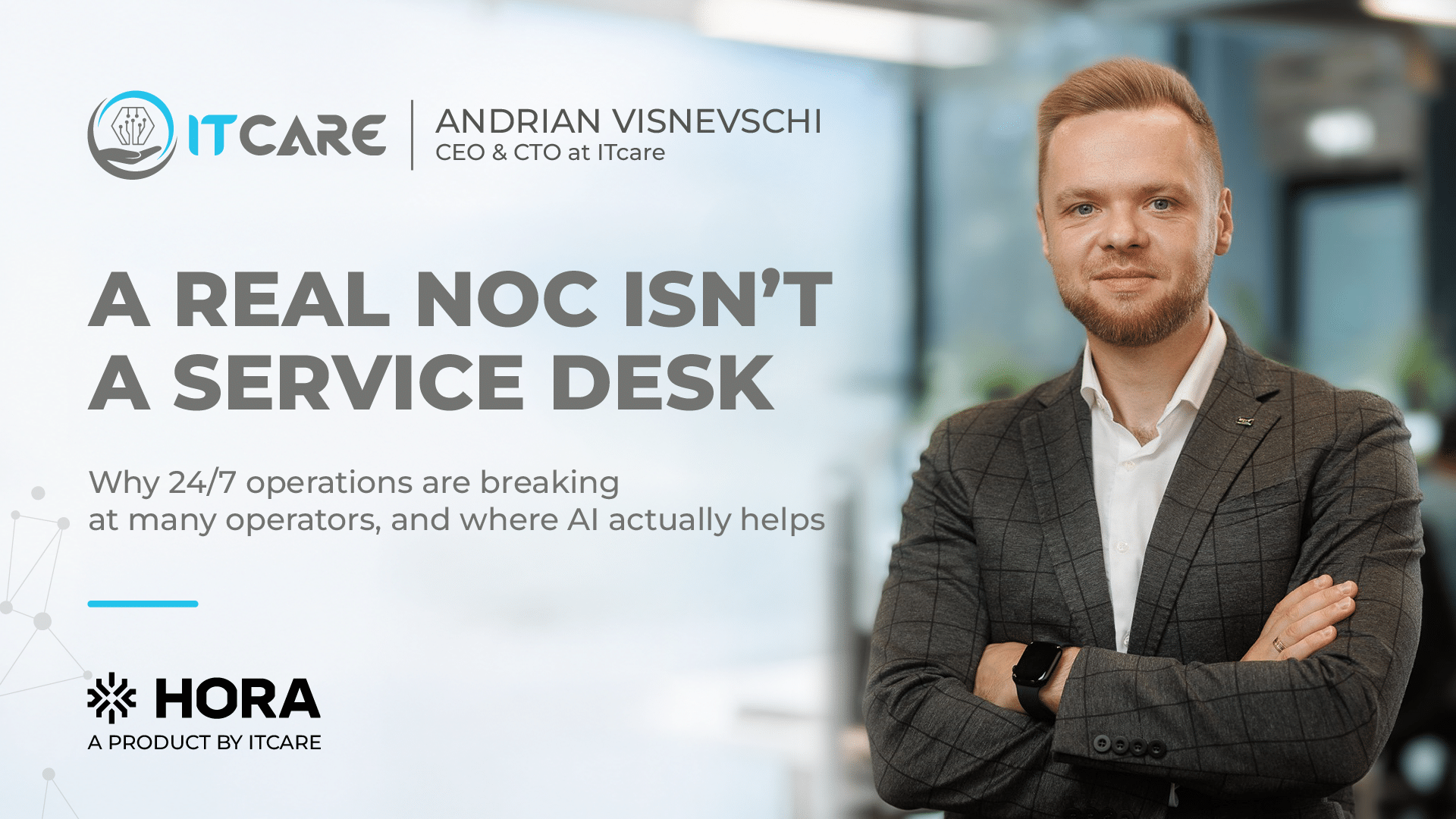
Smarter NOC management in the age of AI

Interview

We caught up with co-founder, CTO and CEO of ITcare, Andrian Visnevschi, to discuss scaling operations and the elusive nature of building autonomous networks

The UK’s fibre sector has a diverse and increasingly complex approach to network operations management. The largest fibre network players can afford to run 24/7 network operations centres (NOCs), manned by specialists to provide round-the-clock monitoring, fault management, and service assurance.

For the smaller players, however, the cost of a 24/7 NOC is often prohibitive, making alternative operational models more attractive. In some cases, this means network oversight by junior staff, or simply an automated alert sent to an on-call engineer, neither of which guarantees a fast response.

As Andrian Visnevschi, co-founder, CTO and CEO of ITcare, explained to us, this can result in costly delays.

“A lot of operators today simply don’t have 24/7 coverage. In some cases, senior NOC engineers are working a typical 9–5. If something happens outside of business hours, in the best case a more junior colleague calls them. Often, it’s just an automated notification from PagerDuty or a similar tool, which can easily be missed or ignored,” said Andrian. “Then the engineer has to wake up, or get home, or pull over the car, acknowledge the alert, find a stable internet connection, connect to the network, and only then start troubleshooting. That’s not a fast reaction. In fact, the mean time to repair of those issues is rising and the customers are suffering.”

Delays in fault repair cause significant damage to customer relationships and undermine the commercial value of the network – both factors of crucial importance in the UK’s highly competitive environment.

“A lot of operators are struggling to survive in the new race for service quality,” said Andrian, highlighting a recent market shift from network coverage to service take-up and reliability. “There is huge pressure to provide quality services without operational costs rising sky high.”

This is where ITcare’s model differs. Rather than a service desk that watches dashboards and escalates, ITcare’s NOC is staffed around the clock by senior network engineers who work across multi-vendor environments, from fibre ISPs and wireless operators to data centre fabrics, and resolve incidents themselves.

“A real NOC isn’t a service desk. The engineers on shift can log into the device, find the problem and fix it at 3am, without waking anyone up,” said Andrian. “They treat our customers’ networks as if they were their own. Every NOC customer we have signed is still with us today.”

HORA: The whole network in one view

For ITcare, which runs managed NOC and network engineering services for telecoms customers, the first step to improvement is a unification of systems and data. Inventory mistakes, poor data visibility, and unclear network topology are commonplace, making resolving issues a slow, complex process. This was one of the primary reasons for the creation of HORA, ITcare’s AI network operations platform, which gives NOC engineers full visibility of the network in one place: inventory and source of truth, metrics, logs, traffic flows, BGP monitoring, live network state, configuration backups and controlled change management, with AI correlating across all of it. ITcare built it for its own NOC first, and its engineers use it every day on live customer networks.

“By combining all of the available data, HORA can quickly troubleshoot and provide root cause analysis. It can also show exactly which customers are affected by a specific outage,” said Andrian. “With all the network data in one place, engineers stop jumping between five different tools. That makes them far more efficient, lets us automate more of the routine work, and cuts response times.”

HORA is designed to be slotted over the top of the network, being on-prem by design and network management system-agnostic. All networks are different – Andrian talks of “fine tuning” HORA to each customer – but fundamentally there are many NOC processes that are similar, regardless of tech stack.

“Over the years, we’ve worked with different ISPs, cloud hosting providers, and data centres worldwide, and our engineers are often doing the same repetitive tasks with each. They may use different hardware, different network architecture, and different protocols, but the troubleshooting chain they all use on a daily basis is usually quite similar,” said Andrian. “That’s where AI can be useful. We’re able to automate some of these tasks to make engineers’ lives easier.”

In ITcare’s own NOC, HORA has cut median investigation time from around 28 minutes to under four, roughly seven times faster than manual root cause analysis.

HORA’s change management capabilities also mean that changes are clearly documented.

“Engineers are usually pretty lazy,” Andrian joked. “They like making changes but they don’t like updating the documentation. HORA not only creates a change management process for you to approve but also handles the documentation so it is always up to date.”

AI guardrails, and Autonomous Level 4

Despite being bullish on the benefits of AI integration, Andrian is no AI evangelist, describing ITcare in a previous Total Telecom article as “conservative in a specific way”. HORA underwent extensive testing in the company’s own NOC before being offered to customers, with strict guardrails in place.

“We’ve all heard horror stories about AIs connecting to data bases, erasing all the data, and even generating random data to replace it,” he said. “You’ve got to be really careful when you build these tools. In HORA, the AI can propose a change, but an engineer reviews and approves it. Nothing touches a device without that approval.”

These safety concerns are, at least in part, why attempting to rapidly progress to Level 4 (L4) autonomy – in which an AI system monitors the network and handles tasks without human intervention – could be highly dangerous.

“I think [many in the industry] are all rushing it too much. It’s really so complicated to reach L4,” said Andrian. “If you’re building something solely for your own operations and infrastructure then it may be possible. But as soon as something changes in the design or a new vendor is added, you’ll need to start again.”

Keeping expert humans in the loop

For Andrian, the use of AI in NOC management is not about replacing engineers, but rather enhancing their abilities so networks can be scaled effectively without expanding overheads.

“It’s about allowing you to scale easily. With HORA, a single engineer has a tool that can quickly get to root cause, assess the impact, and prepare a change across hundreds of devices from a plain-language request, which the engineer then reviews and approves,” said Andrian.

“The tool doesn’t replace the engineer. Our customers get senior engineers on shift around the clock, and HORA makes each of them faster,” he added.

For operators under pressure to improve service quality while controlling costs, the immediate opportunity lies in pairing experienced engineers, whether in-house or through a partner, with tools that let them work smarter and scale operations more efficiently. Full autonomy remains a longer-term ambition.


Andrian Visnevschi is CEO and CTO of ITcare and holds JNCIE-SP #2975. ITcare runs managed NOC and network engineering for ISPs, data centre operators and hosting providers worldwide, and builds HORA, an AI network operations platform.