Nvidia and HPE team up for gen AI solution 


News 

“Never before have Nvidia and HPE integrated our technologies so deeply,” says Nvidia boss Jensen Huang 

Nvidia and HPE have announced a partnership to co-develop AI solutions and joint go-to-market integrations to help businesses accelerate their adoption of generative AI. The partnership is a deepening of a decades-long collaboration between the two companies. 

The announcement was made in Las Vegas at HPE’s Discover event by HPE’s President and CEO Antonio Neri, who was joined on stage by NVIDIA founder and CEO Jensen Huang. One of the key offerings is HPE Private Cloud AI, which will integrate Nvidia’s software and computing technologies with HPE’s storage solutions, which will allow customers to run generative AI workloads efficiently and securely. The companies say that this is the first time the companies have integrated their solutions so fully. 

“Generative AI holds immense potential for enterprise transformation, but the complexities of fragmented AI technology contain too many risks and barriers that hamper large-scale enterprise adoption and can jeopardize a company’s most valuable asset – its proprietary data,” said Neri. 

“To unleash the immense potential of generative AI in the enterprise, HPE and NVIDIA co-developed a turnkey private cloud for AI that will enable enterprises to focus their resources on developing new AI use cases that can boost productivity and unlock new revenue streams,” he continued. 

According to the announcement’s press release, the HPE Private Cloud AI will offer: 

  • Support for inference, fine-tuning and RAG AI workloads that utilise proprietary data.
  • Enterprise control for data privacy, security, transparency, and governance requirements.
  • Cloud experience with ITOps and AIOps capabilities to increase productivity.
  • Fast path to consume flexibly to meet future AI opportunities and growth.

“Never before have NVIDIA and HPE integrated our technologies so deeply – combining the entire NVIDIA AI computing stack along with HPE’s private cloud technology – to equip enterprise clients and AI professionals with the most advanced computing infrastructure and services to expand the frontier of AI,” confirmed Huang. 

Keep up to date with the latest international telecoms news by subscribing to the Total Telecom daily newsletter 

Also in the news:
Nokia and Google Cloud expand partnership for telco APIs
Microsoft to invest $7.16 bn in Spanish data centres
Vietnam suffers three subsea cable outages

Microsoft to invest $7.16 bn in Spanish data centres 


News 

The investment will be spread over the next ten years  

Microsoft is set to invest €6.7billion ($7.16 bn) in data centre development in Aragon, Northeastern Spain. 

According to a report from local Spanish newspaper El Heraldo, Microsoft has applied for a construction permit to build its data centres near Zaragoza, in the Northeast of the country.  

“Microsoft’s new data centre region will provide cutting-edge, sustainable, and secure AI solutions for Spain and the rest of Europe,” said Spanish Minister for Digital Transformation, José Luis Escrivá. 

“It is a great satisfaction that Microsoft is once again betting on Spain for the deployment of state-of-the-art infrastructure and services, thus contributing to the positioning of our country at the forefront of digital transformation,” he continued. 

The particular area of Spain has become a recent hotbed for data centre investment, in part due to the area’s renewable energy capacity to power their facilities with. Last month, Amazon Web Services (AWS) announced plans to invest €15.7 billion in the region, two years after opening its AWS Europe (Spain) hub in three locations in the area. AWS has said that its recent investment in the region will support 17,500 full-time equivalent jobs in local businesses on an annual average basis, and will contribute an estimated €21.6 billion to Spain’s GDP until 2033. 

In a near region of Spain, Microsoft has opened its first cloud region of data centres in the Community de Madrid, which will provide AI, cloud services and solutions to European companies, offering them “reliability, security, privacy, and data residency,” says Microsoft. The deployment is part of the company’s commitment to invest $2.1 billion in Spain before the end of next year. 

Keep up to date with the latest international telecoms news by subscribing to the Total Telecom daily newsletter

Also in the news:
Vietnam suffers three subsea cable outages
South Korea revokes Stage X’s mobile license  
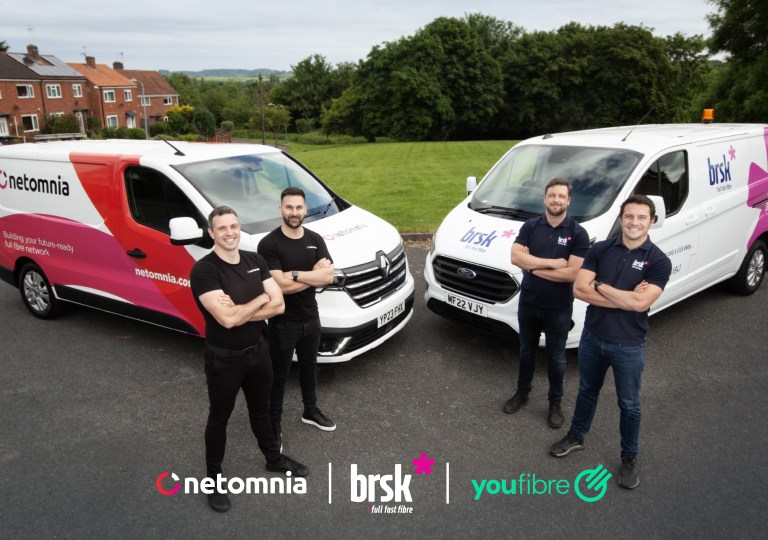
Brsk and Netomnia merge as UK alnet consolidation continues 

Brsk and Netomnia merge as UK alnet consolidation continues 


News

Financial details of the merger have not been disclosed 

UK altnets Brsk and Netomnia have agreed to merge, the companies said over the weekend. 

The newly established unit will have a combined footprint of 1.5 million premises immediately post-merger, with a target of reaching 3 million premises by the end of next year, according to the press release. This will make it the second largest altnet behind CityFibre, who cover around 3.6 million premises. 

There have been rumours surrounding the merger for a while, as the two companies share an investor, asset manager Advencap. 

“By merging our network expertise and resources, we are creating a powerhouse to deliver an unparalleled internet experience for our customers, driving innovation and further consolidation among altnets. The additional capital from our investors and support from our lenders is a powerful endorsement of our vision and ability to execute at the highest level,” said Netomnia CEO Jeremy Chelot. 

“Together, we are set to deliver a fibre network that is not only fast and reliable but also futureproof, ensuring our customers benefit today and tomorrow. Our joint platform will be where the most powerful internet lives,” echoed Giorgio Iovino, CEO of Brsk. 

The deal is set to be finalised in the next few weeks, pending regulatory approval. The new entity will be led by Chelot as CEO. 

There has been much altnet consolidation in the UK broadband market recently. Currently, the UK has over 100 altnets rolling out fibre countrywide. The UK incumbent BT has long claimed that the current altnet landscape is too saturated and thus unsustainable. Back in March, CityFibre, the UK’s leading independent network operator, has announced the acquisition of full fibre altnet Lit Fibre from Newlight Partners. In December, altnets Freedom Fibre and VX Fibre also merged their businesses for an undisclosed amount. 

Join the UK altnets in conversation at this year’s Connected Britain, 11-12 September in London. Get tickets here! 

Also in the news:
T-Mobile selected for decade-long $2.67 billion US Navy contract
BT pushes back against Vodafone–Three merger
IOH and Google Cloud renew AI Native TechCo alliance

Vodafone looks to sell $2.3 billion Indus Towers stake 


News

Bank of America, Morgan Stanley, and BNP Paribas have been hired to manage the sale in the Indian market 

Vodafone is seeking to sell its 21.5% stake of India’s Indus Towers, which is worth around $2.3 billion, sources familiar with the matter told Reuters. 

The sources said that the final stake sale remains undecided, but could be lower than 21.5% if demand is insufficient. 

Indus Towers are one of the largest tower companies in the world, with 219,736 towers and 368,588 co-locations to its name as of March 2024. 

Vodafone first announced its intention to sell its stake in 2022 (which then was 28%), but has only sold off a small percentage so far. 

Staying with the Indian market, Indian operator Vodafone Idea has issued its network equipment vendors Nokia and Ericsson with preference shares instead of payment for product orders. If approved by investors, Nokia will receive nearly 1.03 billion shares and Ericsson 634 million, giving the companies a 1.48% and 0.91% stake in Vodafone Idea respectively. 

“VIL is all set to participate in the industry growth with right investments to expand its 4G coverage and offer 5G experience to its customers while remaining focused on its execution capabilities,” said Akshaya Moondra, CEO of Vodafone Idea in a filing to the Bombay Stock Exchange. 

“As VIL embarks on its growth journey, support from key stakeholders is critical and the agreement with Nokia and Ericsson reaffirms these vendors as long-term partners of the Company, and sets the stage for the next phase of our growth,” he continued. 

The company has struggled with its cash flow for some time. Although the country’s third largest mobile operator by subscriber numbers, it struggles to compete with Reliance Jio and Bharti Airtel. The Indian government became the company’s largest shareholder last year (33.1%), but due to its debt, remains as India’s only telco yet to launch 5G services. 

Keep up to date with the latest international telecoms news by subscribing to the Total Telecom daily newsletter
Also in the news:
Freshwave to deploy small cells in Manchester for VMO2
SGP.32: A reality check on the latest remote SIM provisioning standard
Vodafone Germany partners with FlyNex on industrial drone platform 

BT pushes back against Vodafone–Three merger 


News 

This week, the Competition and Markets Authority (CMA) has published ten responses to an issues statement that was released in May, which invited parties to provide submissions commenting on the issues and possible remedies for the merger

Among them is the response from UK incumbent BT, who released a 40-page report. The company claims that the proposed merger will “create a Merged Entity with a disproportionate share of capacity and spectrum, unprecedented in UK and Western European mobile markets, which will substantially lessen competition and deter investment.” According to the report, the merged entity would have a 61% share of the UK mobile network capacity, an unprecedented amount in UK and Western Europe mobile markets. 

BT say that the merger would result in “higher prices, poorer network quality, and reduced incentives to invest – all to the detriment of UK consumers.” 

Such comments from the UK market leader are to be expected, as the merger puts its top position under threat. Speaking to The Times, Ahmed Essam, Vodafone’s chief executive of European Markets, said that the company is not surprised by BT’s comments, but it was pleasing to see support from other big players, such as Swedish giant Ericsson, 

“Currently the UK mobile sector needs investment, with two large and two sub-scale players. We firmly believe creating a third mobile network operator, with the scale to invest and compete, will strengthen competition in the UK’s mobile market, benefiting customers and the wider UK economy,” concluded Essam. 

“Consolidation is broadly seen as a pivotal measure towards helping operators to attain the necessary scale for expanding their future network infrastructure,” said Ericsson’s supportive response. 

“Consequently, it should facilitate the delivery of the high-quality service, high bandwidth, and extensive coverage needed to fully harness the economic and social benefits of nationwide 5G standalone (5G SA) networks,” the response continued. 

Last month, The UK government released a “Publication of notice of Final Order” that provisionally approves the Vodafone–Three merger, subject to certain conditions. The CMA investigation, which is separate and ongoing, began its second phase in April. The results are expected in September. 

Join the conversation around UK telcos at this year’s connected Britain, 11-12 September in London. Get half price tickets this week only!

Also in the news:
Freshwave to deploy small cells in Manchester for VMO2
SGP.32: A reality check on the latest remote SIM provisioning standard
Vodafone Germany partners with FlyNex on industrial drone platform 

IOH and Google Cloud renew AI Native TechCo alliance


Press Release

The collaboration will advance Indosat’s AI Native TechCo vision, empowering it to better serve more than 100 million customers across its B2B and B2C segments
Companies to develop enterprise-grade AI solutions for customer service modernization, dynamic content generation and hyper-personalization, geospatial analytics and predictive modelling, augmented network and IT operations, and back-office transformation

Jakarta, June 14th, 2024 – Indosat Ooredoo Hutchison (“Indosat” or “IOH”) and Google Cloud today announced the expansion of their long-term strategic alliance, aimed at accelerating Indosat’s transformation from telco to AI Native TechCo. This collaboration will combine Indosat’s vast network, operational, and customer datasets with Google Cloud’s industry-leading unified AI stack to deliver exceptional experiences to over 100 million Indosat customers, as well as enterprise-grade AI and generative AI (GenAI) solutions for businesses across Indonesia.

AI agents and applications, when effectively grounded in a communications service provider’s securely managed and privacy-compliant data assets, can augment human capabilities with powerful multimodal data analysis, pattern recognition, and recommendations to unlock new revenue streams and efficiencies, and elevate the customer experience. Under this alliance, the companies’ joint innovation initiatives will therefore be focused on creating tailored AI and GenAI solutions to address unique opportunities and challenges in the Indonesian market. These include:

  • Customer service modernization: Google Cloud’s Contact Center AI solutions will equip call center staff with GenAI tools to enhance their productivity and effectiveness. Specifically, these tools will provide live call transcription; recommended responses derived from knowledge bases; real-time conversation analysis; and post-call sentiment analysis, leading to faster, more accurate, and more effective resolution of customer queries. In addition, GenAI-powered conversational agents will be built and deployed to offer self-service options across Indosat’s digital touchpoints. These agents will be capable of seamlessly switching between topics, addressing complex inquiries, supporting transactions, and operating 24/7.
  • Dynamic content generation and hyper-personalization: Creative AI agents with multimodal and multilingual capabilities will promote relevant offerings based on a customer’s profile and specific needs. When integrated with customer relationship management and content management systems, they will assist marketers by identifying high-value leads, generating rich content (i.e., text, images, and videos), and engaging customers across channels with personalized offers and messages.
  • Geospatial analytics and predictive modelling: Google Cloud’s custom machine learning (ML) models, trained on Indosat’s extensive operational datasets, will empower organizations across industries to make data-driven decisions around optimal site selection for strategic expansion; optimize asset management and maintenance based on real-time location and condition data; and model potential natural disaster scenarios to develop proactive mitigation strategies. Indosat will also leverage these tools to identify areas with high growth potential but limited network coverage, informing its strategic decisions to expand network capacity and bridge the digital divide between urban and remote communities.
  • Augmented network and IT operations: Self-optimizing systems that are powered by custom ML and multimodal models will predict ROI from capital investments; reduce energy consumption; optimize asset design and utilization; and proactively detect and resolve issues. This results in cost savings, more sustainable operations, and improved service reliability. For example, AI can dynamically adjust cell tower power levels during off-peak hours, assist field technicians in rapidly diagnosing and resolving faults based on their verbal and visual inputs, and intelligently reroute network traffic to avoid faulty components while repairs are being made. Additionally, GenAI-powered agents that assist with code generation, completion, and troubleshooting will significantly increase IT teams’ development and delivery velocity, leading to faster time-to-market and time-to-value for reliable software products and services.
  • Back office transformation: Custom GenAI-powered enterprise search applications will enable HR, legal, procurement, and finance teams to instantly access the precise information they need to excel in their job roles. By simply asking questions in natural language, they will receive accurate, contextually relevant answers or summaries from vast amounts of unstructured data, such as policies, contracts, financial reports, or employee records, thereby eliminating the need for manual searches, accelerating decision-making, and boosting overall productivity.

In addition to implementing these solutions across Indosat’s business operations, Indosat and Google Cloud will also explore joint go-to-market initiatives to empower Indonesia’s digital ecosystem. They will look to provide micro, small, and medium enterprises (MSME), startups, enterprises, and public sector organizations with access to these solutions, alongside Google Cloud’s AI-optimized infrastructureunified data platform, and unified AI development platform.

Vikram Sinha, President Director and Chief Executive Officer, Indosat Ooredoo Hutchison, said: “As Indonesia steps into the digital era, we remain committed to Indosat’s larger purpose of empowering Indonesia by providing businesses and individuals with the essential tools and technologies needed for success. Our collaboration with Google Cloud is not just a pivotal milestone for Indosat, but also a significant stride in our mission to transform into an AI Native TechCo. Together, we will harness the full potential of cloud and AI to drive innovation, create new opportunities, and propel Indonesia’s digital economy forward.”

Karan Bajwa, Vice President, Asia Pacific, Google Cloud, said: “Indosat’s early adoption of cloud-native architectures and an AI-ready data analytics platform exemplifies its forward-thinking approach. This strong foundation, established through our collaboration from 2021, is now enabling Indosat to pursue a wide range of high-value ML and GenAI use cases at scale—and we’re excited by the possibilities. These initiatives will not only demonstrate the transformative power of AI in telecommunications, but also serve as a blueprint for other sectors seeking to harness this technology to drive growth and nationwide impact.”

T-Mobile selected for decade-long $2.67 billion US Navy contract


News

A contract worth billions of dollars will provide U.S. Navy agencies with T-Mobile equipment for years to come

This article was originally released by our sister publication Broadband Communities

T-Mobile has been selected for a $2.67 billion defence contract that will make them a wireless solutions provider for the U.S. Navy for the next decade.

The contract replaces a previous iteration, known as Spiral 3, which expired in May.

With the new Spiral 4 contract, all agencies under the U.S. Department of Defence umbrella will have the ability to place orders for wireless services and equipment for the next 10 years with T-Mobile.

An announcement from T-Mobile, released Thursday, explained how the company has grown its range of services for government operations since 2017, when the provider began participating in Spiral 3.

T-Mobile’s release cited the company’s advanced 5G network solutions, which includes applications that can “meet specific performance needs of government agencies,” as an advantage.

David Bezzant, a VP of sales with T-Mobile’s government division, said the Spiral 4 contract award is a testament to T-Mobile’s network and emphasis on solutions.

“With a cutting-edge product portfolio, a proven track record and a clear vision for the future, we’re ready to take government innovation to the next level,” he said, according to T-Mobile’s release. “It’s an honor to serve those who serve this nation.”

Major carriers like T-Mobile, Verizon, and AT&T were all involved with the Spiral 3 contract vehicle, which allowed agencies to place orders against the contract.

T-Mobile’s release called the Spiral 4 contract a ” comprehensive, multiple-award contract” that includes solutions for voice, data, fixed wireless access, Internet of Things and mobility management.

In the future, according to T-Mobile, the government could also leverage the company’s partnership with Starlink.

In January, T-Mobile celebrated the launch of Starlink satellites with Direct to Cell technology.

According to T-Mobile, the milestone, part of the Coverage Above and Beyond Initiative, “aims to bring connectivity nearly everywhere in the U.S.” for T-Mobile customers.

Keep up to date with the latest international telecoms news by subscribing to the Total Telecom daily newsletter 

Also in the news:
Freshwave to deploy small cells in Manchester for VMO2
SGP.32: A reality check on the latest remote SIM provisioning standard
Telefónica Germany and Ericsson renew core network partnership  

Telefónica Germany and Ericsson renew core network partnership  


News

The deal extends their initial core partnership, which first began back in 2020

Ericsson and Telefónica Germany have agreed to extend their core network partnership. 

The company’s dual-mode 5G Core and cloud infrastructure solutions already provide mobile connectivity to 45 million O2 Telefónica subscribers, covering 5G Standalone (SA), 5G non-Standalone (NSA), 4G, and 2G.  

The agreement, the companies say, will allow them to increase innovation and functionality in the core network in preparation for future demand. 

“With Ericsson, we have embarked on a cloud-native transformation journey and are now going to develop it further by expanding our portfolio and capabilities towards network slicing, automation, and API access. This allows us to roll out new features faster and without temporary maintenance breaks – an important step towards the network of the future,” said Mallik Rao, Chief Technology & Information Officer of O2 Telefonica in a company press release. 

“Our deep partnership with O2 Telefónica in Germany has been a significantly rewarding one from the start,” added Daniel Leimbach Ericsson’s Western Europe Head of Customer Unit. 

“Meeting its challenge to deliver a cloud-native core network for its 45 million subscribers while ensuring it was flexible enough to evolve in line with its strategy meant breaking new ground across a range of disciplines,” he continued. 

According to the companies, the existing core network partnership between the two companies is already delivering exciting new benefits for customers. For example, back in May, the two companies completed a world-first with their In-Service Software Upgrade (ISSU) of network functions in the core network’s user plane. This essentially allows the network’s software to be upgraded without any downtime or service disruption for customers – something previously unthinkable without a cloud-native core.  

Speaking of being cloud-native, last month, Telefonica Germany announced a monumental deal to move 1 million of the company’s 5G customers to the Amazon Web Services (AWS) cloud. In doing so, it will become the first operator in the world to move its 5G core network to AWS’s cloud infrastructure. a 

Join us at this year’s Connected Germany event, 5-6 November in Munich. Get discounted tickets here! 

Also in the news:
Telstra’s network APIs to be added to Vonage platform
e& under investigation over PPF acquisition
Elisa brings smart solar energy management to the Åland Islands

Gavin Davies appointed as Wessex Internet’s first Chief Operations Officer

The Dorset-based rural broadband specialist has ambitious plans for the next five years and beyond, with recruitment to meet this growth also taking place across sales and customer support, network planning and operations, civil engineering, and garden works.
Gavin brings significant leadership experience from operational roles in other technology and utility companies, including, most recently, Avonline. In particular, he has helped lead organisations through times of significant growth, and this expertise was pivotal to his appointment.
Hector Gibson Fleming, CEO of Wessex Internet, said:
“I am delighted to welcome Gavin into the business at such an important time in Wessex Internet’s growth story. We remain passionate about providing full fibre to underserved rural communities across the south west and delivering our recently awarded contracts is the next phase of achieving that mission. Gavin’s extensive experience will help us scale up for those contracts, focussing on expanding our unique capabilities and improving our delivery efficiency. I know everyone in our operations teams is looking forward to working with him.”
New Chief Operations Officer Gavin Davies said:
“I have helped to lead telecoms and utility companies through periods of rapid growth and efficiency improvement, and look forward to bringing this experience to Wessex Internet. In the sector, Wessex Internet is known to be unique in its approach to building its fibre network, both in engineering and technical terms, and in how it engages with the communities it serves.
“On a personal level, I am already relishing working in the glorious countryside after more urban-based recent roles, and I have been fascinated by the innovative methods developed by Wessex Internet to provide broadband in challenging areas that would otherwise not be connected by other providers.
“I believe that businesses and individuals should not face a digital divide based on where they are located and am excited to be part of a company that is removing these barriers. Relatedly, I take seriously the role we play in providing high-quality employment across multiple disciplines in a predominantly rural area.”
Away from work, Gavin is a keen traveller, massive Formula 1 fan, and performance car enthusiast.

Old copper networks: A gold mine for telcos?


News

A report from engineering firm TXO says that over $7 billion-worth of unused copper cabling could be recovered in the next decade

In most developed markets around the world, copper telecoms networks are increasingly becoming a thing of the past, replaced by much more effective fibre optic cables.

But while this copper is unlikely to find reuse in major telecoms networks, it is growing increasingly important in other sectors, such as for electric vehicles and renewable energy infrastructure. In fact, the value of copper has soared by over 50% compared to pre-pandemic levels, spurred by growing demand and reduced mining outputs. Experts predicting that demand for the metal will continue to increase steadily, increasing by more than 50% by 2040.

Now, a new report from engineering firm TXO has shed light on just how much money the telcos’ legacy copper networks could be worth. According to the report, the telecoms companies could expect to recover up to 800,000 tons of copper by 2035, worth up to $7 billion at today’s prices.

The scale of this opportunity is certainly not lost on the telcos, which have been accelerating their recovery efforts in recent years. Openreach in the UK, for example, says they will recover 200,000 tons of copper over the next 15 years.

Unearthing the cables and preparing them for sale can be a time-consuming and costly endeavour, but with copper prices this high it remains highly profitable.

“Recovering the copper cables generates a net income, even after the costs of extracting the cables and processing them,” Openreach told Bloomberg in an emailed statement.

It is worth noting that digging up network copper also represents a huge opportunity for thieves, one that costs telcos around the world millions of dollars every year. While this issue is shrinking as networks transition to fibre, it remains a major challenge in less developed markets.

Keep up to date with the latest international telecoms news by subscribing to the Total Telecom daily newsletter 

Also in the news:
German government sells $2.7 billion stake in Deutsche Telekom
News in Brief: Cable updates from Submarine Networks EMEA
STC joins e& in eying up United Group