The company was founded in 2023 after four years of project development
On day one of the Submarine Networks EMEA Conference in London, IOEMA Fibre unveiled its new submarine cable connecting Northern Europe.
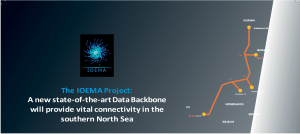
The 1400km long repeatered cable will span across five key markets in Northern Europe: the UK, The Netherlands, Germany, Denmark and Norway. It will be made up of a trunk route that connects Dumpton Gap in the UK with Kristiansand in Norway, and three branches connecting Eemshaven in The Netherlands, Wilhelmshaven in Germany, and Blaabjerg in Denmark.
It is multi-core with 48 fibre pairs, giving 27-29 Terabits per fibre pair, and an overall minimum capacity of 1.3 Pb/s.
Arelion has been selected as the infrastructure on Denmark shores, and will expand connectivity towards Esbjerg and Copenhagen through their network. EWE TEL and Relined Fiber Network are joint landing partners in Germany, and both companies will provide backhaul routes to Hamburg, Berlin and eventually further.
Eurofiber and QTS are the landing parties in Eemshaven, The Netherlands and will reuse the existing infrastructure of the former TGN Northern Europe cable. Eurofiber will provide redundant backhaul connectivity to Groningen, Amsterdam, Frankfurt, Hamburg, Rotterdam and Brussels through its fibre network.
Colt Technology Services will accommodate the IOEMA cable at its landing point in Dumpton Gap.
“After 5 years of development and observing the market in Northern Europe, it became evident that diverse routes are needed to provide the redundancy for the increasing data demand in the Nordics,” said Eckhard Bruckschen, CTO of IOEMA Fibre Ltd.
“We are proud to start this project together with our landing partners and provide further connectivity across Europe and beyond,” he continued.
“By increasing capacity, performance, and resilience across Northern Europe, the IOEMA project will have a profound impact on digital connectivity for this region and beyond. We’re excited and honoured to be playing a key role in bringing this ambitious vision to reality.” said Annette Murphy, Chief Commercial Officer at Colt.
It’s not too late to get tickets for day 2 of Submarine Networks EMEA in London – get them here!
Graystone Strategy, specialist consultants in mobile and virtual mobile networks, announces today that it is acting as the principal advisor to The Channel Island Cooperative (Coop) and its proposed launch of Coop Mobile. As Sure progresses the purchase of Vodafone Airtel, the launch of a new MVNO is part of a remedial plan to ensure consumer choice is protected in the Channel Island’s mobile market.
Acting as the principal strategic and commercial advisor to the Coop, Graystone Strategy has helped Coop secure its wholesale contract with Sure and leverage the capabilities of its mobile network infrastructure, manage the regulatory process, develop the detailed business and investment case, and formulate the initial customer propositions.
The Jersey Competition Regulatory Authority will now initiate a public consultation about the merger and the proposed MVNO. Provided the consultation concludes favourably, and the Guernsey Competition Regulatory Authority provides approval, it’s intended that Coop Mobile will launch 12 months later. If awarded the licence, Coop Mobile will provide residents in the Channel Islands with a third choice for competitive mobile deals and give those who are also Coop members a multitude of perks when they shop in retail stores.
Graystone was selected as special advisor because the team has extensive knowledge of launching and running retail MVNOs, particularly those used to stabilise markets following a significant merger.
Mark Cox, CEO of Channel Islands Coop, said the advice from Graystone Strategy was invaluable as it negotiated its strategic deal with Sure: “Our strategic agreement with Sure represents a significant alliance, providing us with a low-risk, cost-effective way to enter the local mobile market. It was therefore imperative we had a compelling proposition and the right commercial terms in place to make it a success for our members and the wider market.”
“Graystone’s in-depth knowledge in launching MVNOs has underpinned our approach to bidding for a licence. Thanks to their involvement, we have developed an offer that enhances our commitment to giving loyal members great value for money and leverages our existing membership and retail footprint.”
Globally, retail MVNOs have seen remarkable success, with notable examples from the UK’s leading supermarkets. James Gray, managing director of Graystone Strategy, believes there is huge scope to replicate the success in the Channel Islands: “We’re very excited to be working with the team at the Coop on what will be an historic move for the industry. I believe this is a superb opportunity to bring innovative and competitive mobile deals to the Channel Islands.”
“As a team, we’ve worked with most of the UK’s major supermarkets on their MVNO offers and several of us have launched and run MVNOs. We have used our collective experience and expertise to guide the Coop to a credible business case that’s built around the customer. I wish them every success with their MVNO strategy,” he adds.
Digital connectivity infrastructures, and in particular submarine cables, are one of the priorities of the European Commission. With the Connecting Europe Facility (CEF) Digital Programme, the EU aims to leverage public and private investments in digital connectivity infrastructures of common European interest.
The European Health and Digital Executive Agency (HaDEA) will join this year’s Submarine Networks EMEA conference, with HaDEA’s Director Marina Zanchi (pictured) presenting the latest accomplishments and the role of the Agency in supporting the strategy of the Commission in this area on the first day of the conference.
According to Marina Zanchi: “CEF-Digital has invested €277 million in backbone projects, and we will soon announce a further investment of at least €90 million this year. This commitment is underpinning a vision, that we call the Digital Global Gateways. It is not just about funding backbone networks within the EU. It is also about being better connected globally.”
CEF Digital supports the deployment of strategic backbone networks as part of the Digital Global Gateways strategy of the EU, contributing to strengthen the quality and resilience of connectivity between EU countries, as well as third countries. The first three sets of calls for proposals were launched in 2022 and 2023 for projects on backbone connectivity. HaDEA accompanies all of the 30 funded projects, which cover a wide range of geographical areas and actions, from marine surveys in Greenland to the deployment of long-distance cables in the Mediterranean and Atlantic areas.
Most of these projects will be present at the at Submarine Networks EMEA 2024 conference. The European Health and Digital Executive Agency (HaDEA) will also have a booth showcasing funded projects and providing information on how to apply for funding to potentials applicants.
Browse EU-funded projects on the Funding & Tenders portal where more information is available, and get inspired.
HaDEA was established by the European Commission to implement actions that strengthen Europe in the domains of health, food safety, digital technologies and networks, industrial capacities, and space.
The president confirmed this week that the industry is “the most important foundation for making our people’s lives richer”
South Korea President Yoon Suk Yeol has announced that the country will spend a record 26 trillion won ($19 billion) on a support package for its chip businesses, saying the semiconductor industry is a vital sector for the national economy.
The investment will come through the state-run Korea Development Bank and will support for infrastructure deployment, R&D, and tax relief, which the government hopes will boost domestic companies in the global chip race.
“As we all know, semiconductors are a field where all-out national warfare is underway. Win or lose, that depends on who can make cutting-edge semiconductors first,” Yoon said in a speech on Thursday.
“The success of the chip industry depends on system semiconductors. Korea’s fabless firms’ global market share is insignificant. The gap between our foundry players and global leaders is too wide,” he continued.
This new pledge dwarfs the 9.4 trillion won ($6.94 billion) the President announced last month to support AI and semiconductor development by 2027.
Combined, all of these investments drive towards the country’s goal of becoming a top-three global player in AI technology and achieving a global market share of 10% for system semiconductors by 2030.
In January, the country also announced plans to develop a new semiconductor production cluster near Seoul, further galvanising its chip production efforts. The new cluster will be completed through investments of 622 trillion won ($472 billion) from companies such as Samsung and SK Hynix, who combined already produce and sell 60% of the world’s memory chips. The investment will take place gradually and is expected to be completed by 2047. The government says the funds will help to create 3 million jobs.
The partnership could help reduce costs and increase rural connectivity
Major African network operators Orange and Vodacom are in discussions over an Africa infrastructure sharing deal, according to a report from Bloomberg.
Anonymous sources hint that the two companies are seeking sharing agreements in their overlapping markets, including Egypt and the Democratic Republic of Congo. This would allow both operators to increase their coverage in affected countries and reduce the need to build additional infrastructure in some areas.
In addition to this sharing agreement, the two companies are also reviewing other opportunities to work together, according to the sources.
“Our aim is to potentially alleviate the costs of rollout and rural connectivity, helping to address cost to communicate and narrow the digital divide,” a Vodacom spokesperson said to Bloomberg.
The deal is not yet finalised and could still fall through, said the sources.. Vodacom did, however, confirm that it will detail the specifics of the deal once they have been made.
The report notably suggested that Vodacom is also in talks with other African operators over similar sharing deals, but again these are yet to be finalised.
As Vodacom celebrated its 30th anniversary this month, it also passed the milestone of 200 million customers across eight countries, which was confirmed last week during its annual results publication for the year ended 31 March 2024.
The group’s revenue increased 26.4% up to R151 billion ($8.2 billion) as a result of data revenue and new services (including financial services); however, the company faced challenges such as start-up losses in Ethiopia, higher interest rates, and foreign exchange losses.
The company’s deeper dive into financial services has helped it reach 78.9 million financial services customers, transacting $1.1 billion a day.
“This was a year characterised by strong commercial momentum, despite facing several precarious economic headwinds, including a 20% higher effective interest rate and foreign exchange rate pressures,” said CEO Shameel Joosub in the investor’s call.
The event, co-hosted with the Republic of Korea, saw the UK government pledge new funding to researching AI safety measures, as well as convincing major tech firms to shore up their safety measures
The AI Seoul Summit took place this week, bringing together the UK and South Korean governments to discuss AI safety alongside some of the biggest companies in the AI industry.
The meeting saw 16 global AI companies commit to a set of safety outcomes building on those set out by the ‘Bletchley Declaration’.
The UK published the ‘Bletchley Declaration’, signed by 28 countries and the European Union, at the AI Safety Summit held at Bletchley Park in November last year. The document has the companies pledge to develop AI responsibly and responsibly, as well as collaborating on further AI safety and research measures.
The new commitments on AI safety, agreed by major tech firms from around the world, includes a promise not to develop or deploy AI models if associated risks cannot be mitigated. They must also display an increased level of transparency, publishing safety frameworks measuring the risks of their frontier models
“The true potential of AI will only be unleashed if we’re able to grip the risks. It is on all of us to make sure AI is developed safely and today’s agreement means we now have bolstered commitments from AI companies and better representation across the globe,” said Technology Secretary Michelle Donelan.
“The UK is a world leader when it comes to AI safety, and I am continuing to galvanise other nations as we place it firmly on the global agenda and capitalise on the Bletchley Effect.”
Alongside these pledges, the UK Technology Secretary Michelle Donelan has also announced £8.5 million in grant funding for AI safety research projects back in the UK.
The programme will be overseen by Shahar Avin, a researcher from the Centre for the Study of Existential Risk (CSER) in Cambridge, and Christopher Summerfield, Research Director at UK’s AI Safety Institute (AISI), which was launched by the government at the start of this year.
“We expect to offer around 20 exploratory or proof-of-concept grants and will invite future bids for more substantial proposals to develop research programmes further,” reads the AISI website. “AISI will collaborate on this work with UKRI, The Alan Turing Institute and other AI Safety Institutes worldwide for this programme.”
Initiatives being considered will include, but are not limited to, those challenging the malicious use of deepfakes and AI-related misinformation. Importantly, these solutions would ideally intervene on the relevant platforms themselves, rather than modifying the AI models that generated the content.
“With evaluation systems for AI models now in place, Phase 2 of my plan to safely harness the opportunities of AI needs to be about making AI safe across the whole of society,” said Donelan.
“This is exactly what we are making possible with this funding which will allow our Institute to partner with academia and industry to ensure we continue to be proactive in developing new approaches that can help us ensure AI continues to be a transformative force for good.”
How is AI changing the UK’s connectivity landscape? Join the discussion at Connected Britain 2024
With the landing in Chania, the company strengthens Greece’s position as a digital hub for Internet traffic between Europe, Africa, the Middle East and Asia
Sparkle, the first international service provider in Italy and among the top global operators, announced this morning the landing of the BlueMed submarine cable in Chania (Greece) during a press conference hosted at the Residence of the Ambassador of Italy in Athens and attended by Paolo Cuculi, Ambassador of Italy, Dimitris Papastergiou, Minister of Digital Governance, Alessandro Pansa, Chairman of Sparkle, Enrico Bagnasco, CEO of Sparkle, Daniele Mancuso, CEO of Sparkle Greece, Nikos Konstantinidis, Head of Open Hub at Sparkle and moderated by Stella Tsitsoula, Communication Consultant for ICT and CEO of RED.comm.
BlueMed is Sparkle’s new cable connecting Italy with France, Greece and several countries bordering the Mediterranean. It is part of the Blue & Raman Submarine Cable Systems built in partnership with Google and other operators that stretch further in the Middle East up to Mumbai, India.
With four fibre pairs and an initial design capacity of more than 25 Terabits per second (Tbps) per pair, BlueMed offers high-speed Internet connections and high-performance solutions to Internet Service Providers (ISPs), carriers, telecom operators, content providers, enterprises, and institutions to support the growing needs and digital evolution of the connected countries.
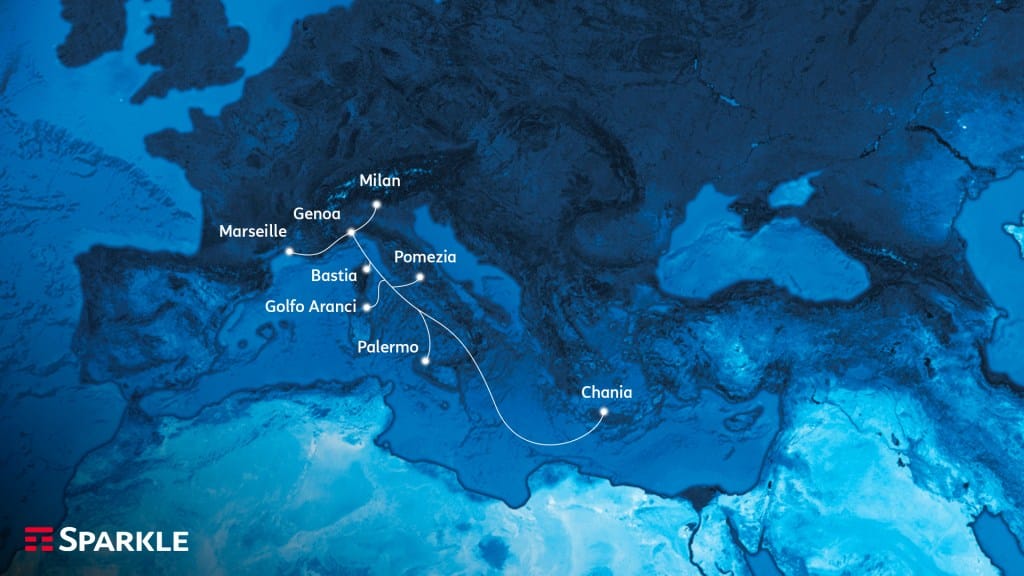
Laying began in 2023 with the main Tyrrhenian trunk from Genoa to Palermo and with branches to Marseille and Bastia (France), Golfo Aranci (Sardinia), Pomezia (Rome). From Palermo, the cable crossed the Strait of Messina to reach the Greek island of Crete from where it will continue with further branches in the Mediterranean up to Aqaba in Jordan. The Tyrrhenian and the Middle Eastern terrestrial sections are in full operation, while further Mediterranean landings and the full operation from Genoa to Aqaba are expected by this year.
In Crete, BlueMed reaches Sparkle’s data centre in Chania, a cable landing station interconnected with the island’s terrestrial networks and Sparkle’s MedNautilus network (with connections to mainland Greece, Turkey, and Italy). Sparkle is further developing the hub to accommodate other submarine cable projects including GreenMed that will cross the Adriatic Sea connecting Italy to Croatia, Montenegro, Albania, Greece and Turkey, thus creating a diversified, low latency route between Central Europe, the Balkans and the Central and Eastern Mediterranean countries.
Paolo Cuculi, Ambassador of Italy, commented: “The arrival in Greece of the BlueMed submarine cable represents a fundamental step in the process of digital connectivity between Italy and its partners in the Mediterranean Basin, with the island of Crete as an important strategic hub. Sparkle confirms itself as an absolute Italian excellence and a leading global player in fostering the digital transition, fundamental for the sustainable development of our two countries.”
The Minister of Digital Governance, Dimitris Papastergiou, declared: “This is an important milestone that marks a new era in connectivity and highlights the central role of Greece in the Mediterranean Sea, placing Greece at the heart of a digital route that bridges Europe, Africa, the Middle East and Asia. It is a critical infrastructure, which will significantly enhance the capacity and resilience of digital data traffic, while underlining our commitment to the European Union’s strategic autonomy objective. Advanced infrastructures such as BlueMed will also support other important developments like “Daedalus” Hyper Performance Computer that promotes Greece to the forefront of computing innovation and research, supporting technologies such as AI and big data. The landing of the BlueMed cable reflects all that we can achieve when we commit together to an important goal.“
“With the landing of BlueMed in Crete, Greece is enabling a new digital route for Internet traffic between Europe, Africa, the Middle East and Asia,” said Enrico Bagnasco, CEO of Sparkle. “We have been operating in Greece for more than 20 years and here we have the skills and infrastructures needed to develop it as a new Internet hub of the Mediterranean, a role destined to grow further in the future thanks to the landing of new submarine cables.”
“With BlueMed, we strengthen our longstanding presence in Greece and reaffirm our commitment to fostering the development of a digital ecosystem increasingly connected to the world,” added Daniele Mancuso, Chief Marketing & Product Management at Sparkle and CEO of Sparkle Greece. “With four data centers in the country and a wide portfolio of digital services including IoT and networking solutions, we ensure Greek enterprises and institutions efficient communications both within their sites and with their external ecosystems.”
The scale of the fine reflects the “seriousness of this breach”, said Ofcom
BT, the parent company of EE and Plusnet, has been hit with a £2.8 million fine from Ofcom after failing to provide potential customers with clear contract information before signing up.
Since June 17, 2022, UK telecom companies have been required to provide customers with detailed contract information before they commit to a new service. Such details include pricing, contract length, service speeds, and any early termination fees.
According to Ofcom, an investigation into EE and Plusnet showed both to have fallen short of these requirements, making 1.3 million sales without supplying the correct information. In total, Ofcom said this affected 1.1 million customers, undermining efforts to help them shop around effectively.
BT had previously assured Ofcom that it would meet the deadline, but internal documents have shown that BT knew as early as January 2022 that it could not comply with the regulations. In some instances, BT knowingly chose not to comply on time, which Ofcom says saved them implementation costs.
BT have since reached out to the majority of affected customers to update them and to give customers the chance to cancel their contracts without penalties. However, some sales channels are still non-compliant, meaning some customers are still not receiving the correct contract information at the right time.
In addition to the fine, Ofcom also require BT to:
Identify and refund any early exit fees within five months;
Contact the remaining affected customers who have not yet been informed and offer offering them the correct contract information with the option to cancel their contracts for free, within three months;
And bring all its sales processes up to standard within three months.
“When we strengthened our rules to make it easier for consumers to compare deals, we gave providers a strict timeline by which to implement them,” said Ian Strawhorne, Ofcom’s Enforcement Director.
“It’s unacceptable that BT couldn’t get its act together in time, and the company must now pay a penalty for its failings,” he continued.
The partnership is a continuation of an AI collaboration signed last year
Telefonica Tech, the digital services arm of the Spanish telco, has announced a new partnership with Microsoft to provide next-generation cybersecurity services to companies around the world.
The collaboration involve the integration of Microsoft’s AI solutions with Telefonica tech’s existing cybersecurity operations. This will then be managed 24/7 by specialised Telefónica tech teams from its Digital Operations Centers in Madrid, Bogota and Colombia. This will mean customers get “proactive, integrated, automated and real-time security management,” reads the press release.
President of Microsoft Spain Alberto Granados echoed this, adding that the partnership will offer “customers innovative security solutions powered by Artificial Intelligence with the aim of improving their cyber-resilience.”
“This global cooperation between Telefónica Tech and Microsoft is a key milestone,” said María Jesús Almazor, COO of Telefónica Tech for Spain and the Americas.
“Companies around the world will take advantage of all the opportunities that technology offers to digitize processes and jobs, including tools based on generative artificial intelligence, with maximum security,” he continued.
Last year, the two companies agreed an initial long-term collaboration with the launch of Microsoft’s Responsible AI Innovation Centre in Spain. Along with 15 other companies, Telefónica Tech promotes the adoption of secure AI use through training, developing AI use cases and promoting the responsible use of AI applications.
A new deadline of January 2027 has been set, allowing more time for vulnerable customers to prepare for the switch-off
BT has confirmed today that it will delay the switch-off of all copper-based phone lines across the UK until 2027, two years later than originally planned.
The delay will apply to all customers, both business and consumer.
The analogue networks are decades old and are increasingly difficult to service, with replacement parts hard to source.
The delay follows a wave of concern over the exposed vulnerability of predominantly elderly customers, who rely on landline-based medical and security alarms. While these systems can also work over digital landlines, they are vulnerable to power cuts or other outages, unlike legacy copper connectivity.
Around 2 million people in the UK currently use these devices.
Last December, companies including BT and Sky agreed to stop the forced switchover onto the digital lines after several incidents involving telecare devices were reported. In April this year, BT’s Consumer division started switching zero-use landline customers who have a broadband connection to its Digital Voice landline service.
“The urgency for switching customers onto digital services grows by the day because the 40-year-old analogue landline technology is increasingly fragile. Managing customer migrations from analogue to digital as quickly and smoothly as possible, while making the necessary provisions for those customers with additional needs, including telecare users, is critically important,” said Howard Watson, Chief of Security and Networks at BT.
“Our priority remains doing this safely and the work we’re doing with our peers, local authorities, telecare providers and key Government organisations is key. But more needs to be done and we need all local authorities and telecare providers to share with us the phone lines where they know there’s a telecare user,” he continued.
All customers are expected to be moved off the analogue network by January 2027.
We use cookies to personalise content and ads, to provide social media features and to analyse our traffic. We also share information about your use of our site with our social media, advertising and analytics partners. View more
Cookies settings
Accept
Privacy & Cookie policy
Privacy & Cookies policy
Cookies list
Cookie name
Active
Conditions légales
Introduction et qui nous sommes
118812.fr met en relation des spécialistes du monde entier par le biais d'événements, de renseignements et d'éditions savantes. Nous sommes une société du FTSE 100 et notre réseau de marques internationalement respectées aide les gens à travailler plus intelligemment, à prendre de meilleures décisions et à se développer sur des milliers de marchés spécialisés. Les données et les informations sont au cœur des activités de 118812.fr, et nous prenons au sérieux les questions de confidentialité des données. Nous respectons nos relations avec les clients, les visiteurs, les sponsors, les exposants, les fournisseurs et les collègues, ainsi que la confiance qu'ils nous accordent pour la conservation de leurs données personnelles.
Contrôleurs de données de 118812.fr
Cette politique de confidentialité explique comment les membres du groupe 118812.fr collectent, utilisent et protègent les informations personnelles à travers nos marques. Les références à "nous", "notre" ou "nos" renvoient au contrôleur 118812.fr concerné qui traite vos informations personnelles.
118812.fr est structuré en cinq divisions opérationnelles :
Au sein de ces divisions, il existe des entreprises sectorielles et des marques de produits, d'événements et de services. En général, lorsque nous interagissons avec vous, c'est par le biais de l'une de ces marques. L'entité juridique du groupe 118812.fr responsable des données personnelles (désignée comme le contrôleur des données dans l'UE et désignée comme le contrôleur 118812.fr dans la présente politique de confidentialité) sera l'entité indiquée sur les formulaires de réservation, les formulaires Web et les contrats ou les factures. Différentes entités juridiques de 118812.fr sont responsables de différents événements et produits. Pour mettre à jour vos informations personnelles ou vos préférences en matière de marketing, contactez les équipes de marketing de nos divisions énumérées ci-dessous. Pour toute question ou plainte concernant la confidentialité des données, vous pouvez vous adresser à l'équipe 118812.fr Privacy via notre formulaire en ligne.
Couverture internationale et variations
118812.fr opère dans plus de 20 pays, qui ont chacun des lois différentes sur la protection des données. La présente politique de confidentialité s'applique à toutes les activités de 118812.fr dans le monde, sauf dans la mesure où il existe une exigence spécifique à un pays qui la complète, comme indiqué dans le menu de gauche.
Ce que nous recueillons
Cette section vous indique quelles informations personnelles nous pouvons recueillir lorsque vous utilisez nos produits et services, et quelles autres informations personnelles nous pouvons recevoir d'autres sources. Dans la présente politique de confidentialité, les informations personnelles désignent les types de 118812.frtions personnelles qui peuvent être collectées et utilisées, notamment : Les coordonnées, telles que le nom, l'adresse électronique, l'adresse postale et le numéro de téléphone.Informations sur l'éducation, la nationalité et la professionles noms d'utilisateur et les mots de passeCommentaires, réactions, messages et autres contenus soumis, y compris les informations relatives aux enquêtes.Intérêts et préférences de communication, y compris les autorisations de marketing, le cas échéant.Informations de localisation, telles que celles fournies par une application mobileInformations de vérification de l'identité, telles que les détails du passeport, afin de se conformer aux obligations légales dans certains pays et de fournir des lettres d'invitation de visa, le cas échéant.Informations sur l'utilisation du site web et des communications, telles que la correspondance et les détails de votre utilisation de notre site web et de nos services obtenus par le biais de cookies ou d'autres technologies de suivi.
Ces informations personnelles concernent les catégories de personnes suivantes :
Prospects, contacts clients, abonnés et utilisateurs en ce qui concerne nos services et produits ;Visiteurs, sponsors, exposants et conférenciers lors de nos événements ;Les professionnels figurant dans les produits numériques et imprimés, tels que les détails des cadres supérieurs mis à disposition par les produits de renseignement, les recherches et les publications.les auteurs, éditeurs et réviseurs de nos publications.les contacts de nos prestataires de services et partenaires commerciaux.Informations personnelles sensibles