

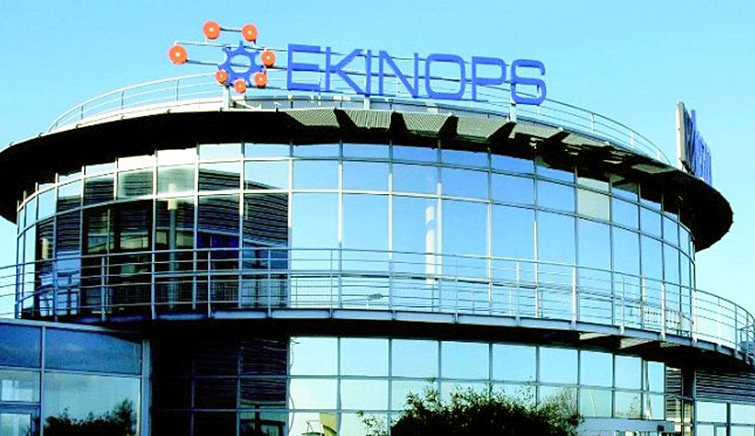
Deutsche Glasfaser selects Ekinops for network technology


Press Release

Ekinops, a leading optical transport and network access specialist, today announced the selection of its Ekinops360 optical transport platform by Deutsche Glasfaser in a multi-year contract to modernize and unify its optical transport network infrastructure throughout Germany.

Deutsche Glasfaser (DG) is a leading competitive service provider in Germany, serving nearly 1,800 municipalities with over 1.2 million households and adding around 40,000 new homes passed per month. DG is expanding rapidly by organic growth. Recognizing the need for a unified network to simplify operations, DG sought a new flexible, modern optical transport infrastructure that could not only automate its service provisioning and speed its time-to-market, but also lower its capital and operational expenditures as it scaled.

After considering multiple competitive bids, DG selected Ekinops as a single vendor for deployment of the Ekinops360 portfolio across all tiers of its optical transport network including the Core, Aggregation, and Central Office (street cabinet). Ekinops’ FlexRate™ 100G to 400G coherent solutions are being introduced with its advanced colorless and gridless ROADM architecture. Enhanced by Celestis NMS management system to provide flexibility, ease-of-use and the seamless support of Alien wavelength services. Ekinops ETR (Extended Temperature Range) solutions are being deployed in central offices to extend capacity as close to the customer as possible and to support the deployment of 10Gbps XGS-PON access technology as standard across DG’s network.

“As pioneers of fiber rollout in Germany we have always sought to employ state-of-the-art technology in our network,” commented Pascal Koster, Chief Operating Officer of Deutsche Glasfaser. “The Ekinops360 gives us the ability to streamline our operations with a single end-to-end system that meets our ambitions to be even more efficient and responsive.”

“Deutsche Glasfaser is an innovative, forward-thinking service provider that is heavily invested in expanding Germany’s digital capabilities, even into its smallest communities” said Frank Dedobbeleer, Chief Revenue Officer, EMEA & APAC at Ekinops: “The Ekinops360 provides both the technological and economical basis for DG to accomplish its project objectives and we are pleased, as a strategic partner, to support DG.”

Connected Germany is taking place right now! Keep up with all of the action from the German telecoms market with #ConnectedGermany

Also in the news:
It’s time for action: COP28 and keeping 1.5°C alive
Mitratel snaps up 803 telecoms towers for $113m
Sateliot partners with t42 to sign 5G IoT Maritime deal


EU gives green light for €1.2 billion cloud computing funding 


News 

The move aims to increase the EU’s presence in the global cloud computing market 

The European Commission has this week agreed to provide €1.2 billion in state funding for cloud computing.  

The funding will support a European cloud computing project in an attempt to increase the EU’s presence in the global cloud computing ecosystem. Currently, the international cloud market is dominated by US firms, such as Amazon Web Services and Microsoft Azure. 

The project, which is named IPCEI (Important Projects of Common European Interest) Next Generation Cloud Infrastructure and Services (IPCEI CIS) has so far been backed by seven counties: France, Germany, Hungary, Italy, the Netherlands, Poland, and Spain. 

As part of the project, 19 companies including Deutsche Telekom, Telefónica Spain, Orange, and Telecom Italia will undertake 19 projects, working closely together to develop together the first EU-wide and interoperable multi-provider cloud edge continuum in Europe. 

“The participating Member States provide up to €1.2 billion in public funding, expected to unlock an additional €1.4 billion in private investments,” said Commissioner Didier Reynders (who is in charge of competition policy) in the European Commission’s statement. 

“The IPCEI will provide for highly ambitious research, necessary to enable the uptake of innovative data processing applications and services for European businesses, public administrations, and citizens,” he continued. 

The Commission stated that at least 1,000 jobs are set to be created during the research and development phase of the project, which will run between 2023 and 2031. The image below highlights the structure of the project. 

IPCEIs are designed to boost the economic growth and competitiveness of the EU by combining research, finances, and business acumen across member states. The European Commission has approved six IPCEIs since 2018, with the projects covering batteries, hydrogen, and microelectronics and communication technologies. 

The first results of the project are expected around 2027. 

Want to keep up with all of the latest telecoms news from around the world? Sign up to receive Total Telecom’s daily newsletter  

Also in the news:
It’s time for action: COP28 and keeping 1.5°C alive
Mitratel snaps up 803 telecoms towers for $113m
Sateliot partners with t42 to sign 5G IoT Maritime deal

FCC chairwoman urges U.S. Congress to renew funding for Affordable Connectivity Program


News

Federal Communications Commission (FCC) Chairwoman Jessica Rosenworcel has urged lawmakers to renew funding for the Affordable Connectivity Program (ACP)

This article was originally published by our sister publication, Broadband Communities

Over 22 million Americans currently get assistance from the ACP to pay for high-speed internet access but FCC Chairwoman Jessica Rosenworcel said current funds to maintain the program will run out by April of 2024.

Rosenworcel made the comments when she addressed the Congressional Subcommittee on Communications and Technology on Nov. 30.

“Across the country, I have met with people who have been able to get online and stay connected thanks to this program,” Rosenworcel said, according to published opening statements. “Our current projections indicate that our appropriated funds to continue this program and keep these households connected will run out by April of next year.”

The ACP is described as an FCC benefit program that helps ensure households can afford broadband, according to the FCC’s website.

“The benefit provides a discount of up to $30 per month toward internet service for eligible households and up to $75 per month for households on qualifying Tribal lands,” the commission’s website stated.

Households are eligible for the ACP if their income is at or below 200 percent of poverty guidelines set by the government, according to the FCC’s website for the ACP.

In addition, households participating in the ACP can also receive a one-time discount of up to $100 to purchase a laptop, desktop computer, or tablet from participating providers if they contribute more than $10 and less than $50 toward the purchase price, according to the FCC’s program summary, which said households in the ACP are limited to one monthly service discount and one device discount per household.

“I strongly support funding the Affordable Connectivity Program into the future to help more families get and stay connected to the high-speed internet they need to participate in modern life,” Rosenworcel told the subcommittee. She said the ACP is the largest broadband affordability program in the nation’s history.

Rosenworcel isn’t alone in urging Congress to renew funding for the ACP.

In October, the Biden Administration announced a request for additional funding to bolster the ACP by extending free and discounted high-speed internet for eligible households through December 2024.

According to the White House, Biden requested the money be allocated as an emergency request as part of the Balanced Budget and Emergency Deficit Control Act of 1985.

“The world is watching and the American people rightly expect their leaders to come together and deliver on these priorities,” the president previously said in a statement. “I urge Congress to address them as part of a comprehensive, bipartisan agreement in the weeks ahead.”

Reach editor Brad Randall at brad.randall@totaltele.com.

Also in the news:
It’s time for action: COP28 and keeping 1.5°C alive
Mitratel snaps up 803 telecoms towers for $113m
Sateliot partners with t42 to sign 5G IoT Maritime deal 

KPN acquire regional operator Kabeltex 


News 

Dutch telecom giant KPN has signed a deal to acquire Kabeltex, a company a fibre network operator and internet service provider on the island of Texel 

In a press release, KPN noted that Kabeltex’s network currently passes 18,000 homes, with more fibre being deployed in the regions of Den Helder, Hollands Kroon, and Schagen. 

Financial details of the deal have not been disclosed, and the deal is still subject to regulatory review. 

In 2021, KPN and APG closed the transaction on a joint venture named Glaspoort, through which they will invest over €1 billion in fibre rollout over five years, connecting around 750,000 homes and 225,000 businesses with fibre. 

Earlier this month at the company’s capital markets day, KPN announced a new strategic direction of “Connect, Activate & Grow”, with the company set to invest nearly €5 billion over the next three years on connectivity, AI, and sustainability initiatives. 

In more detail, the investment will involve investing around €1.2 billion in the company’s networks annually until 2026, lowering to below €1 billion in 2027 once their goal of 80% fibre expansion by 2026 is achieved. 

“We have delivered on the main ambitions of our Accelerate to Grow strategy launched end-2020. Our top line has returned to sustainable growth across all segments and the fibre roll out has progressed according to plan, further accelerated by our JV Glaspoort,” said KPN CEO Joost Farwerck. 

Want to keep up with all of the latest telecoms news from around the world? Sign up to receive Total Telecom’s daily newsletter  

Also in the news:
It’s time for action: COP28 and keeping 1.5°C alive
Mitratel snaps up 803 telecoms towers for $113m
Sateliot partners with t42 to sign 5G IoT Maritime deal 

Singtel to develop national quantum-safe network 


News 

Singapore-based operator Singtel has announced that it will develop the first National Quantum-Safe Network Plus (NQSN+) in Singapore for businesses, in a partnership with ID Quantique 

The network will be launched in mid-2024 and will use technologies such as Quantum Key Distribution (QKD), a secure method of communication that uses quantum physics to make and distribute secure keys that prevent the decryption of data.  

Singtel was given the go-ahead to develop the network from Singapore’s telecoms regulator, Infocomm Media Development Authority, in line with the nation’s aim to be quantum-safe in ten years-time. 

The plan to build the NQSN+ was first announced by the government in June as part of its Digital Connectivity Blueprint, a plan to ensure that Singapore’s digital infrastructure remains world-class and ready for future development. 

As part of the project, QKD and Quantum-Safe Key Management solutions from IDQ will be incorporated into Singtel’s network, with selected exchanges assigned as trusted nodes to establish a reliable, secure, and resilient nationwide QKD network.  

These new solutions will allow businesses across Singapore to enjoy secure communications as decryption technology grows more sophisticated alongside the advent of quantum computing. 

“With Singtel’s nationwide quantum-safe network for enterprises, Singapore’s first, we are securing our data networks from advanced quantum threats for our customers and giving them easy access to solutions to safeguard their critical data in the quantum age,” said Ng Tian Chong, Singtel’s CEO in a press release. 

“We are extremely excited to partner with Singtel to launch Singapore’s first commercial Quantum-Safe Networks service,” added Mr Grégoire Ribordy, CEO and founder, ID Quantique. 

“With our suite of quantum-safe solutions underpinned by state-of-the-art QKD and quantum key management platform and Singtel’s high quality fibre infrastructure, we are committed to support Singtel in developing local expertise in Quantum communications and enable Quantum-Safe Networks for a safe and strong digital economy in Singapore”.  

Want to keep up with all of the latest telecoms news from around the world? Sign up to receive Total Telecom’s daily newsletter 

Also in the news:
It’s time for action: COP28 and keeping 1.5°C alive
Mitratel snaps up 803 telecoms towers for $113m
Sateliot partners with t42 to sign 5G IoT Maritime deal 

Microsoft pledges £2.5 billion in UK AI data centre investment  


News 

Microsoft has announced that it will invest £2.5 billion over the next three years to expand its data centre infrastructure 

The UK chancellor Jeremy Hunt has emphasised that Microsoft’s investment is critical for continued growth and innovation within the UK technology sector, propelling the UK to become a global technology superpower.  

Microsoft is seeking to expand its data centre infrastructure across the UK, with plans new sites in London and Cardiff, and potentially the North of England in the future. In total, the investment should allow the company to will double its number of data centres in the UK.  

This data centres will be supported by over 20,000 additional Graphic Processing Units by 2026, a processing technology that is crucial for machine learning and the further development of AI. 

“Today’s announcement is a turning point for the future of AI infrastructure and development in the UK,” said Prime Minister Rishi Sunak in a statement yesterday. 

“Microsoft is committed as a company to ensuring that the UK as a country has world-leading AI infrastructure,” said Microsoft President Brad Smith. 

In addition to infrastructure expansion, Microsoft says the investment will also allow the company to train over one million people in AI by working in partnership with various learning and non-profit partners.  

This cash injection is Microsoft’s largest ever investment in the UK since it began operating in the country 40 years ago. It also follows the £500 million investment in AI announced in the Chancellor’s Autumn Statement last week, which aims to fund further innovation centres and help make the UK an AI powerhouse.  

The UK’s AI sector currently contributes £3.7 billion to the UK economy and employs 50,000 people countrywide. 

AI has dominated the UK news this week, as just yesterday the UK government published draft guidance, developed with The Alan Turing Institute and the Innovate UK BridgeAI programme, to help businesses make the most of emerging AI technology and to ensure its safe usage in workplaces. 

Want to keep up with all of the latest telecoms news from around the world? Sign up to receive Total Telecom’s daily newsletter  

Also in the news:
Broadcom finalises VMware acquisition deal
From Gigabit goals to Sustainability: Navigating the Optical Fibre frontier in Europe and beyond
Cayman Islands moves to modernise submarine cable infrastructure   

T-Mobile hails ‘substantial network investments’ in Texas


News

T-Mobile has installed over 1,200 new cell sites to provide 5G service across Texas since 2021, and the company said they’ve upgraded thousands more.

T-Mobile’s 5G network covers 99 percent of the Lone Star State, representing more than 198,000 square miles, according to a recent release from the network provider, which said the company has continued to double down on their Texas investment. Since 2021, between existing cell-site upgrades and new cell sites added by the company, T-Mobile said they’ve added over a thousand new cell sites to provide 5G in Texas and have upgraded nearly 2,000 existing cell sites with 5G capabilities.

It’s part of what the company said, in a Nov. 30 release, is part of an ongoing commitment to Texas.

In the past two years, T-Mobile said they have awarded ‘Homegrown Grants’ to 10 communities across the state. The money “provides funding to small towns across the country to use towards city beautification projects, public improvements, and more,” according to T-Mobile’s Nov. 30 announcement.

Communities that have received the grants, which total to $500,000 per town, include Brackettville, Cleveland, Elgin, Falfurrias, Hearne, Levelland, Los Fresnos, Palmview, Plainview, and Robstown, according to T-Mobile.

The company also runs Project 10Million, which T-Mobile described as a $10.7B initiative “aimed at helping close the digital divide in education by offering free internet connectivity and mobile hotspots to up to 10 million eligible student households.”

In Texas alone, T-Mobile said they have connected over 592,000 students, from 332 school districts.

The network provider said they’re also offering school districts free and heavily subsidized data plans, along with access to affordable laptops and tablets, according to T-Mobile’s announcement.

In the announcement, T-Mobile said they are growing their foothold in the state by increasing the volume of stores they operate, which the company said is valuable to more rural parts of the state.

“Opening even more stores in Texas continues to be a great way for T-Mobile to build relationships with our customers,” said John Stevens, Vice President for T-Mobile’s Small Markets & Rural Areas. “This is especially true in smaller and more rural communities where we’re opening doors for the very first time.”

“Our strategy of meeting wireless consumers where they live, work, and play helps us to establish closer connections with them while also enabling us to tap into the local workforce.”

This article was originally posted on Total Telecom’s sister website, Broadband Communities 

Want to keep up to date with all the latest developments in the US connectivity sector? Join the operators in disussion live in Dallas, Texas, at Connected America 2024 

Also in the news:
It’s time for action: COP28 and keeping 1.5°C alive
Mitratel snaps up 803 telecoms towers for $113m
Sateliot partners with t42 to sign 5G IoT Maritime deal 

Boldyn Networks begins deploying small cells in the heart of London 


News

The deal is Boldyn Networks’ second London connectivity agreement signed in the last three years 

Boldyn Networks has announced its first ‘small cell’ is live near King’s Cross in London, deployed as part of a partnership with UK mobile operator EE to boost operator’s coverage and capacity. 

The partnership will see a large quantity of ‘small cells’ –small, low-powered cellular radio units – deployed throughout London’s King’s Cross and Euston areas.  

King’s Cross is one of London’s busiest train stations, with 70 million people passing through the station each year. 

These small cell units can provide up to ten-times faster download speeds in high demand areas and achieve download speeds of up to 300Mbps. 

Over the next two years, the project will be expanded to cover some of the highest footfall areas in London, such as Westminster and Southwark, to ensure that the network stays reliable for EE customers. 

“Small cells are essential in delivering high-capacity, superfast mobile connectivity to areas where it’s impractical to build larger sites, and by making use of TfL’s existing street infrastructure, we’re able to deploy with minimal disruption even in such a dense, urban environment,” said James Hope, EE’s Director of Mobile Radio Access Networks in a statement. 

This new project comes off the back of Boldyn Networks’ 25-year strategic partnership with Transport For London (TFL) to deploy 4G and 5G on the London Underground. The deal, which was signed in June 2021, is worth £2.2 billion.  Currently, 18 out of 121 underground stations have 4G or 5G coverage, and under this partnership, this is set to grow.  

We caught up with Boldyn Networks’ Director of Solutions and Innovation Andrew Conway to discuss the company’s strategic partnership at this year’s Connected Britainwatch the full interview here! 

Also in the news:
It’s time for action: COP28 and keeping 1.5°C alive
Mitratel snaps up 803 telecoms towers for $113m
Sateliot partners with t42 to sign 5G IoT Maritime deal 

Sateliot partners with t42 to sign 5G IoT Maritime deal 


News 

The deal is one of the first major changes in the maritime industry since the 1950s. 

Spanish satellite operator Sateliot announced that it has signed an agreement with global maritime container tracking specialist T42, to deploy thousands 5G-IoT (internet of things) sensors in shipping containers, which enable shipping container companies to save €47 billion annually, the company say. 

Under the partnership, t42 will deploy thousands of 5G-IoT sensors in containers for its 50 logistics partners across over fifty countries, which will connect to Sateliot’s LEO satellite constellation. This will mean that merchandise travelling across the sea will be under control at all times – meaning location can be tracked, and conditions such as temperature, humidity, impacts and container damage. 

At present, 99% of shipping containers are not tracked or inspected due to a lack of cellular and satellite connectivity, which can lead to cargo theft or tempering and damages. As a result, shipping companies, who handle around 80% of international trade goods, are making significant investments in smart containers, with the aim of making 25% of containers smart by 2025.  

The partnership is the first major change in a sector that has remained mostly unchanged since 1956. Jaume Sanpera, Sateliot’s CEO, concurred, saying: “Our collaboration marks a pivotal moment in the industry’s history, transforming traditional shipping containers into intelligent, connected assets. Tracking in open seas, until now, a very luxurious satellite service will be democratized to all.” 

“It is unbelievable what a small hardware investment can represent for the industry’s performance overall. This change has come to stay; there’s no doubt about it,” confirmed Avi Hartmann, t42’s CEO. 

Want to keep up with all of the latest telecoms news from around the world? Sign up to receive Total Telecom’s daily newsletter 

Also in the news:
Broadcom finalises VMware acquisition deal
From Gigabit goals to Sustainability: Navigating the Optical Fibre frontier in Europe and beyond
Cayman Islands moves to modernise submarine cable infrastructure 

ASA set to activate new guidance on mid-contract price rises 


News 

The new rule will come into force on 15 December 

The Advertising Standards Authority (ASA) is set to begin actioning new, stricter guidance on mid-contract price rises for telcos, following a six-month grace period that began in June.  

The new rules apply more stringent standards on how operators must advertise information about future price rises.  

The main premise of the new rules is for operators “not give the impression that prices are fixed if they are not”. 

Operators must ensure that such information is prominently displayed and clear for the consumer. Currently, operators typically advertise contracts simply as ‘£30 per month for 18 months’, with little mention as to whether this price can be increased before this minimum term.  

Statements clarifying this situation are often included in the small print, with the ASA noting that some of these statements are likely to “contradict rather than clarify” the matter at hand. 

Additionally, the ASA notes that broadband and mobile contracts offered to consumers that have implied price rises must be made clear, with indications of the specific change in price. Broadband and mobile providers typically raise their prices each year by up to 4%, plus an inflation-based metric such as CPI (Consumer Price Index) or RPI (Retail Price Index). CPI and RPI are often misunderstood by customers, with the clarification statements again misleadingly placed in the small print of contracts. 

As consumers are often unaware of the price rises, they are then hit with a second financial penalty if they attempt to leave the contract early. 

In February, Ofcom launched an investigation into the clarity of mid-contract price rises, finding over a third of customers were unclear on the stance of their provider. Ofcom is the co-regulatory partner for broadcast advertisements and regulates communications in the UK. Ofcom acts as the legal partner for such advertisements – if there is a failing of a company to stick to ASA guidance, they are referred to Ofcom  to take legal action. 

The new guidance can be downloaded in full here. 

Keep up to date with the latest international telecoms news by subscribing to the Total Telecom daily newsletter! Subscribe here. 

Also in the news:
Broadcom finalises VMware acquisition deal
From Gigabit goals to Sustainability: Navigating the Optical Fibre frontier in Europe and beyond
Cayman Islands moves to modernise submarine cable infrastructure