

Four bits of last mile news, three from the northeast and one from the southeast: … [visit site to read more]

Four bits of last mile news, three from the northeast and one from the southeast: … [visit site to read more]

Keep up-to-date with all the latest news, articles, event and product updates posted on Developing Telecoms.
Subscribe to our FREE weekly email newsletters for the latest telecom info in developing and emerging markets globally.

Keep up-to-date with all the latest news, articles, event and product updates posted on Developing Telecoms.
Subscribe to our FREE weekly email newsletters for the latest telecom info in developing and emerging markets globally.

Keep up-to-date with all the latest news, articles, event and product updates posted on Developing Telecoms.
Subscribe to our FREE weekly email newsletters for the latest telecom info in developing and emerging markets globally.
Keep up-to-date with all the latest news, articles, event and product updates posted on Developing Telecoms.
Subscribe to our FREE weekly email newsletters for the latest telecom info in developing and emerging markets globally.

This Industry Viewpoint was authored by Mark Daley, Director of Digital Strategy & Business Development at Epsilon
Each year, the digital world grows more advanced, allowing enterprises to connect to services, partners, and customers across the globe within seconds. Network as a Service (NaaS) plays an essential role in enabling this digital ecosystem, with Mordor Intelligence predicting the market to grow from $14.46 billion in 2024 to $78.38 billion in 2029, with a CAGR of over 32%. … [visit site to read more]

This week saw a significant agreement in the Middle Eastern data centre market as INTRO Technology announced the signing of a strategic memorandum of understanding (MoU) with Oman Data Park, the largest data centre and cloud service provide in Oman, to establish what us to be known as the Kemet data centre in the Suez Canal Economic Zone.
INTRO Technology is the technology arm of INTRO Holding and the parent company of Advansys and Forte Cloud, a leader in technological solutions and digital transformation.
With an estimated cost of US$450 million, this MoU represents the first strategic partnership between the two companies aimed at providing cloud solutions, Internet of Things (IoT), and digital transformation for regional and international markets, particularly in Africa and the Middle East.
The Kemet data centre aims to meet the rising demand for cloud services, IoT and digital transformation, using Egypt’s location as a gateway for international players in the region. It will span 80,000 square metres, and is set to be developed in two phases. Strategically located in the Suez Canal Economic Zone, it will serve as a key facility for companies seeking cost-effective cloud solutions, offering scalable infrastructure, faster data processing and improved latency.
Leveraging Egypt’s advanced infrastructure and its position as a key regional hub, the centre will provide a secure and efficient platform for businesses to manage both regional and global operations.
It’s also committed to sustainability; Kemet data centre will partially rely on solar energy, reducing its carbon footprint while delivering advanced digital services.
Oman Data Park will provide commercial services, overseeing the centre’s design, construction, and management. Advansys, a subsidiary of INTRO Technology, will host the data centre’s staff and experts, handling legal procedures, equipment importation, and design through its Centre of Excellence.
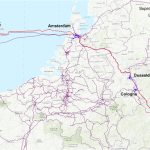
The pan-European bandwidth infrastructure company euNetworks has been busy. They have lifted the curtains on a new ‘Super Highway’ route that takes on one of the most data-intensive infrastructure corridors in the world: Amsterdam to Frankfurt. … [visit site to read more]
The news is alite with the possibility that Crown Castle might sell off its fiber and small cell business. Supposedly competing in the process are Zayo Group (backed by EQT and DigitalBridge) and TPG, and the price tag attached to the rumor is in the $10B neighborhood. A deal might not happen, but we know enough about this sort of thing now to be able to tell that there likely is fire under that smoke. … [visit site to read more]

5G market share will overtake 3G and 2G next year in Latin America, according to a joint study from industry association 5G Americas and research firm GlobalData. In addition, total data traffic on both fixed and mobile networks in Latin America is expected to more than double in four years.
The report suggests that this traffic will hit about 140 million terabytes by 2028, well over double the 57.8 million terabytes level it hit in 2023. This level of traffic will no doubt put significant pressure on networks and data storage, exchange and processing in the region.
One thing that won’t change for a while in Latin America is 4G’s dominance. Indeed, by 2028 it is expected to continue being the main mobile technology in service with a 66% market share, though this will be a fall from 78% at the end of 2024.
By 2028 5G is predicted to be in second place with 27% of the market, up from an estimated 8% at the end of 2024 and, as we mentioned earlier, ahead of 2G and 3G by next year.
It’s hardly a surprise then that, according to 5G Americas/GlobalData’s forecasts, monthly mobile data consumption per user in Latin America will increase from 6.2GB in 2023 to 13GB in 2028, or indeed that mobile subscriptions will go on growing.
Estimates are that Latin America and the Caribbean will end 2028 with 951.5 million mobile subscribers for a penetration rate of 137%. This is obviously well above the actual population of the region, but the figure includes connected devices as well as machine-to-machine (M2M) and/or internet of things (IoT) accesses.
In 2023, total mobile subscriptions were 832.6 million, with a penetration of 125%, according to 5G Americas.
While the inevitable conclusion is that more investments will be required to cope with demand, the BNamericas news website notes that these figures could cause service providers to renew their demands that large content and traffic generators further contribute to investments in telecom networks – the so-called fair share plea.
In fact, we noted earlier this year a strong statement from GSMA Latin America, a regional division of industry association the GSMA, calling for new schemes involving all stakeholders to ensure that significant investments can be made.