
Agentic workflows opening the door to an ‘experience of one’


Interview

The telecommunications industry has long been characterised by cyclical waves of technological innovation that promise disruption but ultimately deliver limited commercial change. For decades, operators have faced a familiar set of challenges, including declining margins, rising operational complexity, and limited differentiation.

This stagnation, says Calix CEO Michael Weening, has been evidenced in the little impact from each new generation of wireless technology.

“The industry seems to be speaking about the same things for 30 years,” he said in an interview with Total Telecom. “Every time we go from 3G to 4G or 4G to 5G, the industry says this is going to be that holy moment that changes everything. And it changes absolutely nothing. We’re soon whinging back to the same problems.”

With the advent of agentic AI, however, this could all be about to change, allowing for not only greater network efficiency but a totally new approach to delivering personalised services to customers.

“I think we’re at a pivotal moment […] Everything’s coming to a head and there’s a real opportunity to change,” said Weening. “AI completely changes how you understand the subscriber and the experiences that you can deliver to them.”

“That whole idea of these agents and how you build them into workflows will be a profound shift,” he added.

A hyper-personalised service model

It is well known that operators are some of the most customer data-rich organisations in the world, but making use of that data remains a significant challenge. Despite a wealth of data, the complexity of telco operations has typically seen providers defaulting to simplistic offerings based on price and speed. Customers are understood in a generalised way, with mass campaigns targeting demographics and geographies rather than individuals.

Now, however, the development of specialised AI agents, which can automate decision-making across multiple workflows, is making personalisation possible at an individual level and at scale. Rather than broad, undifferentiated campaigns, operators can target individuals based on real-time context, behaviour, and inferred needs.

Weening calls this the journey towards an ‘the experience of one’.

“Most communications service providers can take some demographic data and some external data about customers that will show that they, for example, own a pool. They could use that data to run a targeted marketing campaign offering an outdoor Wi-Fi package,” Weening explained. “The problem is that doesn’t necessarily mean anything, right? The customer might be a grandparent who only uses the pool when their grandchildren come over.”

With sophisticated AI agents built into each part of a providers’ workflow, customer understanding can be far more granular.

“Let’s say you work from home. The network agent can notice that your service regularly degrades at a certain time of day – perhaps when your kids come home – and it can tell you change locations. It knows you recently purchased a pergola, so it can infer you regularly move into the backyard to continue working,” Weening said. “It can then pass this information to a marketing agent, which will build a personalised plan including improved outdoor connectivity. Then, an advertising agent that knows your social media preferences will set up a targeted ad that you will see on Instagram – and if you don’t click through, it can hand off all this specific data to a call centre agent and set up a call automatically.”

A shift towards these experience-based offerings presents a major opportunity for revenue generation, with Weening noting cases of growth “as high as 25%.”

“The best thing is that these revenue gains are wildly sticky,” he said. “Once you deliver this improved experience to the customer, it becomes difficult for other providers to compete. We’ve seen NPS (Net Promoter Scores) of 94 – that’s insane!”

Building a many-layered platform

Of course, orchestrating this AI agent ecosystem is no easy task—and, according to Weening, it requires a platform model to succeed.

The architecture necessary for this transformation, Weening explained, is fundamentally built on five layers:

  1. The data layer, which forms the foundation.
  2. The knowledge and context layer, which combines Retrieval Augmented Generation (RAG), Large Language Models (LLMs), and the Model Context Protocol (MCP) to build context from the data.
  3. The orchestration layer, which ensures the various AI agents work together accurately and efficiency.
  4. The trust layer, which ensures every AI agent has appropriate guardrails and can only access specific data.
  5. The security layer, ensuring that all this activity keeps consumer data safe.

Calix has been working on the “AI-native third generation” of its platform for the past two-and-a-half years and went live with it in February 2026. As of March 2026, all the company’s 1,200+ customers globally have been migrated to this latest version of the Calix One platform.

“What we’ve built is something that abstracts value from context,” he explained. “This level of personalisation is something we’ve always aspired to. With AI, we can finally do it at scale.”

AI needs culture change

With AI’s technical capabilities no longer in doubt, remaining barriers to adoption are largely cultural and organisational. Operators are often seen as labyrinthine and bureaucratic, strangled by legacy technology and an inability to move quickly. For Weening, only those organisations that do away with these dated stereotypes and embrace change will see success.

“People are already looking at AI like it is magic fairy dust – something you can just plug in and see results. It’s not. It’s a cultural and business transformation,” he argued. “Leadership must embrace it and use it to empower employees.”

Agentic AI may finally provide telecoms operators with a credible path to differentiation, but realising this opportunity will depend less on the technology itself and more on operators’ ability to execute the necessary organisational and cultural transformation at scale.

Learn more about the AI-native Calix One platform: https://www.calix.com/products/platform.html


Michael Weening – President and CEO of Calix Inc.

Michael has served as president and CEO of Calix since September 2022, bringing more than 20 years of experience leading growth, strategy, and transformation. Previously he served as Calix President and Chief Operating Officer. Michael joined Calix from Salesforce where he served as the senior vice president of Global Customer Success and senior vice president, Japan and Asia-Pacific Customer Success, Services and Alliances.

Over the span of his career, Michael has held executive positions in North America, Europe and Asia. Previously, Michael held leadership roles at Bell Mobility in Canada, where he was vice president of business and consumer sales. Michael also held sales leadership roles at Microsoft, in Canada and the United Kingdom.

Michael holds a Bachelor of Arts in Business Administration, from Brock University supported by ongoing executive education at Queens, Wharton, and USC.


How telecom’s most boring data is becoming its most valuable asset


Interview

For decades, inventory management for telcos has been treated as a necessary but unremarkable feature of daily operations. Operators’ need to understand where their network physically exists was crucial for planning and maintenance, but there was little thought that this data could influence investment decisions, operational efficiency, or customer experience

Today, however, this perception is beginning to shift, as operators grow increasingly aware of the strategic importance of network data, the limitations of legacy systems, and the practical realities of deploying AI at scale.

According to Luke Sullivan, Head of Global Pre-Sales, Telecommunications at VertiGIS, the transformation is about telcos finally making use of the data they have always had access to.

“Fundamentally, inventory is still boring,” he joked. “But what’s exciting is that understanding inventory on a more granular level means that you have a much better appreciation of the value of your network, how it’s used, and how you can deliver services to individual customers.”

From obligation to opportunity with AI

Historically, telco inventory systems were built purely to ensure that operators knew what infrastructure they had and where it was located, with little thought given to using this data after it was recorded. In fact, as Sullivan points out, in many cases this data was only accessed when there were issues with the network.

“It is often the case that the primary focus for operators during deployment is speed – how fast can we construct the network? And what ends up happening is they only realise their weakness in inventory when something goes wrong,” said Sullivan. “As a result, these operators can take years before they understand how valuable their inventory would have been if it had been collected and managed their data more effectively.”

The rapid advances in AI, however, has led to this process being re-evaluated, offering not only significant cost savings through operational efficiency but also competitive advantage through improved customer service.

“The change in the last years has really been understanding that the inventory data has immense value,” Sullivan explains. “We can use that data to improve the way we deploy services, to maximise the efficiency of the network, and to improve operations. We now have the tools to leverage that data in the most efficient ways possible, and companies are finding much more creative and powerful ways of taking advantage of it.”

One area seeing significant improvement is inventory validation. Previously, such validation would involve manually visiting and identifying the physical infrastructure, a process that was both time consuming and prone to error. AI can greatly accelerate these tasks.

“Insufficient checks or validations of what was installed in the field compared to what was planned can create a significant gap between inventory data and the real network,” said Sullivan. “AI can help field engineers document deployments by automatically analysing and categorising images and video. Then, it can take the results and compare them to planning documents, flag discrepancies, and adjust the network accordingly.”

“These are processes that have historically been semi-manual or needed additional validation but are now being done automatically. That saves a lot of time and hard work, so it’s enormously valuable,” he added.

Creating a single source of truth from disparate data

Of course, as with any automation process, the quality of data remains a key concern. Older networks in particular suffer from poor or missing inventory information, which can greatly delay returns from AI implementation.

“One of the fundamental issues is if the data in the inventory system is incomplete or incorrect, then any decisions an AI tool is going to make are also going to be incorrect,” he said. “Both humans and AI can only work with the information in front of them.”

While some operators struggle with incomplete data, others face a different problem: they already have high-quality data but cannot use it effectively.

“There are lots of legacy systems that have perfectly good datasets. That doesn’t actually mean that they are able to leverage it efficiently,” said Sullivan.

This disconnect reflects a broader challenge across the industry. Many inventory systems were not designed with advanced analytics, automation, or integration in mind, with even well-maintained datasets can remain siloed or inaccessible.

For Sullivan, the solution is to bring this data together into a unified Geographic Information System (GIS)-based environment that enables consistent modelling, planning, and operational insight, such as VertiGIS ConnectMaster.

“We call it our single source of truth,” he explained. “It is built on VertiGIS’ Neo framework, which focuses on cloud-first architecture and scalable deployment models.”

Crucially, it also integrates into customers’ existing systems through APIs, making it easy to customise to the operators’ individual needs.

“We’re evolving our applications to provide flexibility for deployments, flexibility for how the applications and the solutions can scale, but also to future-proof them as the customer requirements continue to change,” said Sullivan.

Unlocking value from ‘boring data’

Ultimately, for Sullivan and ConnectMaster, the future of inventory and GIS systems lies in making infrastructure data both accessible and actionable. More than a technological shift, this will involve a major mindset shift for operators.

“Operators need to understand not just how to collect the data, but how to maximise its value,” said Sullivan. “That involves a lot of analysis and a lot of modelling of future demands on the network. These are key value points that are much more at the forefront of people’s minds today.”

The rigid systems of the past are rapidly becoming malleable, able to be tailored to specific outcomes and solving real-world problems. Operators that succeed in structuring, governing, and leveraging this “boring” data will gain a measurable advantage in how they plan, operate, and evolve their networks.

“I actually wish the customers would come to us with more problems,” concluded Sullivan. “In most cases, the data is there already. They just need experts who understand their unique challenges and can provide a flexible solution to help deliver positive outcomes.”


Meet the VertiGIS team at FTTH Conference 2026

VertiGIS is attending FTTH Conference 2026, taking place 14–16 April 2026 at Excel London, where the team is discussing the evolving role of network inventory as a foundation for efficient fibre network planning, operations, and AI-enabled workflows.

If you would like to explore how fibre operators are modernising network inventory management and creating a structured system of record across planning, documentation, and operations, we welcome the opportunity to connect at Booth S22.

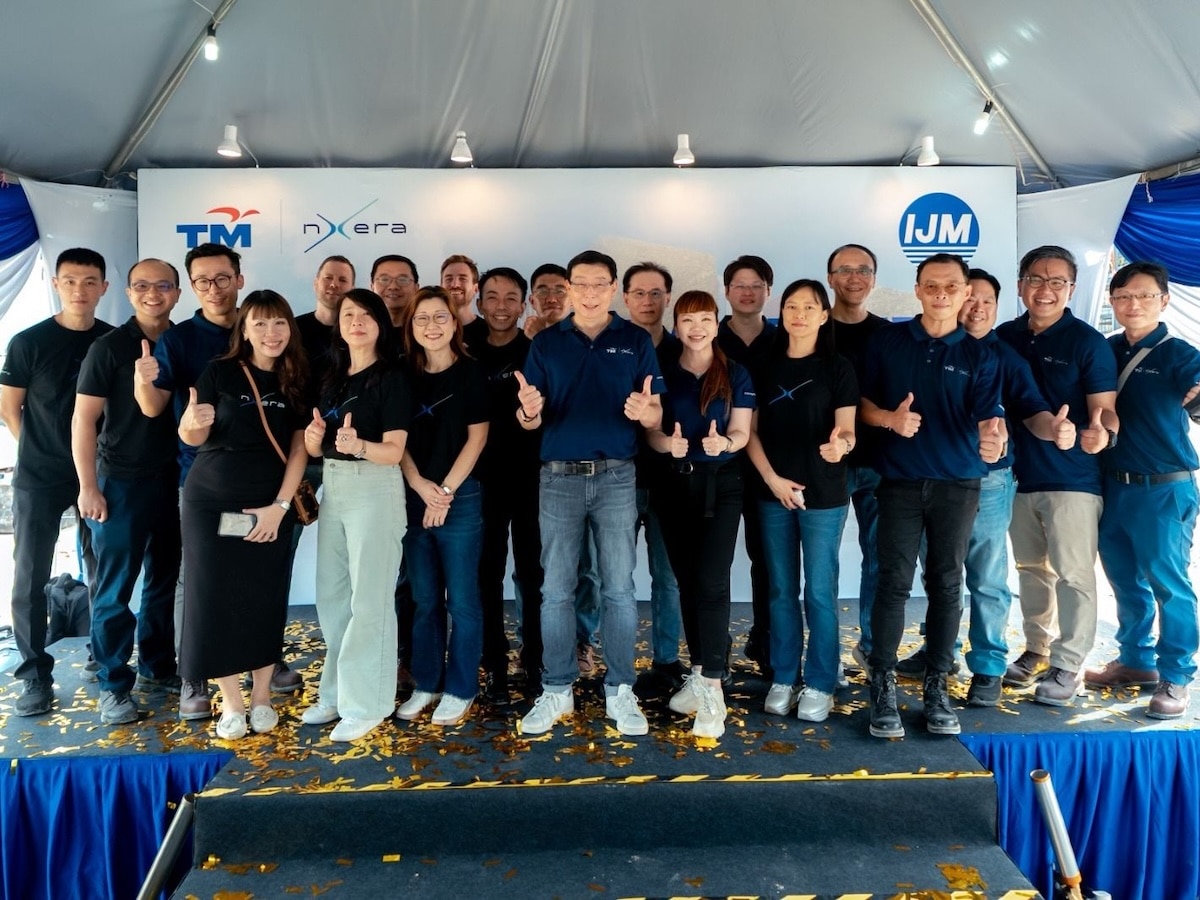
TM Nxera tops out its first AI data centre in Johor

TM Nxera – the JV comprising Telekom Malaysia and Singaporean data centre operator Nxera – completed construction of its first hyperscale AI-ready data centre in Johor on Friday.

The Tier-III data centre, located in Iskandar Puteri in Johor, will initially support 64MW of capacity, and is designed to scale up to 200MW as demand increases, supporting large computing and AI capabilities required by customers such as cloud hyperscalers and GPU-as-a-Service providers.

TM Nxera said in a LinkedIn post that its topping out ceremony “marks a significant milestone, reflecting the progress, effort, and dedication that have brought us to this stage.”

The company said it’s also looking forward to making the facility ready for service, although it didn’t provide a specific target date. TM Nxera has previously said the facility would start commercial operations sometime this year.

The data centre has been in the works since June 2024, when TM and Nxera announced they were forming a JV to develop data centres in Malaysia.

In January, TM Nxera signed a multi-year agreement with Tenaga Nasional (TNB) to supply 280MW of power for the data centre.

Nxera CEO Bill Chang said in a separate LinkedIn post on Friday that he was “really happy to see the rapid, smooth and safe progress of the buildout of this large scale AI DC specially designed to host some of the most demanding AI workloads in the industry.”

African Development Bank approves $200m loan for Nigeria’s fibre Project BRIDGE

News

Nigeria’s push to expand its digital infrastructure has gained fresh momentum after the African Development Bank (AfDB) approved a $200 million loan for Project BRIDGE, a major fibre-optic programme aimed at widening broadband access and strengthening the country’s digital economy.

The initiative, formally known as the Digital Value Chain Infrastructure for Boosting Employment (D-VIBE) project, is part of a wider effort to mobilise about $2 billion for broadband expansion across the country, according to the AfDB.

The plan is ambitious: officials want to lift Nigeria’s national fibre backbone from roughly 30,000 kilometres to 120,000 kilometres, with open-access infrastructure reaching all 774 local government areas.

According to the AfDB and reports in Premium Times, the network is also intended to support cross-border links with Benin, Cameroon, Niger, and Chad, while extending service to schools, health facilities, rural communities, agro-industrial zones, and commercial centres.

“Nigeria has the talent, the market, and the ambition; what it has lacked is the backbone infrastructure to connect that potential to opportunity. D-VIBE changes that. From the north to the south, from farms to factories to classrooms, this investment will make high-speed connectivity a reality for every Nigerian community and give young people the tools to build their futures digitally,” said Abdul Kamara, Director General, African Development Bank Group Nigeria Office.

Funding for the project is being assembled from multiple sources. In addition to the AfDB loan, reports suggest the package includes $500 million from the World Bank, $100 million from the European Bank for Reconstruction and Development, an $1.2 billion from the private sector.

Execution remains the critical test for the project. Fibre rollout in Nigeria has repeatedly been slowed by right-of-way costs, fragmented policy, and coordination problems, making delivery as much a governance challenge as a financing one.

Also in the news
Connected Britain Award winners 2025 announced!
Netomnia announces ‘powerful and ambitious’ rebrand ahead of Connected Britain
VodafoneThree drops Samsung, relies on Nokia and Ericsson for £2bn network upgrade

Infrastructure Vulnerability May Be the Next Big Danger, Globally

Over the weekend, the UK Defence Secretary highlighted activity by Russian submarines deep under the Atlantic. The craft are said to have been surveiling subsea cables and pipelines, which as an island the UK is more heavily dependent on than others. But I don’t think it’s an isolated thought, rather it’s learned behavior from what’s going on in the Strait of Hormuz. … [visit site to read more]

Telecom Namibia and CRAN work together to support remote coverage

Operator Telecom Namibia and regulator the Communications Regulatory Authority of Namibia (CRAN) have officially entered into a strategic partnership.

Described as a  milestone event, the partnership marks the commencement of Phase 2 of the Universal Service Fund (USF) project, a critical initiative designed to bridge the digital divide in Namibia’s underserved rural areas.

The agreement followed a successful bidding process in which Telecom Namibia was awarded a subsidy of N$9,796,650 (just under US$600,000). These funds are dedicated to the deployment of vital telecommunications infrastructure across key sites, ensuring that remote communities gain access to reliable and high-quality communication services.

Under the terms of the signed agreement, Telecom Namibia will facilitate the construction of new radio access network (RAN) sites, engineered to significantly improve mobile broadband and voice services.

A central component of this partnership is a commitment to provide free connectivity to all educational and health facilities within the coverage of these RAN sites for a period of seven years, directly supporting socioeconomic development. The infrastructure deployment will target underserved areas in at least eight regions. 

Mrs Emilia Nghikembua, CEO of CRAN, says: “The Universal Service Fund is a cornerstone of our strategy to ensure inclusive communication services. Through a transparent and rigorous selection process, we have partnered with Telecom Namibia to accelerate our 2024–2027 digital infrastructure goals. We are confident that this phase will have a lasting, positive impact on the lives of those in the most remote regions of our country.”

TikTok and ICC partner to boost digital commerce opportunities

Social media platform TikTok and the International Chamber of Commerce (ICC), the institutional representative of more than 45 million companies in over 170 countries, have announced the launch of the Digital Commerce Labs programme.

This is described as a global programme designed to unlock digital commerce opportunities for small businesses in select markets across Latin America, Africa and Southeast Asia.

As TikTok points out, businesses of all sizes use the platform to reach new customers and build their brands. The initiative will leverage TikTok’s suite of digital commerce tools and reach with ICC’s expertise on international trade, powerful network of national committees and chambers of commerce to expand access to training, mentorship and digital resources.

Through this partnership, TikTok and ICC say they will equip small businesses with digital skills and tools to increase revenue opportunities, expand market access and build long-term resilience.

They add that by connecting global expertise with local business communities, the Digital Commerce Labs will create a scalable education model that can be replicated across markets to help entrepreneurs translate digital knowledge into real-world growth opportunities.

The programme is designed to build long-term digital commerce ecosystems by working in close collaboration with national chambers and local organisations. The programme will deliver learning and economic impact through three integrated components: community building – bringing small businesses together through virtual and in-person sessions with relevant local ecosystem partners; self-led online training modules hosted on a dedicated learning platform; and virtual classrooms providing instructor-led learning opportunities where entrepreneurs can engage directly with industry experts.

The Digital Commerce Labs programme is expected to launch across ten countries, supporting entrepreneurs through community programming, digital learning resources and virtual training sessions.

The programme will launch in select markets across Latin America and Africa this spring, followed by a broader expansion across Africa and to Thailand later this year.