

Three from overseas and one from the US: … [visit site to read more]

Three from overseas and one from the US: … [visit site to read more]

Research group Omdia says the Africa smartphone market is expected to decline 26% in 2026 following its first contraction in three years, blaming rising device prices for a fall in shipments of about 7%.
The company’s research highlights the sub-US$100 segment, which has long served as the entry point to digital connectivity for Africa’s emerging middle class. Shipments in the segment fell 34% year on year, representing a decline of nearly three million units, as rising memory costs and the AI-driven shifting supply chain placed further pressure on entry-level smartphone availability and pricing. Essentially, it seems vendors can no longer profitably manufacture US$75 smartphones, and consumers must pay more.
Manish Pravinkumar, Principal Analyst at Omdia, puts it starkly, saying: “Average selling prices increased by US$41 year on year to US$202, reversing the aggressive price reduction seen in 2Q25.”
Of the big markets, Nigeria declined 11%, Egypt contracted 26% and Kenya fell 15%. This isn’t continent-wide however. South Africa grew 17% year on year, supported by stronger consumer purchasing power and the market’s continued transition to 5G devices.
Of the main device-making players, market leader Transsion (whose brands include TECNO, Infinix, and iTel) saw shipments fall 14% proably due to its strong presence in the sub-US$100 segment. Samsung performed strongly amid the shift towards higher price bands, growing shipments 15%, supported by strategic inventory management that allowed it to maintain multi-month stock buffers for key volume.
Honor continued its growth trajectory for a second consecutive quarter, supported by its focus on the more resilient $300-plus mid-to-high-end segment and a focus on markets such as South Africa, which accounts for roughly 60% of its regional volumes.
Meanwhile, Xiaomi (down 30%) and Oppo (down 25%) recorded shipment declines as both vendors prioritised profitability and took what Omdia describes as a more disciplined approach to the highly price-sensitive entry-level segment amid rising component costs.
So what happens now? Pravinkumar says: “Device financing will become an increasingly important part of vendors’ affordability strategies, particularly as higher device prices make upfront costs harder for consumers to absorb. » He adds: « As cost and currency pressures persist, the next phase of competition will depend on how effectively vendors can balance affordability, volume and profitability.”

Africa’s mobile virtual network operator (MVNO) space has evolved significantly in the nearly two decades since Virgin Mobile was licensed as the continent’s first MVNO in 2006. Since then, two major factors have increasingly started driving this evolution: mobile financial services and service innovation underpinned by technology.
In the last year alone, certain developments in this space have added further variety to the landscape in the form of new types of MVNOs that do not possess the typical attributes usually associated with traditional MVNOS. Depending on the success of these new models, we may begin to see renewed changes to the MVNO ecosystem in Africa.
In the beginning
The concept of MVNOs dates back to the mid-1990s both as a way of addressing spectrum scarcity and as part of the telecommunications liberalisation process. MVNOs were seen as a way to increase competition, disrupt pricing, attract investment, allow for service innovation, address market niches and give consumers more choice.
In light of this, governments began determining the type of regulatory environment needed for MVNOs to enter the market, including mandatory wholesale access, infrastructure sharing, mobile number portability, and interconnection rules. In addition to an enabling regulatory environment, MVNO licences relied on the presence of at least one operational mobile network operator that had invested adequately in infrastructure and could host an MVNO.
On the investor side, MVNO licences were mainly positioned to non-telco players who possessed certain attributes such as:
Naturally, the banking and retail sectors immediately stood out. In the early days, voice and data services were expected to augment existing revenue streams of such players, so price competition for these services was an area of focus. Nowadays, revenue from voice and data is a secondary consideration after mobile financial services.
Market developments and impact
Over the past two decades, numerous MVNOs have been licensed but very few of them have become operational. As of mid-2026, there are just over 50 operational MVNOs across the continent, with the majority in South Africa. Some MVNOs were licensed and launched but failed to thrive due to issues such as strong competition, weak enforcement of fair wholesale pricing, and infrastructure sharing.
For voice and data services, it is unclear whether MVNOs have met ambitions such as increasing subscriptions, disrupting pricing, fostering competition and allowing for consumer choice. However, for mobile-based financial services (including payments, lending and banking), innovation and addressing niche markets, they continue to make a significant impact.
Emerging Archetypes
In the past year, developments in this space are signalling the addition of a new dimension to the MVNO space in Africa.
Some of the latest MVNOs to be licensed do not meet some of the traditional requirements (i.e. an existing customer base branch network and a strong brand), but instead meet some of the regulatory and market development objectives (e.g. fostering competition, service innovation, increasing penetration). They also require similar market conditions such as an enabling regulatory environment and a host mobile network operator.
Thus, in addition to the originally envisaged banking and retail MVNOs, three new models are emerging from beyond the original mould, although they are unproven.
These include:
1 – Technology focused : Vitel Wireless was among the 46 recently licensed MVNOs in Nigeria. It launched operations in late 2025 and now stands as an outlier across the continent as a new brand in the market without any existing customers or a branch network.
Its ambition is underpinned by its goal of distinguishing itself through collaboration with different ecosystem players as well as diversifying offerings to include areas such as the Internet of Things (IoT),where it can supply its SIM cards to enterprises for tracking goods and products.
It will be interesting to see how Vitel navigates the stormy quality of service seas, as it will invariably inherit the same electricity supply and power backup issues faced any host networks – an issue singled out by market players as the main cause of poor quality of service.
Depending on how well wholesale access and pricing regulations are enforced in Nigeria, this model may herald a new type of MVNO that is viable in markets that share one of Nigeria’s key characteristics: a high population.
Countries like Ethiopia and the Democratic Republic of Congo (DRC), which have relatively low penetration rates and potential host operators, may be viable for similar MVNO models as long as there is an enabling regulatory environment.
Technology companies across Africa will be watching Vitel closely and may seek to make inroads in other markets with this model.
2 – MVNO extension – Dolphin Telecoms recently launched in South Africa on the back of its existing MVNO operations in Zimbabwe. The operator, which is hosted by Cell C, targets the diaspora, offering a range of mobile-based financial services. It has long-term plans to build a digital payment ecosystem across different countries in the region.
Investors and existing players in countries that host huge diaspora populations or displaced persons, like those around the horn of Africa and the Great Lakes region, may be viable markets for this type of model as long as local regulations allow for the entry of MVNOs.
Existing MVNOs like Kenya’s Equitel (owned by Equity Bank) may also want to consider replicating their existing successful model to markets where they already have banking licences such as the DRC, Uganda and South Sudan – again, if local regulations allow for MVNO operations.
3 – “Rescue” Model – Sierra Leone’s highly indebted, state-owned mobile operator, Sierratel, was recently relaunched as an MVNO hosted by the market leader, Africell. Sierratel is expected to regain its footing in the market to compete against its host as well as Orange and QCell. It plans to target the underserved segments of the market along with government and public sector education institutions.
It should be noted that Sierra Leone does not have any tower leasing companies, though infrastructure sharing already takes places among existing operators. As such, this kind of transition may only be applicable to similar markets.
Beleaguered mobile arms of state-owned operators in countries like Kenya and Uganda, would have been ideal candidates for transitioning into MVNOs using this model to help unburden them of capex. However, unlike Sierra Leone, both these markets already have established tower leasing companies as a recourse to owning and operating towers.
Furthermore, this model is not yet proven; taking this direction may be putting a struggling entity under palliative care that prolongs its demise rather than preventing it.
Overall, across these emerging models, a strong play in mobile money offerings is among the key differentiators to help new MVNOs carve a niche in existing markets, especially for those with cross-border elements (such as diaspora remittances) or where existing mobile money markets could stand some disruption or innovation (e.g. integration with banks and international payment providers, Islamic banking compliance, new micro lending offerings, insurance services etc.).
For both new and existing MVNO models, effective and fair market regulation remains a key enabler that allows a healthy MVNO market to thrive.

Two from the UK and one from Japan: … [visit site to read more]

As the smart home continues to evolve, service providers face growing pressure to deliver consistently high-quality in-home connectivity. With more connected devices, higher broadband speeds and increasing customer expectations, validating Wi-Fi performance before deployment has never been more important.
For most of the industry, this testing takes place in a laboratory with predictable interference and ideal device positioning. While this is great for understanding the theoretical limits of the equipment, it is usually a far cry from what the average consumer experiences. Real-world Wi-Fi usage is far more complex, being impacted by the unique layout of the house, the many varied competing devices and users, and differing levels of interference.
It is this complexity that Linksys is attempting to address with its Signal Studio, a dedicated real-world Wi-Fi and broadband testing facility in Reading.
A real home connectivity environment
Rather than treating a customer’s home as an abstract test case, Linksys’ Signal Studio recreates realistic residential environments so operators can study the lived experience of their customers. This includes the creation of bedrooms, kitchens, living rooms, and home offices, all filled with typical furniture and devices one would expect from a real home.
The studio is even equipped with configurable wall structures that can be repositioned to simulate the construction characteristics of both modern-build properties and older homes, allowing Linksys and its partners to better understand how different building materials affect wireless performance.
“The Linksys Signal Studio represents the next step in Linksys’ evolution as an innovation partner for service providers,” said Canus Augustus, ISP Sales Director for Linksys. “It is much more than a demonstration facility – it is a collaborative environment where we work alongside our ISP partners to validate new technologies, optimise deployments, and understand how networks perform in real homes.”
Since the Studio’s opening in December 2025, multiple ISP partners have already used the facility for real-world validation, identifying coverage issues, optimising mesh placement and exploring how best to support customer self-installation. The Studio has also hosted collaborative sessions involving a London-based ISP customer and an independent industry regulator, demonstrating its value as a neutral environment for collaboration and innovation.
“Signal Studio was designed to be a collaborative space where our customers can work alongside us. Whether that’s validating a deployment, exploring a new technology, filming product content or simply meeting together, we’ve created an environment that feels much closer to the homes their subscribers actually live in,” said Jessica Peck, Linksys’ Product Marketing Director.
Indeed, this openness was a major factor in selecting Reading as the Studio’s location. Easily accessible from London, Heathrow Airport, and the M4 corridor, the studio is well positioned to welcome customers from across the UK and Europe.
Connecting Britain one room at a time
At a time when the fibre broadband industry is increasingly looking to drive take-up and reduce churn, optimising in-home connectivity has never been more important. With Wi-Fi 7 and mesh technology now maturing, ensuring high quality connectivity throughout every room of the home must no longer be a matter of best effort, but of assurance. As such, the future of Wi-Fi testing must start where customers actually use it: at home.
“For too long, the industry has relied on laboratory testing to predict customer experience, but subscribers don’t live in labs. They live in busy homes filled with connected devices, competing demands on the network and constantly changing environments,” said Canus. “Linksys Signal Studio allows us to validate performance in conditions that genuinely reflect how people use WiFi every day. That collaboration helps operators deploy with greater confidence, optimise the customer experience, and ultimately reduce support issues post install.”
Find out more about our Signal Studio at Connected Britain on Stand F20. Meet the Linksys team to discuss the connectivity challenges subscribers are facing and explore how collaborative testing can help deliver better WiFi experiences.
Not registered yet? Linksys has a limited number of all-access guest passes available. Get in touch to secure yours.

According to the Home Office, the non-emergency police 101 service receives around 20 million calls per year, roughly 20% (4 million) of which are in fact intended for other services, like local councils.
Now, a new AI software is being introduced to assess calls and redirect callers to relevant services without needing to connect them to a call handler. This means erroneous callers can quickly be removed from the system, easing the workload for the call hander, reducing queuing times, and reducing wasted time for the callers.
In addition to removing calls made error, the system will also include deliberate nuisance calls, which have historically included novelty complaints about delayed pizza deliveries and slow service at the local pub. Indeed, even during a pilot of the new AI service, the system reportedly screened out calls attempting to report a missing umbrella and asking the local police to give them a lift.
By making the 101 system more efficient, the new AI service is expected to save policing up to £8.5 million each year.
“Police call handlers are wasting hours fielding calls meant for other organisations. Every minute spent on these calls is time taken away from helping people who genuinely need their support,” said Crime and Policing Minister, Sarah Jones. “AI is already helping police catch dangerous criminals and speed up investigations. Now, it will help bring control rooms into the 21st century, freeing up time and unlocking millions of pounds. Forces can reinvest those savings into tackling the crime on our streets.”
The AI service was co-developed by Home Office and National Police Chiefs’ Council in partnership with delivery partner Vodafone Business, backed by £1.4 million in government investment.
It forms part of more widespread police reform initiatives, which are investing £16.5 million to modernise how the police and public interact. Alongside the new 101 triage system, this will include AI that transcribes 999 and 101 calls, and links crime reports to identify patterns in demand.
Is AI being used effectively to optimise public services? Join the discussion at Connected Britain 2026, the UK’s largest digital economy event
Also in the news
Shared Rural Network rollout extends to UK national parks with over 150 4G masts live
Vodafone touts latest attempt to bridge the UK’s digital divide
Virgin Media O2 cuts 5,200 tonnes of carbon dioxide emissions

One bit of M&A news, one edge data center deal, some campus networking, and a little FTTx: … [visit site to read more]

With the explosion of interest in Low Earth Orbit (LEO) satellites and direct-to-device (D2D) satellite services in recent years, the UK government is racing to secure the country’s place as a space innovator.
Between 2024 and 2025, the UK government said it catalysed £2.2 billion in investment and revenue for the UK space sector, a move it said was crucial to ensuring a sovereign and competitive satellite industry.
Today, the UK Space Agency has announced a further £13 million in funding for a range of UK-based satellite initiatives, aiming to boost the sector’s development and deliver economic benefits across the country. These 16 projects selected for support cover a wide range of topics, from technical R&D work to pilot connectivity projects in rural locations.
The largest tranche of the funding – £2.1 million – is going to the STARS project by Exobotics Ltd, which aims to develop “next-generation optical communications capability designed to provide ultra-fast, resilient and near real-time connectivity for satellite operators”. This will take the form of a satellite relay network, used to rapidly transmit mission-critical data.
Other large tranches are being given to Project Optimus (£1.845 million), a laser communications system that can transmit data between satellites and the ground at over 100 Gbps; Airbus’s Theia project (£1.5 million), which aims to make satellite processor functions reprogrammable and customisable while still in orbit; and the QUAKES (Quick Universal Array for Ka-band, E-band, and S-band Earth Stations) project (£1.71 million) from Orbital Astronautics Ltd, which is developing a compact, portable ground station that can be rapidly deployed and connect to multiple satellites at once.
Some of the smaller grants were given to projects with far more tangible benefits for UK citizens. CGI’s SODOR (Satellites for Digitalisation of Railways) project, for example, has been given £428,000 to fit a ScotRail train West Highland Line with satellite communications equipment, providing reliable broadband in one of the UK’s most remote rail corridors.
Additionally, the Gardens, Allotments and Urban Farming Facilitator (GAUFF) Sensor project (£199,000) from agricultural connectivity specialist Farmer Charlie will support the development of satellite-linked agricultural sensors that are designed to work in locations where terrestrial connectivity is poor.
“By combining affordable sensors with satellite connectivity, we are making it easier for growers to make informed decisions, improve productivity and farm more sustainably anywhere in the UK,” said Betty Bonnardel MBE, CEO of Farmer Charlie.
All of these projects will be delivered through the European Space Agency (ESA)’s Advanced Research in Telecommunication Systems (ARTES) programme, which is supported by the UK Space Agency, itself part of the Department for Science, Innovation and Technology.
“This investment shows how innovations in the UK’s satellite sector can improve lives, with better connectivity delivering internet access for more train journeys, and smarter farming,” said Space Minister Liz Lloyd. “By backing brilliant British companies, we are not only furthering our status as one of the world’s leading space powers, but creating high-quality jobs and new opportunities across the UK.”
A complete breakdown of the funding commitment to each of the 16 projects is available here.
Satellites are increasingly being recognised as critical part of the UK’s telecommunications infrastructure. According to a government fact sheet from 2024 around 18% of the UK’s GDP (£454 billion) is reliant on satellite connectivity
Is the UK doing enough to support rural connectivity? Join the discussion at Connected Britain 2026, the UK’s largest digital economy event
Also in the news
Shared Rural Network rollout extends to UK national parks with over 150 4G masts live
Vodafone touts latest attempt to bridge the UK’s digital divide
Virgin Media O2 cuts 5,200 tonnes of carbon dioxide emissions
At 03:00 next Sunday, someone will be on shift, responsible for your network. It is worth asking who that actually is, and whether they can read a BGP table or only acknowledge an alarm. For a growing number of UK fibre operators, the honest answer is the second one, and for 128 of the 168 hours in a week there may be no answer at all.
That question used to be survivable, because the market rewarded building, but that era is closing. Ofcom puts full fibre at more than three-quarters of UK premises, and AlixPartners estimates nearly half of UK fibre operators must refinance by the end of 2026, at rates far above what they borrowed at. Lenders no longer fund premises passed. They fund take-up, revenue and cost discipline. The sorting criterion has moved from how much network you built to how well you run it.
The gap every operations lead already knows about
Most operations leaders at altnets know exactly where their gaps are, overnight coverage is thin, the inventory has drifted, the change process depends on one person being awake. What they lack is the headcount economics to fix it.
Covering one 24/7 seat sounds like simple arithmetic, 168 hours against 40-hour weeks suggests five engineers. Anyone who has built a rota knows that people need rest after nights, and someone is always on leave, off sick or working on their notice. A sustainable team takes six engineers, or five plus a lead, and it cannot be six juniors because a seat that can resolve incidents at 03:00, not just acknowledge them, needs a mix of first-line and senior engineers, which in the UK means salaries from around £33,000 to £50,000 and beyond, per public salary data. That puts the team behind that one seat at roughly £250,000 a year in base pay, and £350,000 or more with employer costs, shift premiums, recruitment, training and tooling. All of it buys one person watching at any given moment. In a consolidating market, closing this gap by hiring is the most expensive answer, competing for the same scarce engineers everyone else is chasing.
What we find inside real networks
ITcare runs managed NOC and network engineering for ISPs, data centre operators and hosting providers across North America and Europe. When we take over or extend an operator’s network operations, the pattern is consistent, the inventory is wrong in ways nobody has quantified, monitoring has either no visibility or produces a ton of alarms nobody has triaged in months, and the topology lives in one senior engineer’s head. None of this reflects badly on the teams involved. It reflects an operations function built during the build era, now carrying an operate era load it was never staffed for.
The specialist model exists for exactly this, a dedicated team of service provider engineers takes the 24/7 load, the change discipline and the escalations, working as a standalone team or an extension of the operator’s own team, and usually for less than what staffing a single 24/7 seat in-house would cost. The in-house engineers stop firefighting and go back to the work that grows the business.
The AI claim, stated honestly
Every stand at Connected Britain will say AI this year, so let me say it precisely. We build and operate HORA, an AI network operations platform, and we ran it inside our own NOC, breaking things in our own lab, before any customer touched it. That made us conservative in a specific way.
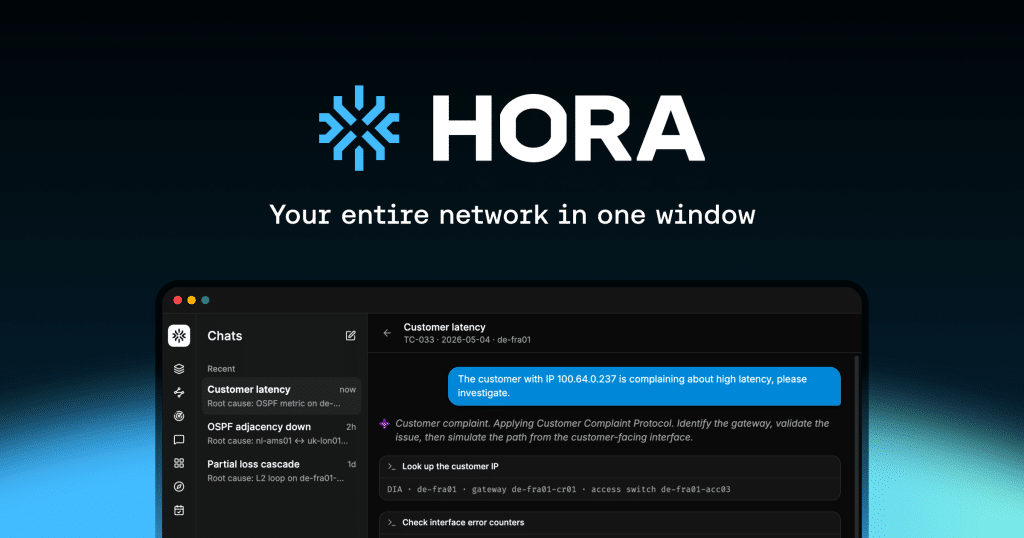
AI earns its keep on the read side. HORA brings metrics, logs, flows, BGP state, discovered topology and the source of truth into one place, and an AI engineer correlates across all of it to get a human to root cause in minutes. That is why a lean team can operate more network, and why, after a merger leaves two networks and two half-accurate inventories, automated discovery turns an integration plan into an integration. The write side is different. We keep AI off it by architecture, it proposes, a human approves, and what touches a device is deterministic automation a person wrote and can audit. Any AI pitch that skips this distinction is selling you the demo.
HORA correlating live network state to root cause.
The operate era
The strategic question for every operator heading into the autumn is not how much network you have, but whether the way it is operated would survive due diligence. If the honest answer is no, that is fixable, and it costs less than you think.
We will be at Connected Britain on 9 and 10 September, stand 140. Bring us your hardest operational problem, the inventory nobody trusts, the alarm queue nobody reads, and we will tell you on the spot how we would approach it. To set up a meeting ahead of the event, write to andrian.visnevschi@itcare.net.
Andrian Visnevschi is CEO and CTO of ITcare and holds JNCIE-SP #2975. ITcare runs managed NOC and network engineering for ISPs, data centre operators and hosting providers worldwide, and builds HORA, an AI network operations platform.

A major deal has been announced that could change the Polish telecom landscape. Deutsche Telekom has agreed to acquire 100% of Fiberhost, a Polish open-access fixed network operator, together with Inea, a retail broadband and TV provider.
Deutsche Telekom will buy the companies for an enterprise valuation of about EUR1 billion (US$1.16 billion) from current shareholder Macquarie European Infrastructure Fund 5, a fund managed by Macquarie Asset Management, and minority shareholders.
DT says the acquisition will accelerate T-Mobile Polska’s growth by adding Inea’s over 300,000 customers and Fiberhost’s fibre network passing over 1.4 million homes.
The transaction is also a new stage in T-Mobile Poland’s transformation from a mobile-only operator into a fully convergent telecommunication provider. Since signing its first wholesale access agreement in 2018, T-Mobile has expanded its fixed coverage through wholesale partners and built a nationwide convergent offer.
Together, the businesses say they will be better positioned to compete more effectively with operators that already own substantial fixed infrastructure. The acquisition also strengthens T-Mobile Poland’s role as an investor in critical infrastructure supporting Poland’s digitalisation.
T-Mobile Poland CEO Andreas Maierhofer explains: “Our award-winning mobile network, nationwide backbone, data centres and fibre infrastructure will now be complemented by our own fibre-to-the-home network reaching 1.4 million households. Owning an FTTH network will allow us to further develop our already successful portfolio of convergent products.”
Fiberhost will continue to offer transparent and non-discriminatory access to its state-of-the-art fibre infrastructure to all existing and potential internet service providers in Poland.
Closing of the transaction is conditional upon customary Polish competition approvals.