Colt develops Agentic AI engine with Microsoft AI cutting enterprise quote time from days to minutes

London, March 2nd 2026 – Colt Technology Services (Colt), the global digital infrastructure company, today announced a successful proof of concept for an agentic AI engine it has developed together with Microsoft, to accelerate, simplify and clarify complex deal pricing for customers and enhance the Colt customer experience. As Colt’s customers grow, scale and expand their global presence, pricing can be complex, particularly across global markets, and a lack of transparency can be confusing and costly. The new agentic AI engine reduces time spent on developing and sharing pricing from days to just 10 minutes, giving customers fast, accurate competitive deal pricing to help drive decision making and manage cost control.  

Colt is exploring ways to apply agentic AI throughout the customer journey, from pricing to onboarding and beyond. This pricing agent is one of the first proofs of concept to be explored and delivered as part of the Colt programme. In just three days Colt and Microsoft trained the agent to deliver complex deal pricing across the majority of its markets, with 99% accuracy. While the quotes are generated by the agent, Colt’s skilled teams check them before issuing to customers.  

This agentic AI engine is one of the first tools to be developed as part of Colt’s broader ‘people first’ AI strategy, which focuses on creating secure, scalable and responsible AI ecosystems for its employees and customers, empowering them to face an AI defined future with confidence.  

Frank Miller, chief AI and platforms officer, Colt Technology Services says, “Enterprise IT buying has always been complex. A large-scale global infrastructure project can take weeks for providers to generate accurate pricing, but there’s no question it can slow down delivery. Together with Microsoft, we wanted to explore how AI capabilities can break this pattern. By accelerating and clarifying pricing, our customers can focus on achieving their goals, faster, while we keep them connected across the world. Businesses deserve connectivity without complexity and its down to global digital infrastructure providers to make sure this happens.” 

Frank added, “We’ll continue the innovation journey with Microsoft in building the factory for agentic application in telecommunication with a specific focus on the best possible customer experience; fast, simple, accurate, secure and reliable.” 

“Agentic AI has the potential to transform complex enterprise workflows in the telecom industry, where speed, accuracy and scale are critical,” said Rick Lievano, Worldwide CTO, Telco, Media & Gaming at Microsoft. “Colt’s initiative, combining deep telecom domain expertise with Microsoft cloud AI capabilities, helps automate complex processes, improve consistency, and give customers faster access to the information they need to make informed decisions.” 

The agentic AI engine for pricing is expected to become available for use later this year.  

About Colt Technology Services 

We’re Colt. We own and operate exceptional digital infrastructure which powers the global AI economy, connects societies, builds communities and transforms lives. Thousands of colleagues in 65+ offices across Europe, Asia, and North America share a deep commitment to delivering an outstanding experience and making every interaction effortless for our customers. 

Customers and partners choose our award-winning fibre infrastructure, digital platforms and security solutions, delivered across a network that spans continents and crosses oceans. We’re Europe’s largest B2B operator: we connect 40+ countries, 32,000 enterprise buildings, 275+ points of presence, and 12 cable landing stations and we manage eight subsea cable systems. We also co-manage AS3356 – the most widely peered network in the world. 

Founded in London over 30 years ago, we’re privately funded and driven by values of fairness, inclusion and equity. We’re known for our urgent call for social and sustainable change and we’re guided by our purpose in everything we do: creating effortless connections and extraordinary outcomes for our customers, communities and people. Be a part of our story: come on over to www.colt.net  or join our amazing communities at LinkedInInstagramTikTokFacebook and YouTube. Media enquiry? Email us at pressqueries@colt.net 

You can meet Colt at Submarine Networks EMEA, in London on the 27th – 28th May 2026. Get your ticket HERE


Building trust at scale: Why digital sovereignty needs a rethink

Viewpoint 

The future is federated sovereignty, says Aaron Boasman-Patel of TM Forum. Learn what that means for you, from concept to architecture

By Aaron Boasman-Patel, VP, Innovation, TM Forum

Over the years, digital sovereignty was defined by borders. That mindset increasingly feels outdated and is being challenged as perceptions evolve behind how it is understood and exercised.

Across Europe, narratives of a “failing concept” and “falling behind” are gaining traction, signaling the need for organizations to move faster and strengthen the strategic position on how they manage and organize data.

It’s no longer feasible for every country to build a fully autonomous digital stack as the economics don’t add up and operational risks are high. And today’s networks, cloud, and AI systems are designed to interconnect, not isolate. These realities are forcing us to rethink what sovereignty means in a hyper-connected world. Europe is already moving in this direction with initiatives like Gaia‑X and the EU Digital Networks Act, signaling a shift from isolation to interoperability and system‑level coordination.

The future is federated sovereignty. This is where connectivity is organized around regional alliances, common standards, and shared trust frameworks that enable interoperability while keeping control of critical assets local.

From concept to architecture

Federated sovereignty means evolving into a framework of collaboration and shared responsibility rather than nationally isolated control. Initiatives such as Gaia‑X signal this shift at a policy and framework level, setting common rules for interoperability and trust across borders and moving sovereignty away from isolation and toward system‑level coordination.

Increasingly, federated sovereignty is being expressed through technical architecture. Sovereign cloud implementations such as the AWS European Sovereign Cloud illustrate how sovereignty can be enforced through technical controls, operational separation, and European governance while still participating in global cloud and AI ecosystems. Rather than fragmenting infrastructure, this approach enables interoperability by design while keeping control of critical assets local.

For telecom operators, this evolution brings both responsibility and opportunity. When sovereignty is no longer just about ownership, it becomes an issue of control, assurance, and verifiability in a world of disaggregated networks, cloud‑native infrastructure, and AI‑driven operation. Operators must answer fundamental questions in real time: Where is data processed and trained? Who controls decision-making systems? How are policies enforced? And how can outcomes be audited?

Governance and leadership in a federated world

Artificial intelligence accelerates the challenge. As networks move toward intent‑driven and autonomous operation, sovereignty shifts from physical hardware to adaptive software, policy, and model governance from manual configuration to cognitive automation.

To manage this, leadership models must evolve. Sovereignty spans networks, IT, AI, cloud, data, security, and regulation; it cannot sit solely within compliance or legal. It requires ongoing oversight, clear decision rights, and joined‑up leadership across technology, policy, and operations. Many organizations are formalizing this through introduction of a ‘Chief Sovereignty Officer’ function or equivalent operating model that unites governance, architecture, and operational assurance.

Telcos as architects of cloud sovereignty

What do telcos need to do, to ensure they are serving the needs of customers prioritizing sovereignty? Primarily, collaboration between telcos and cloud providers is essential to deliver secure, compliant, and innovative services. Telcos bring unique strengths to this partnership: trusted relationships with governments and enterprises, operation of critical infrastructure, and deep regulatory expertise.

Meanwhile, hyperscale cloud providers offer advanced technology and scalability. Together, they can create interoperable solutions that meet stringent security and compliance requirements while opening new market opportunities.

Real-world progress is underway, and multi‑cloud resilience practices reduce single‑provider risk. TM Forum’s Open Digital Architecture (ODA) and Level‑4 autonomous network capabilities advance observability, automation, and componentized networks, the essential foundation for sovereignty by design. Across geographies, operators and network infrastructure providers are recognizing that investment in autonomous network capabilities is key to control now and into the future. Which is why ODA and Level 4 autonomy play a pivotal role, providing operators the foundation to scale intelligent and sovereign networks.

Designed trust at scale

This year, those who lead the way will be those who embed sovereignty into architectures through policy-driven control, certification, continuous testing, and clear accountability. Something this critical should never be an afterthought. Risk-based resilience will be critical, including diversified routes and mediums such as fiber, subsea, and satellite networks, and tiered service continuity for emergency traffic.

The future of digital sovereignty is not fragmentation but designed trust at scale. Telecom operators sit at the center of that future, not just as connectivity providers but as custodians of controlled digital resilience.

Building sovereignty through collaboration

The path forward is shared. It is a commitment to federated sovereignty architectures rooted in open standards and shared assurance. It is an imperative to operationalize sovereignty with joint governance and runtime verification across multi‑cloud and multi‑network domains. It requires investment in observability, automation, auditability, and sovereign key management as core capabilities, not add‑ons.

By the end of this year, we expect to see those that lead on sovereignty to have made headway on four key milestones. These are:

  1. Establishing a cross‑functional sovereignty council that brings together technology, legal, security, policy within the organization;
  2. Defining and publishing sovereignty Service Level Objectives (SLOs) for data residency, model lineage, policy enforcement latency, auditability KPIs;
  3. Completing pilot sovereign cloud landing zones with route diversity and traffic tiering;
  4. And certifying model and data provenance for critical AI workflows.

Sovereignty built this way is verifiable, interoperable, and investable. It brings structure, clarity and control to an increasingly sensitive and mission critical organizational defense. Those who move first will define the standards, architectures, and trust models that others will follow.

AI-powered solution launched to support Zimbabwean farmers

Two Zimbabwean companies, Hurudza AI and Paltech Africa, have announced a strategic partnership to launch The Farmers’ Bench, an AI-powered solution aimed at transforming access to agricultural knowledge across Zimbabwe and beyond.

Paltech describes itself as a technology company democratising AI and sustainable energy through smart infrastructure. Hurudza AI is an artificial intelligence-powered multilingual agricultural contact centre.

Together, the two companies say they are building a unified system that delivers data-driven insights to farmers on the ground, helping them make better decisions and improve productivity.

At the core of the initiative is The Farmers’ Bench, a hybrid physical and digital innovation hub that provides farmers with actionable insights, climate-smart recommendations, and tailored support.

By integrating AI with accessible infrastructure, the platform aims to bridge information gaps and ensure that smallholder farmers can make informed decisions in real time. This is expected to improve yields, reduce risks linked to climate change and support more sustainable farming practices across the country.

Paltech Africa will provide the hardware backbone, including solar-powered systems and edge AI infrastructure. The company will also oversee installation, site selection and maintenance of the smart units deployed in farming communities.

Hurudza AI will power the software side, offering its conversational AI platform that delivers accurate, multilingual agricultural advice. The system will be continuously updated to ensure farmers receive relevant and timely information.

This integration of hardware and software is important. Instead of relying on internet-heavy solutions, the platform works at the edge, meaning it can function effectively even in areas with limited connectivity. Embedding Hurudza AI’s capabilities into solar-powered infrastructure allows farmers to access knowledge directly where they work, without needing advanced devices or constant internet access. For many farmers, this could mark a shift from delayed or unavailable information to instant, reliable support.

The partnership reflects a broader ambition to democratise access to artificial intelligence across the agricultural sector. The initiative is expected to contribute to improved food security, empower rural communities, and support scalable, locally driven solutions for agricultural development.

The project is now at the pilot phase but there are plans to expand the platform across provinces.

BW Digital lands Tonga’s second international subsea cable

Digital infrastructure operator BW Digital announced on Friday that it has successfully landed the Hawaiki Tonga subsea cable in Vava’u, giving Tonga extra international capacity as well as needed resilience.

The 383-km cable, which officially landed on March 18, connects Tonga directly to the transpacific Hawaiki Cable linking Australia, New Zealand, Hawaii and Oregon on the US West Coast, with branching units for American Samoa and New Caledonia.

The Hawaiki Tonga cable – which has been in the works since June 2024 – was jointly funded by Australia, through the Australian Infrastructure Financing Facility for the Pacific, and the Government of New Zealand. BW Digital delivered the cable in partnership with the Government of Tonga and Tonga Cable Limited.

In a LinkedIn poston Friday, BW Digital said work is now underway to prepare the system for commercial service in the coming months.

The Hawaiki Tonga cable is Tonga’s second international subsea connection, and its first direct link to a major transpacific cable system. Up to now, its only source of international subsea capacity has been the Tonga Cable – owned by Digicel Tonga, the Government of Tonga and Tonga Communications Corporation – that connects to Fiji.

The lack of redundancy has made Tonga highly vulnerable to internet disruptions. In January 2022, the eruption of the Hunga Tonga-Hunga Ha’apai volcano damaged both the Tonga Cable and the Tonga Domestic Cable Extension (TDCE), the island nation’s sole domestic subsea cable that connects the main island of Tongatapu with the northernmost island of Vava’u.

The TDCE suffered damage again in 2024 due to an earthquake.

Huawei unveils AI-native framework and new generation solutions to enable all intelligence

Partner Article

Huawei unveils AI-native framework and new generation solutions to enable all intelligence 

The communications industry is entering a new phase of transformation, as operators move beyond basic automation towards building intelligent networks. Rising network complexity, surging data traffic and the rapid adoption of Artificial Intelligence (AI) across enterprises and consumer use cases are exposing the limitations of traditional operations models, which remain largely reactive and fragmented.  

At the recently concluded MWC Barcelona 2026, Huawei outlined its vision for this shift, unveiling what it describes as the industry’s first AI-native framework for intelligent operations, alongside a new suite of solutions designed to accelerate the transition. The announcement is in line with a broader industry trend, where telecom operators are increasingly looking to leverage AI across the entire network lifecycle, from Operations and Maintenance (O&M) to customer engagement and monetisation. 

According to Capgemini, telcos have, on average, achieved a 20% improvement in operational efficiency and 18% reduction in operational expense through autonomous networks over a period of two years. While telcos are increasingly using AI to automate networks, the rise of AI-powered tools and applications is placing new demands on network performance and reliability.  

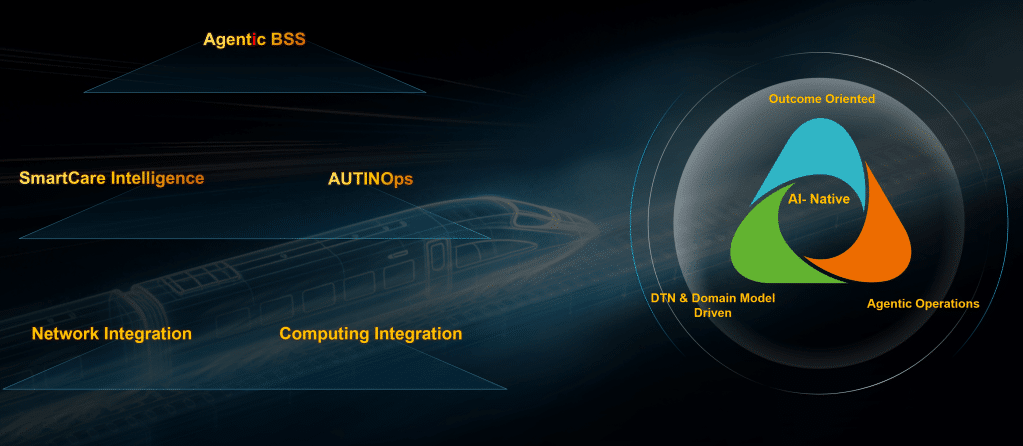
President of Huawei’s Global Technical Service, Bruce Xun, announced the launch of three solutions, Agentic BSS, SmartCare Intelligence and AUTINOps, which he believes will “ensure a seamless evolution while establishing new paradigms, creating new value, and achieving a massive leap in intelligence.” He was speaking in a session on Agentic Services and Software Enable All Intelligence.  

These solutions are based on an AI-native framework, which is “designed to accelerate the transition of AI innovations into real production, creating tangible new value,” said Xun.  

This framework is built on three core pillars. To begin with, it targets operational and business challenges that legacy solutions have failed to resolve. Secondly, it leverages digital twins and telecom-domain models to enable optimal solutions. Thirdly, the framework reinvents workflows and talent development to ensure a seamless collaboration between human experts and digital employees. 

A key challenge for service providers today is that traditional operations models remain largely reactive.  The tariff design and launch process is slow, and may not meet customer needs or effectively recommend the right products at the right time. 

In this context, Agentic BSS focuses on transforming business operations by introducing AI agents that can interpret customer intent, design new offerings and optimise customer engagement. By enabling collaboration between multiple agents, service providers can significantly reduce time-to-market and deliver more personalised services. 

“The key to intelligent operations lies in our ability to anticipate customer intent and identify unmet needs,” said Xun. This shift towards intent-driven operations is particularly relevant as operators expand into enterprise services and digital ecosystems, where responsiveness and customisation are critical.  

Huawei received a Silver award in the Total Experience category for its collaboration with a Chinese operator, where AI-driven account management agents were introduced. These digital assistants improved response times, reduced business processing time by 30%, and enhanced enterprise customer engagement. 

Reimagining network optimization  

While business transformation is one aspect, network operations remain central to the AI-native vision. SmartCare Intelligence, another solution introduced by Huawei, is designed to move network optimisation from a reactive to a predictive model. By leveraging large AI models, including User Experience Large Model (UELM) and Beam Space Large Model (BSLM), the system can analyse network data in real time, simulate potential scenarios and generate optimal adjustments. This approach ensures that the networks are always tuned to deliver optimal performance. This is significant because service providers are struggling with growing network complexity. AI-driven systems can help them provide consistent service quality.  

Towards predictive and preventive operations 

The third pillar of Huawei’s portfolio, AUTINOps, focuses on Operations and Maintenance (O&M), introducing a predictive approach to network reliability. 

Traditional O&M models often respond to faults after they occur, leading to service disruptions and longer recovery times. AUTINOps addresses this by identifying potential risks in advance and taking preventive action. It uses a cross-domain digital twin network and EDNS 2.0 model to monitor networks in real time, detect risks and trigger recovery actions. It combines proactive risk mitigation (T-1) with quick fault recovery (T0) to ensure “dual protection,” leading to high uptime and network reliability.  

Huawei’s approach is beginning to see validation in real-world deployments. At the World Communication Awards (WCA), the company received a Silver award for Best Digital Transformation Programme for its work with a Middle Eastern operator, where it implemented an AI-driven O&M system focusing on fault management and resource topology optimization. Based on the AUTIN platform, the solution enabled over 95% topology visibility across VoWiFi access points, LTE anchor points and IMS core network elements. It delivered measurable improvements, including service availability exceeding 99.5%, a 40% reduction in call drop rates, and significant gains in fault detection and repair times. 

Xun emphasized the importance of robust connectivity, without which AI remains an information silo. He urged the industry leaders to standardize definitions and specifications of AI native elements, jointly design new business and transaction models and to share best practices to simplify network operations while ensuring improved performance.  

Vodacom Lesotho invests $40 million in network upgrade and digital push

Vodacom Lesotho is investing more than US$40 million (LSL 700 million) to upgrade its network infrastructure and expand connectivity, as it looks to improve service quality and extend coverage to underserved areas.

According to TechAfrica News, the programme will focus on boosting network performance and widening access, in a move aimed at strengthening digital inclusion across the country.

CEO Mohale Ralebitso said the operator is also introducing artificial intelligence across its operations, spanning network management, customer engagement and internal processes. The use of AI is expected to drive efficiency and support more data-led decision-making.

The investment is set to deliver broader coverage and improved service quality for customers, while also enhancing operational performance through advanced analytics.

Alongside its network push, Vodacom Lesotho is expanding its financial services arm, VCL Financial Services, positioning it as a more independent unit offering savings and investment products. The move is intended to deepen financial inclusion and provide customers with more flexible financial tools.

Globe expands LTE and 5G coverage across Tarlac province

Globe Telecom has expanded its LTE and 5G footprint in the Philippine province of Tarlac, as it moves to meet rising demand for faster and more reliable connectivity.

According to the Manila Standard, the upgrade covers 18 municipalities, including Tarlac City, Capas, Concepcion, Gerona, Victoria, Paniqui, Mayantoc, San Jose, Moncada, Santa Ignacia, La Paz, Camiling, Bamban, San Clemente, Pura, San Manuel, Ramos and Anao.

Globe said the expanded network will enable improved browsing speeds, clearer voice calls and faster data services for residents across the province.

Joel Agustin, Globe’s head of service planning and engineering, said the rollout supports the region’s mix of economic activity and tourism, adding that the operator is focused on delivering more seamless connectivity for users at work, in education and on the move.

The AI Power Gold Rush: How Hybrid-Drive Cooling Will Reframe Data Center Power Economics

The AI Power Gold Rush: How Hybrid-Drive Cooling Will Reframe Data Center Power Economics

This Industry Viewpoint was authored by Stephen Lafaille, VP Business Development

The data center industry is entering a defining era – one in which power, not land or capital, determines competitive advantage. As AI compute requirements surge and the grid strains under unprecedented demand, operators face a simple but unforgiving equation: every megawatt not available for IT constrains … [visit site to read more]