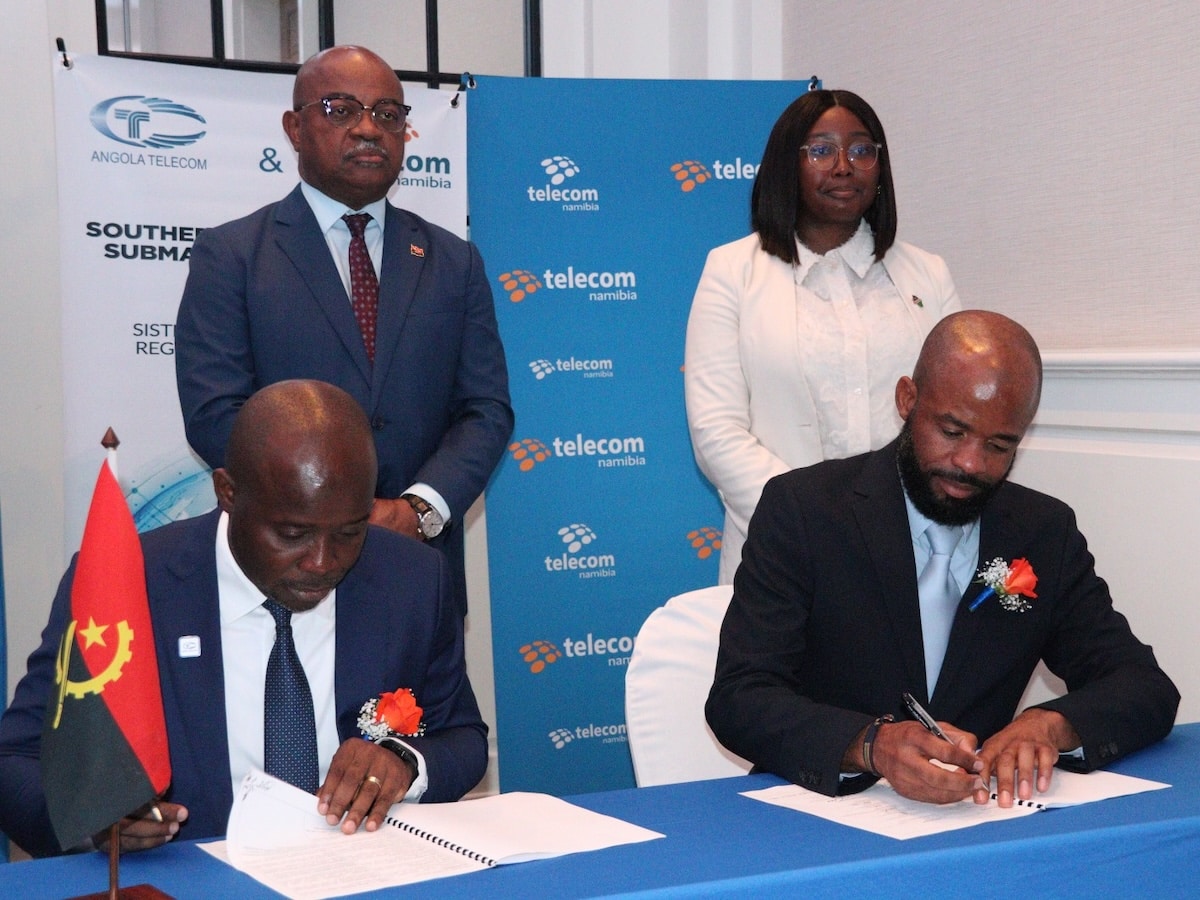
Telecom Namibia and Angola Telecom cooperate on subsea connectivity

Telecom Namibia and Angola Telecom announced on Thursday they have signed an MoU and commercial terms agreement (CTA) to boost regional and international subsea cable connectivity along Southern Africa’s west coast.

The MOU and CTA establish a commercially sustainable framework to govern cooperation between the two telcos, including long‑term access to international capacity, shared operational principles, and a milestone‑based commercial structure.

More specifically, Angola Telecom will gain access to international capacity via Telecom Namibia’s Equiano subsea cable landing in Swakopmund under the deal. Meanwhile, the agreements also lay the groundwork for deeper collaboration linked to Angola Telecom’s planned Southern Africa Regional Submarine Cable System (SARSSy).

The SARSSy cable project aims to interconnect with Equiano via the Swakopmund  landing station, and provide additional international capacity to Namibia, Angola and other countries along the west coast of Southern Africa, while also enhancing Angola’s infrastructure sovereignty, redundancy, and international reach, said Angola Telecom CEO Adilson Miguel dos Santos.

“This collaboration with Telecom Namibia enables us to extend the reach and resilience of Angola’s international connectivity,” he said in a statement. “By integrating SARSSy with Equiano through Swakopmund, we are strengthening Angola’s position within the regional digital ecosystem and ensuring scalable, reliable capacity for the future.”

Telecom Namibia CEO Dr. Stanley Shanapinda added, “By leveraging the Equiano Subsea Cable and working in partnership with Angola Telecom, we are strengthening network resilience, expanding international bandwidth, and positioning Namibia as a key digital transit hub for the region.”

Deutsche Telekom reportedly considers merger with T-Mobile US


News

Deutsche Telekom is reportedly considering a merger with T-Mobile US, a move that could create the largest telecom in the world.

By Brad Randall, Broadband Communities

A report by Bloomberg says Deutsche Telekom is considering a merger with T-Mobile US.

The report cites people familiar with the deal as confirming that early-stage talks have begun regarding the creation of a holding company that would make bids for shares from both publicly traded companies.

Currently, Deutsche Telekom holds a majority stake (53%) in T-Mobile US.

Their involvement with T-Mobile US stretches back decades.

Bloomberg also reports that successful discussions may be contingent on commitments to maintain operations in Germany.

According to Bloomberg, the theoretical deal, if it gained regulatory approval, would set a record for the largest public M&A and simultaneously create the world’s largest telecom.

Yahoo! has reported that the deal could create a telecom with a market value approaching $300 billion, though they also point out that Berlin will hold influence over any future decisions.

Currently, Deutsche Telekom is 28% held by state lender KfW and the German government, Yahoo! reported.

Both companies have declined opportunities to comment on the reports.

Get this news in your inbox. Subscribe to the Broadband Communities newsletter!

Bangladeshi telcos warn of shutdowns due to fuel crisis

News

The country is one of the worst impacted by the ongoing war in Iran, with the majority of its fuel typically being imported from the Middle East

This week, Bangladesh’s telecoms network operators are warning that they may soon be forced to shut down services due to a lack of fuel.

In a letter to the Bangladesh Telecommunication Regulatory Commission (BTRC), the Association of Mobile Telecom Operators of Bangladesh (AMTOB) said that the industry is facing “severe operational distress due to the prolonged unavailability of commercial power and the lack of assured fuel supply for backup systems”.

“The situation has escalated beyond the operational control,” said the AMTOB in the letter. “If these conditions persist, there is an imminent risk of large-scale telecom network shutdowns across significant parts of the country.”

Bangladesh is facing a sever fuel shortage caused by the ongoing war in Iran, which has limited the export of vital fuel supplies from the Middle East. Around 80% of Bangladesh’s crude oil and 65% of its natural gas are imported from the region.

Fuel prices in Bangladesh have risen by around 15% since the start of the conflict and rationing is being imposed by the government.

For the telcos, which operate much of their infrastructure using this fuel, the situation could soon be untenable. Base transceiver stations (BTS) consume over 52,000 litres of diesel and 20,000 litres of octane daily, while data centre operations use around 500–600 litres of diesel per hour, or around 4,000 litres per day per facility.

“Multiple strategically vital telecom facilities are currently running on dangerously low fuel reserves,” said the letter.

Network operators are calling on the government to grant parts of their networks priority in order to ensure that critical services like mobile financial transactions and emergency response can remain operational.

Also in the news

Connected Britain Award winners 2025 announced!
Netomnia announces ‘powerful and ambitious’ rebrand ahead of Connected Britain
VodafoneThree drops Samsung, relies on Nokia and Ericsson for £2bn network upgrade

Veon’s Banglalink to offer Starlink Mobile D2C service in Bangladesh

Veon Group announced on Wednesday that its Bangladesh subsidiary Banglalink has signed an agreement with Starlink Mobile to integrate its Direct to Cell (D2C) satellite connectivity in remote areas with Banglalink’s terrestrial coverage.

Banglalink will launch Starlink’s D2C service later this year, giving its customers access to Starlink Mobile satellites using standard 4G smartphones, although the service will initially be limited to text messaging.

Banglalink said it will introduce data services in the next phase of Starlink Mobile’s rollout, pending regulatory approvals.

“By enhancing our connectivity with Starlink’s satellite-to-mobile technology, we aim to ensure that Banglalink customers will not be limited by the availability of terrestrial networks,” said Banglalink CEO Johan Buse in a statement.

Banglalink’s Starlink Mobile tie-up is the third such deal for Veon’s operator stable, following the commercial launch of D2C service with Ukraine’s Kyivstar in November 2025 and a field test with Beeline Kazakhstan in December 2025 that also marked the first WhatsApp call over Starlink’s network in Central Asia. Beeline Kazakhstan aims to launch commercial D2C services later this year.

“By expanding our partnership with Starlink into Bangladesh, we are redefining resilience and opening up new possibilities for our digital ecosystem – now in the third country across the five markets that we proudly serve,” said Veon Group CEO Kaan Terzioglu.

NTT Data launches 400 Gbps peering in South Africa’s JINX

NTT Data announced on Monday that it has established active 400 Gbps peering at the Johannesburg Internet Exchange (JINX), adding that it’s the first network operator in Africa to do so.

NTT Data said its 400 Gbps peering capability signals that South Africa’s internet exchange environment is operating at a level comparable to leading global markets, supporting growing demand for high-capacity, low-latency connectivity.

For local businesses, the upgrade delivers tangible benefits, including improved performance during peak demand periods, greater capacity to support sustained traffic growth and enhanced reliability across digital services, said said JC Burger, director of infrastructure engineering and operations at NTT DATA in South Africa.

“Africa’s Internet traffic is growing rapidly and the demand for scalable, resilient and low-latency connectivity continues to increase,” Burger said in a statement. “Establishing 400Gbps peering at JINX is a strategic investment that strengthens our ability to deliver high-performance connectivity while supporting the long-term growth of Africa’s digital economy.”

JINX – which was established in 1996 as Africa’s first Internet exchange point – is operated by the Internet Exchange Point of South Africa (INX‑ZA), a division of the Internet Service Providers’ Association (ISPA).

Arelion upgrades Nørre Nebel site, prepares for more subsea cables

Press Release

These developments support the continued growth of the Nordic digital infrastructure market amid significant private data center expansion in Jutland and Copenhagen

Arelion is upgrading its Nørre Nebel site to support additional cable landings and long-term network scalability. The site is fully operational and project-ready with front haul, back haul and subsea horizontal directional drilling (HDDs) for landing multiple diverse sea cables in place.

The global internet carrier is leveraging its network of ducts on the north route from Nørre Nebel to Copenhagen via a unique subsea cable system from Aarhus to Copenhagen. On the south route, ducts passing Esbjerg to Kolding and Copenhagen add resilience and route diversity, with Kolding serving as a key junction point for routes south to Germany and east to Copenhagen.

These investments are part of Arelion’s ongoing strategy to connect many new data center developments in the region to its network, including the recently completed new duct and cable extensions connecting the atNorth DEN01 Copenhagen data center to Arelion’s Nordic AI superhighway.

Complementing the infrastructure, new optical systems supporting wavelength capacity have been added between Amsterdam and Kolding to enable more efficient traffic routing and offer diversity bypass options for Hamburg.

The improvements strengthen connectivity for customers in Denmark’s expanding data center markets and align with broader European initiatives to improve subsea and terrestrial infrastructure across the North Sea region. Denmark’s access to renewable energy and its strategic position continue to support its emergence as a regional data center hub, with the national market expected to reach $2.9 billion by 2030 at a compound annual growth rate (CAGR) of 11.44 percent.

“These upgrades to our Danish network reflect our broader commitment to strengthening digital infrastructure across the Nordics, helping us support enterprise and wholesale customers with low-latency, fully diverse connectivity and predictable performance as they deploy AI applications,” said Johan Ottosson, VP Strategy & Product Management at Arelion. “Our continued investment ensures the capacity needed to keep pace with accelerating demand for AI-driven services, providing a scalable and secure foundation for both training workloads and latency-sensitive inference use cases.”

The submarine cable industry is changing rapidly. Join the industry in discussion at Submarine Networks EMEA, the world’s premier subsea industry event

Also in the news
Connected Britain Award winners 2025 announced!
Netomnia announces ‘powerful and ambitious’ rebrand ahead of Connected Britain
VodafoneThree drops Samsung, relies on Nokia and Ericsson for £2bn network upgrade

AST SpaceMobile satellite placed into wrong orbit

News

The failed deployment could hinder commercial pilots of direct-to-device (D2D) services for AST’s mobile operator partners

Satellite company AST SpaceMobile has hit a setback this week, with its latest BlueBird 7 satellite being deployed in the wrong orbit.

The launch, which took pace on Sunday, saw BlueBird 7 carried into low Earth Orbit (LEO) by Blue Origin’s New Glenn reusable rocket. However, issues in deployment led to the satellite being placed into too low an orbit.

“During the New Glenn 3 mission, BlueBird 7 was placed into a lower than planned orbit by the upper stage of the launch vehicle. While the satellite separated from the launch vehicle and powered on, the altitude is too low to sustain operations with its on-board thruster technology and will [be] de-orbited,” explained AST SpaceMobile in a statement, noting that the cost of the lost satellite was covered by an insurance policy.

AST is currently in the process of deploying a constellation of roughly 90 LEO satellites, which will be used to provide global coverage of D2D satellite services. This will allow AST’s mobile operator partners, such as Vodafone and AT&T, to provide customers with coverage beyond the limits of their terrestrial networks.

AST currently has six active satellites in orbit, which provide intermittent coverage and have primarily been used for preliminary tests of the company’s D2D technology. BlueBird 7 was set to be the first of the company’s upgraded satellites, with 45–60 additional devices targeted for launch before the end of the year.

“The company is currently in production through BlueBird 32, with BlueBird 8 to 10 expected to be ready to ship in approximately 30 days,” said the company statement. “The company continues to expect an orbital launch every one to two months on average during 2026, supported by agreements with multiple launch providers, and it continues to target approximately 45 satellites in orbit by the end of 2026.”

The extent to which the failure to deliver BlueBird7 will impact AST’s customers is unclear. VodafoneThree, for example, is scheduled to begin trials of the technology with customers this summer.

Also in the news
Connected Britain Award winners 2025 announced!
Netomnia announces ‘powerful and ambitious’ rebrand ahead of Connected Britain
VodafoneThree drops Samsung, relies on Nokia and Ericsson for £2bn network upgrade