Vodafone has added an AI-driven scam call filter to its Secure Net Mobile security package as the operator intensifies efforts to cut fraud and nuisance traffic on its network.
The new Scam Call Protection feature is built into the network rather than installed as a separate app, allowing it to scan incoming calls in real time and warn customers when a number looks suspicious.
The service is designed to spot fraudulent, spam and other unwanted calls around the clock, including numbers already linked to scam activity. If the system judges a call to be high risk, an alert appears on screen so the user can decline it or pick up with more information. Vodafone says the feature is switched on automatically for existing Secure Net Mobile users, with no extra setup required.
“Scam calls are becoming increasingly harder to spot, and it’s easy to feel caught off guard. Scam Call Protection on Vodafone Secure Net Mobile gives customers an extra layer of reassurance – constantly working in the background to monitor calls, and flagging known and suspected scam calls. The introduction of Scam Call Protection strengthens our commitment to provide comprehensive built‑in digital security, helping people feel safer, more informed and more in control of their digital world,” said Rob Winterschladen, Consumer Director at VodafoneThree.
In recent years all of the UK’s mobile operators have been doubling down on their attempts to quash scam callers. In 2025, under the new Telecommunications Charter, BT (EE), Virgin Media (O2), VodafoneThree, Tesco Mobile, TalkTalk, Sky (Sky Broadband) and the Comms Council UK all pledged to crack down on scammers, including enhancing their existing scam detection systems. AI, naturally, has played a significant role in these upgrades, with O2’s AI-powered scam detection software, for example, having blocked over 1 billion scam and spam calls to customers.
The global telecom networks are under tremendous pressure to build networks capable of sustaining the explosive, bandwidth-hungry requirements of mobile Artificial Intelligence (AI). With the growing popularity of AI applications and tools among enterprises and individual users, the industry is realizing that the existing networks do not have the capacity to meet the demands of emerging AI-driven traffic.
According to GSMA, AI-driven traffic is likely to lead to a three-fold increase in cellular data traffic by 2030 compared to 2024 base. AI applications and devices have already started to record a massive growth over the past year, with global monthly active users surpassing one billion and token consumption surging by hundreds of times.
While this is a massive opportunity for the service provider, AI-generated traffic places new demands on the network. To begin with, traditional mobile networks were designed for more downlink consumer traffic. The data suggests that uplink speeds continue to be far lower than peak downlink performance, making it difficult to ensure performance for AI inference-based applications. AI inference traffic is also prone to unexpected surges and demands millisecond-level response times. To put it simply, networks are emerging as bottlenecks and may prevent enterprises and individuals from leveraging the full potential of AI.
In addition, the service providers face business challenges of diminishing returns even as traffic volumes continue to rise. Emerging use cases, including intelligent connected vehicles and industrial digitalization, are creating new demands that existing infrastructure is not designed to address. To capture the Mobile AI opportunity, the service providers need to build a network architecture capable of delivering differentiated services and experiences that can be monetized. Furthermore, service providers must evolve their offerings from vanilla connectivity solutions to new innovative use cases that are based on differentiated experiences.
With commercial 6G deployments likely only by 2030, present-day networks can’t address the demands of AI-driven traffic. In this scenario, 5G-Advanced (5G-A) networks, the next evolutionary step between 5G and 6G, is helping service providers address the explosive growth in AI-driven traffic without impacting performance. It has already been deployed in more than 300 cities around the world.
In this context, Huawei’s All Bands to 5G-A strategy is designed to address these challenges faced by the service providers. It helps service providers maximize network performance, energy efficiency, and user experience while minimizing capital outlay. This approach not only addresses the present-day challenge of surging AI workloads but also lays the groundwork for 6G.
It focuses on using a range of solutions to evolve the entire spectrum, including low, medium and high frequency bands, towards 5G-A. These solutions are designed to help service providers maximize the performance of 5G-A while ensuring energy efficiency and user experience. On one hand, it focuses on unlocking the untapped potential of the existing sub-3 GHz and sub-6 GHz allocations through spectrum refarming and targeted technology upgrades. On the other hand, it leverages the Upper 6 GHz (U6 GHz) band as the foundation of next-generation network architecture.
Significantly, it helps service providers align network capabilities with the evolving needs of the customers, thus unlocking new revenue streams beyond basic connectivity. Huawei’s All-Band Path to 5G-A strategy is designed to help service providers accelerate the transition of networks to build a more sustainable and scalable model. Through coordinated use of spectrum across bands, the strategy helps operators tap into both high-end consumer and enterprise markets, creating a broader and more resilient growth engine in the AI-driven telecom landscape. It allows service providers to move from selling commoditized connectivity solutions to delivering differentiated, experience-led services, helping them to boost monetization of their investments while providing new experiences to their customers.
The U6 GHz opportunity
The U6 GHz band has emerged as a key band for 5G-A evolution since it provides a large bandwidth and superior coverage. It is a critical enabler of next-generation services, going beyond improved capacity and coverage to support uplink-intensive use cases such as immersive XR, industrial digital twins and real-time AI applications at scale. Its inclusion within evolving 5G-A standards further reinforces its role in future network architectures.
Several markets, including China, the United Arab Emirates (UAE) and Brazil, have already moved ahead with spectrum allocation, while a growing availability of compatible chips and devices indicates that U6 GHz ecosystem is maturing rapidly.
Significantly, U6 GHz is not just a 5G-A band. It is engineered as a smooth on-ramp to 6G, protecting long-term spectrum investments of service providers. It stands as the most vital resource for the Mobile AI Era, favored by leading operators in many countries for its ability to drive digital economic growth. By offering a potent mix of high-uplink performance and broad-bandwidth capabilities, it ensures that 5G-A networks can seamlessly evolve into 6G while supporting complex needs like FWA and high-density hotspots. To ensure this power reaches every corner of the digital landscape, an ecosystem of diverse base station form factors will emerge, providing the architectural flexibility to meet the specific deployment needs of every scenario—from dense urban centres to specialized industrial environments.
U6 GHz enables continuous urban coverage, supports massive terminal access in high-density scenarios, and provides the bandwidth headroom that mobile AI applications require. To put it simply, it gives 5G-A networks the ability to deliver extensive coverage, high capacity, and high speed. In addition to mobile AI, services also include low-altitude economy, local and wide area networks to business (ToB) field, and internet of vehicles (IoV). As a large-bandwidth spectrum, the U6 GHz band transforms bandwidth into an engine for diverse digital services.
To address this opportunity, Huawei has developed a comprehensive U6 GHz product portfolio, covering the entire chain from base station hardware to end-user device support, thus enabling service providers to quickly move once they deploy the spectrum.
Huawei has introduced a portfolio of U6 GHz Active Antenna Units (AAUs) to address growing outdoor coverage and capacity demands. Its flagship 256 TRx AAU uses Extremely Large Antenna Array (ELAA) design and hybrid beamforming to deliver C-band-like coverage. With advanced MU-MIMO and 400 MHz bandwidth, it supports up to 100 Gbps downlink and over 10 Gbps uplink, enabling a consistent high-speed user experience.
For indoor environments, where high concurrency and capacity are critical for AI-driven applications, Huawei has launched U6 GHz small cell solutions, which support up to 400 MHz bandwidth. On the transport side, the company has introduced new microwave solutions to support the increased bandwidth requirements of U6 GHz deployments.
As AI-driven applications continue to scale, U6 GHz is emerging as a key enabler of next-generation connectivity built from 5G-A networks. Huawei’s All Bands to 5G-A strategy and end-to-end U6 GHz portfolio offers service providers a pathway to address immediate capacity challenges while supporting long-term network evolution to 6G.
A strategy built for what comes next
As AI applications move from the edge to the mainstream, networks will need to deliver not just higher speeds but consistent performance, higher uplink capacity, and deterministic service levels. In this context, spectrum strategy is emerging as a defining factor. Service providers that transition to 5G-A and can effectively combine existing spectrum assets with new bands such as U6 GHz will be better positioned to gain from the AI opportunity.
Amazon announced on Tuesday it will officially acquire LEO satellite operator Globalstar in a deal valued at up to US$11.5 billion as part of its strategy to enter the direct-to-device (D2D) satellite sector.
As part of the agreement – rumours of which have been circulating since the beginning of this month – Amazon will acquire Globalstar’s existing satellite operations, infrastructure and assets, including its mobile satellite services (MSS) spectrum licenses with global authorizations.
Globalstar currently operates 31 LEO satellites, including seven HIBLEO-4 satellites licensed by the US and 24 HIBLEO-X satellites licensed by France. Globalstar is currently in the process of replacing its HIBLEO-4 fleet with 17 new satellites supplied by MDA Space.
Amazon said Globalstar’s existing satellite fleet and its new satellites with expanded MSS capabilities will operate alongside its LEO satellite constellation, enabling its Amazon Leo unit to add D2D to its service portfolio ahead of its own planned next-gen D2D satellite system, which is scheduled to start deploying in 2028.
Amazon said its D2D LEO system will offer substantially higher spectrum use and efficiency than existing D2D systems, which translates into faster speeds and better performance for customers. It will also integrate seamlessly with Amazon’s first- and second-generation LEO systems, combining fixed and mobile satellite services to support a wide range of customers and use cases.
Financial breakdown
The financial terms of the deal give Globalstar stockholders a choice between US$90.00 in cash per share of Globalstar common stock they own, or 0.3210 shares of Amazon common stock with a value capped at $90.00 per share. Amazon said Globalstar stockholders holding around 58% of the combined voting power of the outstanding shares of Globalstar common stock have approved the transaction in writing.
The transaction is expected to close in 2027, pending the usual regulatory approvals. The deal also hinges on Globalstar staying on track with its HIBLEO-4 replacement plan.
“By combining Globalstar’s proven expertise and strong foundation with Amazon’s customer-obsession and innovation, customers can expect faster, more reliable service in more places,” said Panos Panay, Amazon’s SVP of devices and services, in a statement.
“The combination [of Globalstar] with Amazon Leo will advance innovations in digital connectivity that will benefit our customers and advance us toward a more intelligent, continuously connected world,” added Globalstar CEO Paul Jacobs.
D2D satellite race
The acquisition essentially enables Amazon Leo to get into the D2D satellite game earlier, as rivals like Starlink have already launched commercial services in a handful of markets.
It also gives Amazon Leo access to MSS spectrum that is already allocated and licenced, which MSS satellite players argue gives them an edge in the D2D race over operators such as Starlink, Lynk Global and AST Spacemobile that use existing terrestrial mobile network spectrum.
D2D satellite has been pitched in the past couple of years as a way to bring mobile voice and data services to underserved and unserved areas, particularly in emerging markets.
However, mobile operators from emerging markets warned at this year’s Mobile World Congress that the regulatory environment has not kept pace with the rise of D2D, which creates risks for terrestrial mobile operators.
Satellite operators themselves have expressed similar concerns over regulatory readiness for D2D services.
Apple iPhones to stay connected
On a side note, Amazon also announced on Tuesday that it has signed an agreement with Apple to continue to provide satellite connectivity via the Globalstar network for current and future iPhone and Apple Watch features.
That agreement is an extension of a current partnership established in 2022 between Globalstar and Apple to power satellite service on iPhone 14 or later, as well as Apple Watch Ultra 3, allowing users to text emergency services, message friends and family, request roadside assistance and share their location.
Apple currently owns a 20% equity stake in Globalstar, which it bought in November 2024 as part of a deal to invest US$1.5 billion in Globalstar to fund its new satellites.
The telecommunications industry has long been characterised by cyclical waves of technological innovation that promise disruption but ultimately deliver limited commercial change. For decades, operators have faced a familiar set of challenges, including declining margins, rising operational complexity, and limited differentiation.
This stagnation, says Calix CEO Michael Weening, has been evidenced in the little impact from each new generation of wireless technology.
“The industry seems to be speaking about the same things for 30 years,” he said in an interview with Total Telecom. “Every time we go from 3G to 4G or 4G to 5G, the industry says this is going to be that holy moment that changes everything. And it changes absolutely nothing. We’re soon whinging back to the same problems.”
With the advent of agentic AI, however, this could all be about to change, allowing for not only greater network efficiency but a totally new approach to delivering personalised services to customers.
“I think we’re at a pivotal moment […] Everything’s coming to a head and there’s a real opportunity to change,” said Weening. “AI completely changes how you understand the subscriber and the experiences that you can deliver to them.”
“That whole idea of these agents and how you build them into workflows will be a profound shift,” he added.
A hyper-personalised service model
It is well known that operators are some of the most customer data-rich organisations in the world, but making use of that data remains a significant challenge. Despite a wealth of data, the complexity of telco operations has typically seen providers defaulting to simplistic offerings based on price and speed. Customers are understood in a generalised way, with mass campaigns targeting demographics and geographies rather than individuals.
Now, however, the development of specialised AI agents, which can automate decision-making across multiple workflows, is making personalisation possible at an individual level and at scale. Rather than broad, undifferentiated campaigns, operators can target individuals based on real-time context, behaviour, and inferred needs.
Weening calls this the journey towards an ‘the experience of one’.
“Most communications service providers can take some demographic data and some external data about customers that will show that they, for example, own a pool. They could use that data to run a targeted marketing campaign offering an outdoor Wi-Fi package,” Weening explained. “The problem is that doesn’t necessarily mean anything, right? The customer might be a grandparent who only uses the pool when their grandchildren come over.”
With sophisticated AI agents built into each part of a providers’ workflow, customer understanding can be far more granular.
“Let’s say you work from home. The network agent can notice that your service regularly degrades at a certain time of day – perhaps when your kids come home – and it can tell you change locations. It knows you recently purchased a pergola, so it can infer you regularly move into the backyard to continue working,” Weening said. “It can then pass this information to a marketing agent, which will build a personalised plan including improved outdoor connectivity. Then, an advertising agent that knows your social media preferences will set up a targeted ad that you will see on Instagram – and if you don’t click through, it can hand off all this specific data to a call centre agent and set up a call automatically.”
A shift towards these experience-based offerings presents a major opportunity for revenue generation, with Weening noting cases of growth “as high as 25%.”
“The best thing is that these revenue gains are wildly sticky,” he said. “Once you deliver this improved experience to the customer, it becomes difficult for other providers to compete. We’ve seen NPS (Net Promoter Scores) of 94 – that’s insane!”
Building a many-layered platform
Of course, orchestrating this AI agent ecosystem is no easy task—and, according to Weening, it requires a platform model to succeed.
The architecture necessary for this transformation, Weening explained, is fundamentally built on five layers:
The data layer, which forms the foundation.
The knowledge and context layer, which combines Retrieval Augmented Generation (RAG), Large Language Models (LLMs), and the Model Context Protocol (MCP) to build context from the data.
The orchestration layer, which ensures the various AI agents work together accurately and efficiency.
The trust layer, which ensures every AI agent has appropriate guardrails and can only access specific data.
The security layer, ensuring that all this activity keeps consumer data safe.
Calix has been working on the “AI-native third generation” of its platform for the past two-and-a-half years and went live with it in February 2026. As of March 2026, all the company’s 1,200+ customers globally have been migrated to this latest version of the Calix One platform.
“What we’ve built is something that abstracts value from context,” he explained. “This level of personalisation is something we’ve always aspired to. With AI, we can finally do it at scale.”
AI needs culture change
With AI’s technical capabilities no longer in doubt, remaining barriers to adoption are largely cultural and organisational. Operators are often seen as labyrinthine and bureaucratic, strangled by legacy technology and an inability to move quickly. For Weening, only those organisations that do away with these dated stereotypes and embrace change will see success.
“People are already looking at AI like it is magic fairy dust – something you can just plug in and see results. It’s not. It’s a cultural and business transformation,” he argued. “Leadership must embrace it and use it to empower employees.”
Agentic AI may finally provide telecoms operators with a credible path to differentiation, but realising this opportunity will depend less on the technology itself and more on operators’ ability to execute the necessary organisational and cultural transformation at scale.
Michael has served as president and CEO of Calix since September 2022, bringing more than 20 years of experience leading growth, strategy, and transformation. Previously he served as Calix President and Chief Operating Officer. Michael joined Calix from Salesforce where he served as the senior vice president of Global Customer Success and senior vice president, Japan and Asia-Pacific Customer Success, Services and Alliances.
Over the span of his career, Michael has held executive positions in North America, Europe and Asia. Previously, Michael held leadership roles at Bell Mobility in Canada, where he was vice president of business and consumer sales. Michael also held sales leadership roles at Microsoft, in Canada and the United Kingdom.
Michael holds a Bachelor of Arts in Business Administration, from Brock University supported by ongoing executive education at Queens, Wharton, and USC.
For decades, inventory management for telcos has been treated as a necessary but unremarkable feature of daily operations. Operators’ need to understand where their network physically exists was crucial for planning and maintenance, but there was little thought that this data could influence investment decisions, operational efficiency, or customer experience
Today, however, this perception is beginning to shift, as operators grow increasingly aware of the strategic importance of network data, the limitations of legacy systems, and the practical realities of deploying AI at scale.
According to Luke Sullivan, Head of Global Pre-Sales, Telecommunications at VertiGIS, the transformation is about telcos finally making use of the data they have always had access to.
“Fundamentally, inventory is still boring,” he joked. “But what’s exciting is that understanding inventory on a more granular level means that you have a much better appreciation of the value of your network, how it’s used, and how you can deliver services to individual customers.”
From obligation to opportunity with AI
Historically, telco inventory systems were built purely to ensure that operators knew what infrastructure they had and where it was located, with little thought given to using this data after it was recorded. In fact, as Sullivan points out, in many cases this data was only accessed when there were issues with the network.
“It is often the case that the primary focus for operators during deployment is speed – how fast can we construct the network? And what ends up happening is they only realise their weakness in inventory when something goes wrong,” said Sullivan. “As a result, these operators can take years before they understand how valuable their inventory would have been if it had been collected and managed their data more effectively.”
The rapid advances in AI, however, has led to this process being re-evaluated, offering not only significant cost savings through operational efficiency but also competitive advantage through improved customer service.
“The change in the last years has really been understanding that the inventory data has immense value,” Sullivan explains. “We can use that data to improve the way we deploy services, to maximise the efficiency of the network, and to improve operations. We now have the tools to leverage that data in the most efficient ways possible, and companies are finding much more creative and powerful ways of taking advantage of it.”
One area seeing significant improvement is inventory validation. Previously, such validation would involve manually visiting and identifying the physical infrastructure, a process that was both time consuming and prone to error. AI can greatly accelerate these tasks.
“Insufficient checks or validations of what was installed in the field compared to what was planned can create a significant gap between inventory data and the real network,” said Sullivan. “AI can help field engineers document deployments by automatically analysing and categorising images and video. Then, it can take the results and compare them to planning documents, flag discrepancies, and adjust the network accordingly.”
“These are processes that have historically been semi-manual or needed additional validation but are now being done automatically. That saves a lot of time and hard work, so it’s enormously valuable,” he added.
Creating a single source of truth from disparate data
Of course, as with any automation process, the quality of data remains a key concern. Older networks in particular suffer from poor or missing inventory information, which can greatly delay returns from AI implementation.
“One of the fundamental issues is if the data in the inventory system is incomplete or incorrect, then any decisions an AI tool is going to make are also going to be incorrect,” he said. “Both humans and AI can only work with the information in front of them.”
While some operators struggle with incomplete data, others face a different problem: they already have high-quality data but cannot use it effectively.
“There are lots of legacy systems that have perfectly good datasets. That doesn’t actually mean that they are able to leverage it efficiently,” said Sullivan.
This disconnect reflects a broader challenge across the industry. Many inventory systems were not designed with advanced analytics, automation, or integration in mind, with even well-maintained datasets can remain siloed or inaccessible.
For Sullivan, the solution is to bring this data together into a unified Geographic Information System (GIS)-based environment that enables consistent modelling, planning, and operational insight, such as VertiGIS ConnectMaster.
“We call it our single source of truth,” he explained. “It is built on VertiGIS’ Neo framework, which focuses on cloud-first architecture and scalable deployment models.”
Crucially, it also integrates into customers’ existing systems through APIs, making it easy to customise to the operators’ individual needs.
“We’re evolving our applications to provide flexibility for deployments, flexibility for how the applications and the solutions can scale, but also to future-proof them as the customer requirements continue to change,” said Sullivan.
Unlocking value from ‘boring data’
Ultimately, for Sullivan and ConnectMaster, the future of inventory and GIS systems lies in making infrastructure data both accessible and actionable. More than a technological shift, this will involve a major mindset shift for operators.
“Operators need to understand not just how to collect the data, but how to maximise its value,” said Sullivan. “That involves a lot of analysis and a lot of modelling of future demands on the network. These are key value points that are much more at the forefront of people’s minds today.”
The rigid systems of the past are rapidly becoming malleable, able to be tailored to specific outcomes and solving real-world problems. Operators that succeed in structuring, governing, and leveraging this “boring” data will gain a measurable advantage in how they plan, operate, and evolve their networks.
“I actually wish the customers would come to us with more problems,” concluded Sullivan. “In most cases, the data is there already. They just need experts who understand their unique challenges and can provide a flexible solution to help deliver positive outcomes.”
Meet the VertiGIS team at FTTH Conference 2026
VertiGIS is attending FTTH Conference 2026, taking place 14–16 April 2026 at Excel London, where the team is discussing the evolving role of network inventory as a foundation for efficient fibre network planning, operations, and AI-enabled workflows.
If you would like to explore how fibre operators are modernising network inventory management and creating a structured system of record across planning, documentation, and operations, we welcome the opportunity to connect at Booth S22.
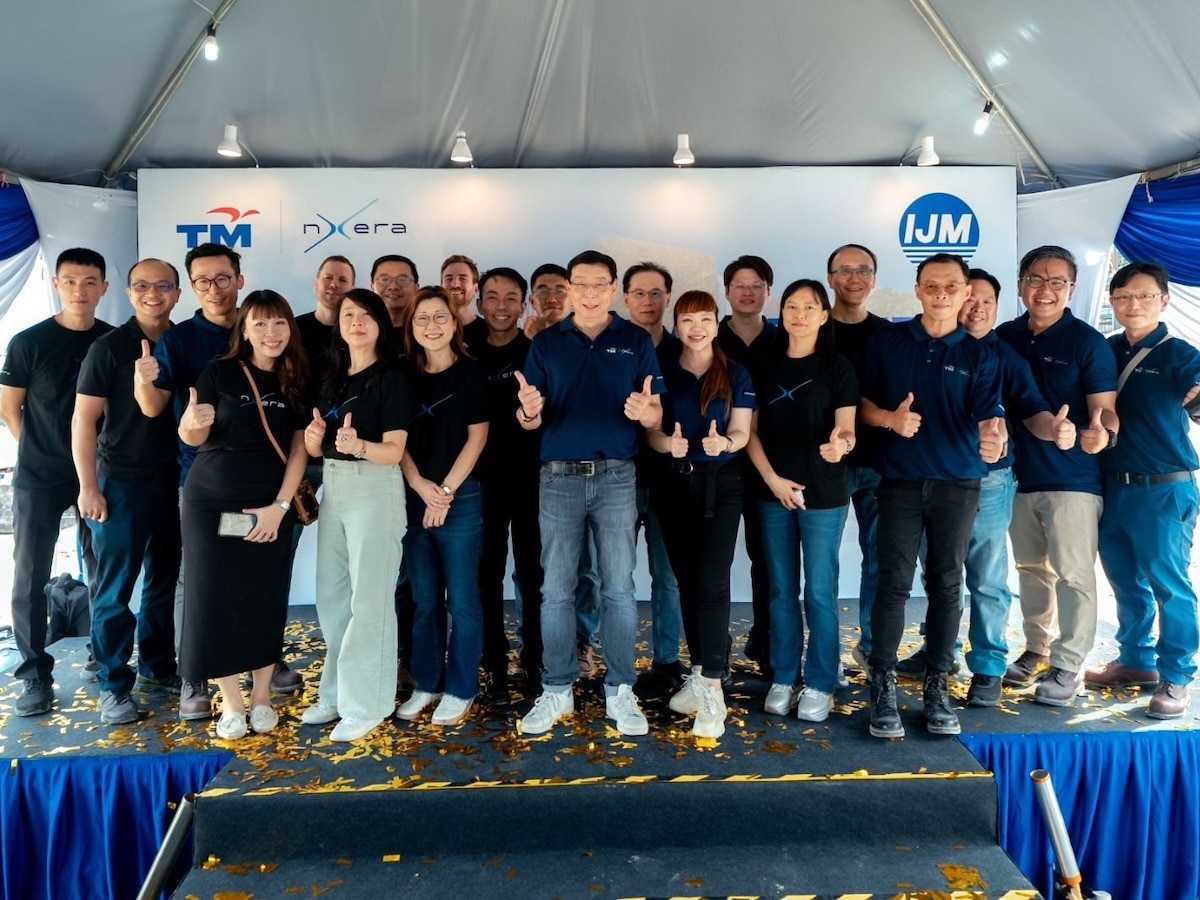
TM Nxera – the JV comprising Telekom Malaysia and Singaporean data centre operator Nxera – completed construction of its first hyperscale AI-ready data centre in Johor on Friday.
The Tier-III data centre, located in Iskandar Puteri in Johor, will initially support 64MW of capacity, and is designed to scale up to 200MW as demand increases, supporting large computing and AI capabilities required by customers such as cloud hyperscalers and GPU-as-a-Service providers.
TM Nxera said in a LinkedIn post that its topping out ceremony “marks a significant milestone, reflecting the progress, effort, and dedication that have brought us to this stage.”
The company said it’s also looking forward to making the facility ready for service, although it didn’t provide a specific target date. TM Nxera has previously said the facility would start commercial operations sometime this year.
The data centre has been in the works since June 2024, when TM and Nxera announced they were forming a JV to develop data centres in Malaysia.
In January, TM Nxera signed a multi-year agreement with Tenaga Nasional (TNB) to supply 280MW of power for the data centre.
Nxera CEO Bill Chang said in a separate LinkedIn post on Friday that he was “really happy to see the rapid, smooth and safe progress of the buildout of this large scale AI DC specially designed to host some of the most demanding AI workloads in the industry.”
Nigeria’s push to expand its digital infrastructure has gained fresh momentum after the African Development Bank (AfDB) approved a $200 million loan for Project BRIDGE, a major fibre-optic programme aimed at widening broadband access and strengthening the country’s digital economy.
The initiative, formally known as the Digital Value Chain Infrastructure for Boosting Employment (D-VIBE) project, is part of a wider effort to mobilise about $2 billion for broadband expansion across the country, according to the AfDB.
The plan is ambitious: officials want to lift Nigeria’s national fibre backbone from roughly 30,000 kilometres to 120,000 kilometres, with open-access infrastructure reaching all 774 local government areas.
According to the AfDB and reports in Premium Times, the network is also intended to support cross-border links with Benin, Cameroon, Niger, and Chad, while extending service to schools, health facilities, rural communities, agro-industrial zones, and commercial centres.
“Nigeria has the talent, the market, and the ambition; what it has lacked is the backbone infrastructure to connect that potential to opportunity. D-VIBE changes that. From the north to the south, from farms to factories to classrooms, this investment will make high-speed connectivity a reality for every Nigerian community and give young people the tools to build their futures digitally,” said Abdul Kamara, Director General, African Development Bank Group Nigeria Office.
Funding for the project is being assembled from multiple sources. In addition to the AfDB loan, reports suggest the package includes $500 million from the World Bank, $100 million from the European Bank for Reconstruction and Development, an $1.2 billion from the private sector.
Execution remains the critical test for the project. Fibre rollout in Nigeria has repeatedly been slowed by right-of-way costs, fragmented policy, and coordination problems, making delivery as much a governance challenge as a financing one.
Nigeria’s push to expand its digital infrastructure has gained fresh momentum after the African Development Bank (AfDB) approved a $200 million loan for Project BRIDGE, a major fibre-optic programme aimed at widening broadband access and strengthening the country’s digital economy.
The initiative, formally known as the Digital Value Chain Infrastructure for Boosting Employment (D-VIBE) project, is part of a wider effort to mobilise about $2 billion for broadband expansion across the country, according to the AfDB.
The plan is ambitious: officials want to lift Nigeria’s national fibre backbone from roughly 30,000 kilometres to 120,000 kilometres, with open-access infrastructure reaching all 774 local government areas.
According to the AfDB and reports in Premium Times, the network is also intended to support cross-border links with Benin, Cameroon, Niger, and Chad, while extending service to schools, health facilities, rural communities, agro-industrial zones, and commercial centres.
“Nigeria has the talent, the market, and the ambition; what it has lacked is the backbone infrastructure to connect that potential to opportunity. D-VIBE changes that. From the north to the south, from farms to factories to classrooms, this investment will make high-speed connectivity a reality for every Nigerian community and give young people the tools to build their futures digitally,” said Abdul Kamara, Director General, African Development Bank Group Nigeria Office.
Funding for the project is being assembled from multiple sources. In addition to the AfDB loan, reports suggest the package includes $500 million from the World Bank, $100 million from the European Bank for Reconstruction and Development, an $1.2 billion from the private sector.
Execution remains the critical test for the project. Fibre rollout in Nigeria has repeatedly been slowed by right-of-way costs, fragmented policy, and coordination problems, making delivery as much a governance challenge as a financing one.
We use cookies to personalise content and ads, to provide social media features and to analyse our traffic. We also share information about your use of our site with our social media, advertising and analytics partners. View more
Cookies settings
Accept
Privacy & Cookie policy
Privacy & Cookies policy
Cookies list
Cookie name
Active
Conditions légales
Introduction et qui nous sommes
118812.fr met en relation des spécialistes du monde entier par le biais d'événements, de renseignements et d'éditions savantes. Nous sommes une société du FTSE 100 et notre réseau de marques internationalement respectées aide les gens à travailler plus intelligemment, à prendre de meilleures décisions et à se développer sur des milliers de marchés spécialisés. Les données et les informations sont au cœur des activités de 118812.fr, et nous prenons au sérieux les questions de confidentialité des données. Nous respectons nos relations avec les clients, les visiteurs, les sponsors, les exposants, les fournisseurs et les collègues, ainsi que la confiance qu'ils nous accordent pour la conservation de leurs données personnelles.
Contrôleurs de données de 118812.fr
Cette politique de confidentialité explique comment les membres du groupe 118812.fr collectent, utilisent et protègent les informations personnelles à travers nos marques. Les références à "nous", "notre" ou "nos" renvoient au contrôleur 118812.fr concerné qui traite vos informations personnelles.
118812.fr est structuré en cinq divisions opérationnelles :
Au sein de ces divisions, il existe des entreprises sectorielles et des marques de produits, d'événements et de services. En général, lorsque nous interagissons avec vous, c'est par le biais de l'une de ces marques. L'entité juridique du groupe 118812.fr responsable des données personnelles (désignée comme le contrôleur des données dans l'UE et désignée comme le contrôleur 118812.fr dans la présente politique de confidentialité) sera l'entité indiquée sur les formulaires de réservation, les formulaires Web et les contrats ou les factures. Différentes entités juridiques de 118812.fr sont responsables de différents événements et produits. Pour mettre à jour vos informations personnelles ou vos préférences en matière de marketing, contactez les équipes de marketing de nos divisions énumérées ci-dessous. Pour toute question ou plainte concernant la confidentialité des données, vous pouvez vous adresser à l'équipe 118812.fr Privacy via notre formulaire en ligne.
Couverture internationale et variations
118812.fr opère dans plus de 20 pays, qui ont chacun des lois différentes sur la protection des données. La présente politique de confidentialité s'applique à toutes les activités de 118812.fr dans le monde, sauf dans la mesure où il existe une exigence spécifique à un pays qui la complète, comme indiqué dans le menu de gauche.
Ce que nous recueillons
Cette section vous indique quelles informations personnelles nous pouvons recueillir lorsque vous utilisez nos produits et services, et quelles autres informations personnelles nous pouvons recevoir d'autres sources. Dans la présente politique de confidentialité, les informations personnelles désignent les types de 118812.frtions personnelles qui peuvent être collectées et utilisées, notamment : Les coordonnées, telles que le nom, l'adresse électronique, l'adresse postale et le numéro de téléphone.Informations sur l'éducation, la nationalité et la professionles noms d'utilisateur et les mots de passeCommentaires, réactions, messages et autres contenus soumis, y compris les informations relatives aux enquêtes.Intérêts et préférences de communication, y compris les autorisations de marketing, le cas échéant.Informations de localisation, telles que celles fournies par une application mobileInformations de vérification de l'identité, telles que les détails du passeport, afin de se conformer aux obligations légales dans certains pays et de fournir des lettres d'invitation de visa, le cas échéant.Informations sur l'utilisation du site web et des communications, telles que la correspondance et les détails de votre utilisation de notre site web et de nos services obtenus par le biais de cookies ou d'autres technologies de suivi.
Ces informations personnelles concernent les catégories de personnes suivantes :
Prospects, contacts clients, abonnés et utilisateurs en ce qui concerne nos services et produits ;Visiteurs, sponsors, exposants et conférenciers lors de nos événements ;Les professionnels figurant dans les produits numériques et imprimés, tels que les détails des cadres supérieurs mis à disposition par les produits de renseignement, les recherches et les publications.les auteurs, éditeurs et réviseurs de nos publications.les contacts de nos prestataires de services et partenaires commerciaux.Informations personnelles sensibles